

Do surge protectors protect against lightning? They can help limit lightning-induced transient overvoltages that enter or couple into a building electrical system, but an SPD cannot stop a direct lightning strike and should not be presented as a guarantee of immunity. Lightning protection, grounding and surge protection are related layers with different jobs.
The useful procurement question is narrower: which power or communication paths can receive a lightning-induced transient, what protection already exists and what current documentation fits the system? That boundary keeps an SPD lightning protection discussion technically useful without turning it into a lightning-system design.
Do surge protectors protect against lightning strikes?
A direct strike involves the building, service or another exposed structure in the lightning path. Its energy and physical effects exceed the purpose of a single panel device. A qualified lightning-protection and grounding review must address the building and the paths where current may flow.
A nearby or indirect strike can induce a transient on power, control or communication conductors. Utility conductors can also carry an event into the facility. An SPD is intended to limit transient overvoltage or divert surge current within the conditions for which the exact device is documented. It does not erase the need to review the whole path.
Those paths can be different even within one building. Power may enter at a service switchboard, while control and data conductors enter from a remote sensor or another structure. A lightning induced surge on one path does not prove that a device on another path is exposed in the same way. The project team should inventory each entry and interface before discussing the location or type of protection.
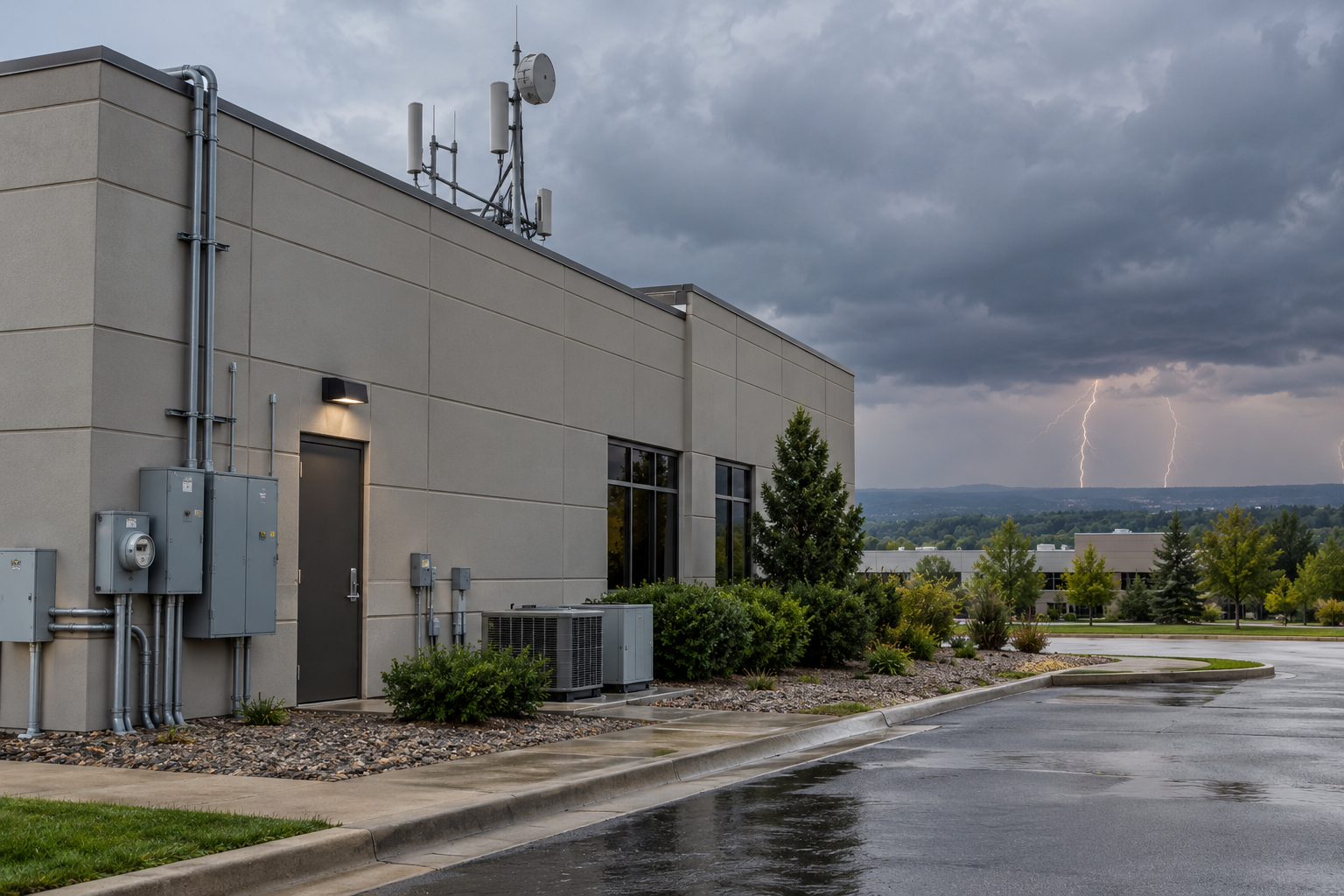
Lightning boundary map
| Situation | What an SPD discussion can address | What remains separate |
|---|---|---|
| Nearby or induced lightning | Transient paths on power and connected circuits. | System data, device role, grounding and current documentation. |
| Utility-coupled event | Incoming and distribution paths exposed to an external transient. | Utility records, one-line and facility-level coordination. |
| Direct strike exposure | Only the documented role of an SPD within the system. | Lightning protection, bonding, grounding and qualified design. |
| Communication or control path | Whether a compatible protection family should be reviewed. | Protocol, entry path and the exact signal-protection requirements. |
The table is a boundary tool, not a design drawing. NEMA explains that lightning and other external events can produce transients, while SPDs are intended to limit transient overvoltages. The article should not convert that principle into a promise that equipment will survive a strike.
When a specification says “lightning protection,” ask which objective it means. It could refer to building-level interception and down-conductor design, or to transient limitation on an electrical circuit. Those objectives interact, but a purchasing line item for an SPD does not document the building design. A clear scope statement prevents that omission from disappearing behind one broad term.
How SPDs coordinate with lightning protection
Coordination begins with the building and facility paths. Identify the service entrance, distribution equipment, transfer points, generators, outdoor conductors and sensitive loads. Then record where lightning protection and bonding are addressed, where grounding information is available and which power or signal circuits need their own review.
Schneider’s application guidance shows why SPDs may be considered at several locations in a power system, including downstream equipment and transfer-switch paths. That guidance is an application reference, not a universal layout for every site. The exact voltage, topology, installation role and current instructions control the final selection.
Keep the protection record explicit. A project can have a lightning-protection system and still require a separate SPD review for power, control or communication paths. It can also have an SPD and still lack the building-level design needed for direct-strike exposure.
During a renovation, revisit this record when a new outdoor cable, rooftop system or generator is added. The new conductor may create an entry path that did not exist when the original equipment was specified. The team should compare the revised one-line and interface list with the existing protection design, then resolve any gaps with qualified specialists.
Coordination checklist
- State whether the concern is direct strike, nearby lightning, utility coupling or an unexplained transient.
- Attach the current one-line, building entry points and the list of outdoor-connected circuits.
- Identify lightning protection, bonding and grounding records, keeping their design review separate.
- List critical power, control and communication loads and their equipment requirements.
- Request exact SPD documentation after system voltage, topology and installation role are confirmed.
For AC family discovery, the Wanze AC surge protection device category can be a starting point. It does not establish a lightning-protection design or guarantee a direct-strike outcome.
FAQ
Can an SPD stop a direct lightning strike?
No. An SPD can address documented transient overvoltage paths, but it is not a substitute for a qualified lightning-protection, bonding and grounding design and cannot promise immunity from a direct strike.
What is lightning-induced surge protection?
It is the review and protection of transient paths coupled into power, control or communication circuits by nearby or external lightning events. The exact device and system conditions still require verification.
How do SPDs coordinate with a lightning protection system?
Review the building protection, bonding, grounding, incoming power and connected circuits together, then document the separate role of each SPD. Do not infer coordination from device count alone.