

Single phase vs three phase describes the electrical source, not simply the number of wires entering a machine. A single-phase supply has one alternating phase relationship. A balanced three-phase supply has three alternating phases separated by 120 electrical degrees. The right choice for commercial equipment depends on its required voltage, phase, frequency and connection arrangement.
A three-phase building can still contain single-phase loads. Conversely, a machine with several supply conductors is not necessarily three-phase. Buyers need to distinguish the building service, the actual branch circuit and the equipment nameplate before comparing prices or specifying surge protection.
Single phase vs three phase: the practical differences
| Question | Single-phase supply | Three-phase supply |
|---|---|---|
| What defines it? | One alternating phase relationship | Three phases, separated by 120 electrical degrees in a balanced source |
| Does it always need a neutral? | No; the circuit and voltage arrangement determine that | No; wye and delta arrangements differ |
| What current formula applies? | P = VI × PF for sinusoidal operation | P = √3 × VLLI × PF for a balanced sinusoidal load |
| What must the buyer verify? | Actual circuit voltage and matching equipment rating | Actual circuit voltage, configuration and matching equipment rating |
| Does the phase label select an SPD? | No | No |
Three-phase power is common in commercial and industrial distribution because it suits many larger equipment loads. That does not make it universally better for every device. A small single-phase load does not become a three-phase load merely because the facility has three-phase service.
The comparison is also incomplete without voltage. Comparing a 120 V single-phase circuit with a 480 V three-phase circuit changes two variables at once. Any claim about current, conductor quantity or cost should state what power, voltage and operating conditions are held constant.
Neutral and protective earth serve different purposes and should be identified separately in the documentation. Neither should be counted as another phase. A photograph of a cable or terminal block cannot establish the full supply configuration; drawings and equipment documentation provide the necessary context.
US split-phase, wye and delta are not interchangeable
120/240 V split-phase is still single-phase
A common US split-phase system provides 120 V line-to-neutral and 240 V line-to-line from a center-tapped single-phase source. The two line conductors do not make it a two-phase or three-phase service. The presence of a neutral gives access to different circuit voltages within that supply arrangement.
For procurement, “single-phase” alone is therefore insufficient. A piece of equipment rated for a particular 120 V input is not automatically suitable for a 240 V circuit. The supplier needs the intended circuit voltage, not just a description of the building as single-phase.
A wye label contains two voltage references
In a 208Y/120 V system, 208 V describes line-to-line voltage and 120 V describes line-to-neutral voltage. Similarly, 480Y/277 V identifies a different voltage pair. Those numbers describe the same system from two references; they are not interchangeable inputs for one equipment connection.
A 208 V single-phase load and a 208 V three-phase load can consequently have the same nominal line-to-line voltage while requiring different supply arrangements. “208 V available” does not resolve phase count, neutral requirements or the manufacturer’s permitted input configuration.
Delta requires its own configuration check
Delta systems should not be treated as wye systems with a different name. Manufacturer selection tables distinguish ordinary delta from other arrangements, including high-leg delta. Neutral availability and voltage-to-ground relationships need confirmation for the exact system.
This is particularly important when an accessory is selected by voltage alone. A product description saying “three-phase” or a photograph showing three or four poles does not establish suitability for every three-phase supply. The equipment supplier needs an unambiguous system designation and the relevant manufacturer requirements.
Nameplate punctuation also deserves attention. The referenced transformer manufacturer’s guidance distinguishes an “x” voltage marking from a slash marking on the products it discusses. Buyers should check the manufacturer’s meaning rather than assuming every pair of printed voltages offers the same simultaneous outputs.
These examples identify supply categories, not terminal connections. The project electrician or designer should verify the actual installation arrangement from current documentation. A purchasing worksheet can then preserve that verified information without asking the buyer to infer it from conductor colors or appearance.
Compare current at the same power, voltage and power factor
For a useful single-phase versus three-phase current comparison, hold the electrical input power, voltage and power factor constant. Consider a hypothetical load consuming 18 kW of electrical input power at 208 V and 0.90 power factor. For the three-phase case, 208 V is line-to-line voltage and the load is balanced.
- Single-phase current: I = P / (V × PF) = 18,000 / (208 × 0.90) = 96.15 A.
- Balanced three-phase line current: I = P / (√3 × VLL × PF) = 18,000 / (√3 × 208 × 0.90) = 55.51 A per line.
The three-phase case has lower current per line for this like-for-like comparison. That is not the same as saying every three-phase machine uses less energy. Both hypothetical loads consume the same 18 kW because equal electrical input power was an explicit starting condition.
The example does not compare motor shaft output. If a motor rating describes mechanical output, efficiency also enters the conversion to electrical input. Nor do these current values specify conductor size, overcurrent protection or starting capacity. Those decisions require the actual equipment data and a complete circuit design.
Power factor is not an optional decimal added for appearance. Omitting the assumed 0.90 would produce a different current estimate. Likewise, using line-to-neutral voltage in the balanced three-phase expression would mix voltage references and invalidate this comparison.
Match three levels: service, circuit and equipment
The most useful procurement question is not “Which phase is best?” It is “Can the verified supply at this equipment location meet the exact machine’s input requirements?” That question separates a facility-wide description from the particular circuit being purchased or modified.
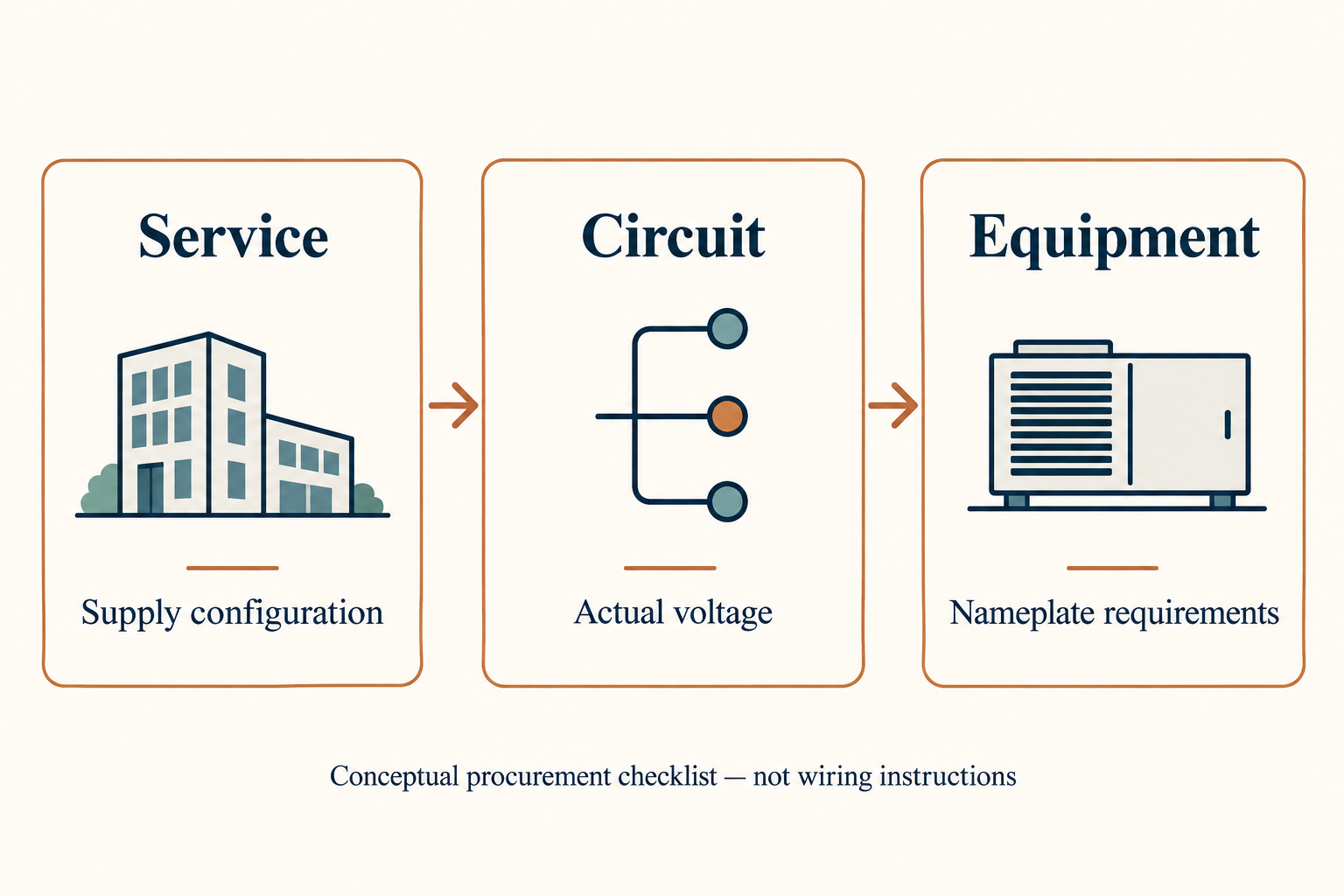
1. Record the service configuration
The service description establishes the facility’s available source arrangement. Useful records identify nominal voltages, phase configuration and the relevant distribution drawings. A general statement such as “industrial three-phase power” is too broad to support an equipment order.
This level helps the facility team identify which supply questions remain open. It does not prove that every panel or outlet has the same configuration. The equipment location and its supplying circuit still need to be identified.
2. Verify the intended branch circuit
The actual circuit determines what the machine will receive. A three-phase facility may have single-phase branches, so the building label cannot replace the circuit schedule. The project team should document the circuit’s voltage reference and whether the required neutral is available.
If a supplier’s quotation assumes a different circuit, the mismatch should be resolved before ordering. The buyer should not assume that adding conductors, substituting an SPD or changing a product’s pole count will reconcile incompatible supply requirements.
3. Match the exact equipment nameplate and manual
The equipment record should state the required input voltage, phase and frequency, together with the manufacturer’s permitted arrangements. Where the nameplate offers alternatives, the supplier should confirm which configuration the quoted unit actually supports and what documentation applies.
Mixed-load equipment deserves a clear system description. A machine can contain components with different supply needs, and an accessory’s rating does not necessarily describe the complete machine. The machine manufacturer should explain the required incoming supply rather than leaving the purchaser to infer it from one component label.
This three-level check also makes competing quotations easier to compare. Two vendors may use the same phase label while quoting different input voltages or configurations. A shared supply record exposes that difference before the discussion moves to price, lead time or protection accessories.
Prepare a supply record before selecting an SPD
A surge protective device is a downstream protection choice, not a phase converter. It does not change a single-phase source into three-phase power, provide a missing neutral or correct an incompatible equipment input voltage. The supply match should be settled before selecting a protection configuration.
The Wanze AC surge protection device category is relevant where the project also needs AC transient-overvoltage protection. A meaningful selection request should include the following verified information rather than only “single-phase SPD” or “three-phase SPD.”
| Record field | What to provide | Why it matters |
|---|---|---|
| System designation | Verified split-phase, wye, delta or other exact arrangement | Phase count alone does not define the configuration. |
| Nominal voltage | Line-to-line and, where applicable, line-to-neutral values | The voltage reference must match the product documentation. |
| Neutral and earth | Availability and system arrangement confirmed by the designer | These are separate from phase conductors. |
| Location | Identified panel or equipment supply point | A service-wide label may not describe this circuit. |
| Equipment input | Exact model’s voltage, phase, frequency and allowed configuration | The incoming supply must match the actual quoted unit. |
| Protection documentation | Exact SPD model, configuration and applicable manufacturer files | A family photograph or a pole count cannot prove suitability. |
Manufacturer SPD tables illustrate why this detail matters: they separate single-phase, split-phase, wye and delta options rather than offering one universal three-phase arrangement. That principle is useful for procurement, but another manufacturer’s product table does not establish a Wanze model’s ratings or approvals.
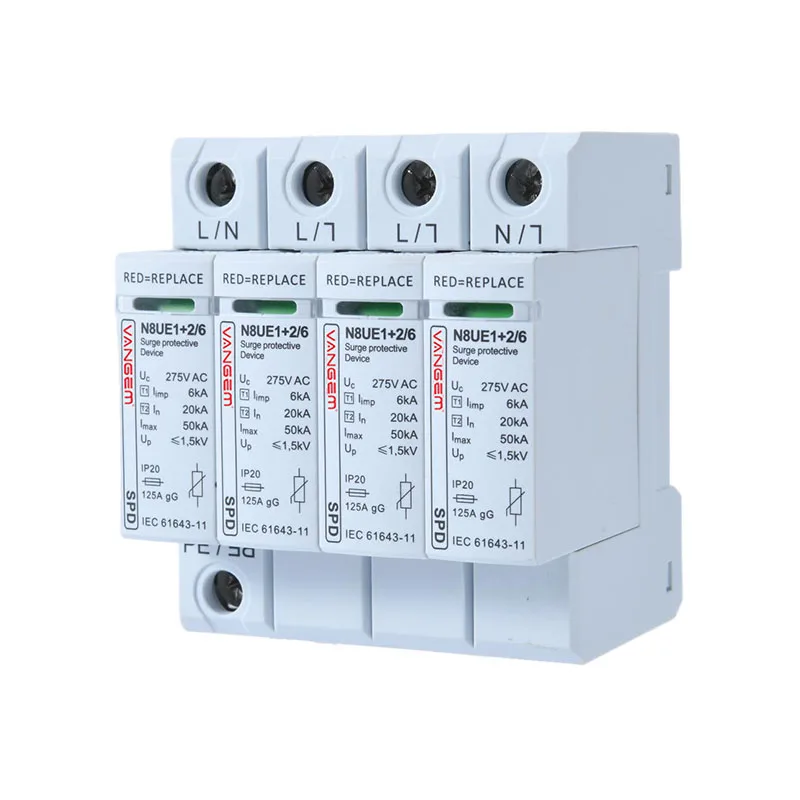
For an actual quotation, the supplier and project designer should match the documented supply to the exact product configuration. If a required file or compatibility detail is missing, that question remains open. A similar-looking device is not a substitute for an application-specific confirmation.
Choose the supply match, not a universal winner
Single-phase and three-phase power describe different source arrangements. Neither label, on its own, determines equipment suitability, energy consumption or the correct surge protective device. The useful comparison starts with a defined load and a verified voltage reference.
For a commercial equipment purchase, retain one agreed supply record across the facility team, machine supplier and protection supplier. It should connect the building service to the intended circuit and then to the exact equipment requirements. That record turns a broad phase comparison into a decision the project team can verify.
Where the source, circuit and equipment do not match, resolve that mismatch through the qualified project team before treating protection accessories as the answer. Where they do match, SPD selection remains a separate, configuration-specific task supported by the actual manufacturer’s documentation.