

Commercial electric landscape lighting does not have one dependable lifespan in years. If the buying question is “how long does a commercial electric landscape light really last?”, start with the exact fixture’s rated life, its nightly operating hours and the condition of the complete system. An LED light-output rating does not guarantee that the driver, connections, seals and housing will remain serviceable for the same period.
For illustration, a hypothetical 50,000-hour rating converts to about 17.1 years at eight hours per night. That is an operating-hours conversion, not a prediction that the installed fixture will last 17 years. A maintenance plan needs to keep those two statements separate.
How long does a commercial electric landscape light really last?
There is no sound universal year range for every commercial landscape fixture. A buyer needs to identify what the manufacturer actually rated: the LED source, a replaceable module or the complete luminaire. The stated operating conditions and end-of-life criterion matter as much as the number of hours.
Lumileds explains that LED light output typically decreases gradually, while abrupt failures are a separate reliability issue. An IEA 4E review likewise distinguishes gradual performance deterioration from sudden loss of operation and notes the influence of application conditions and use patterns. These distinctions help explain why a working but dim fixture and a completely dark fixture present different maintenance questions.
L70 describes light output, not the life of every component
L70 means 70% of the initial light output. A stated time to L70 describes a light-maintenance criterion under the conditions attached to the claim. It does not mean that every light switches off at that hour, or that a stated percentage of complete fixtures must have failed.
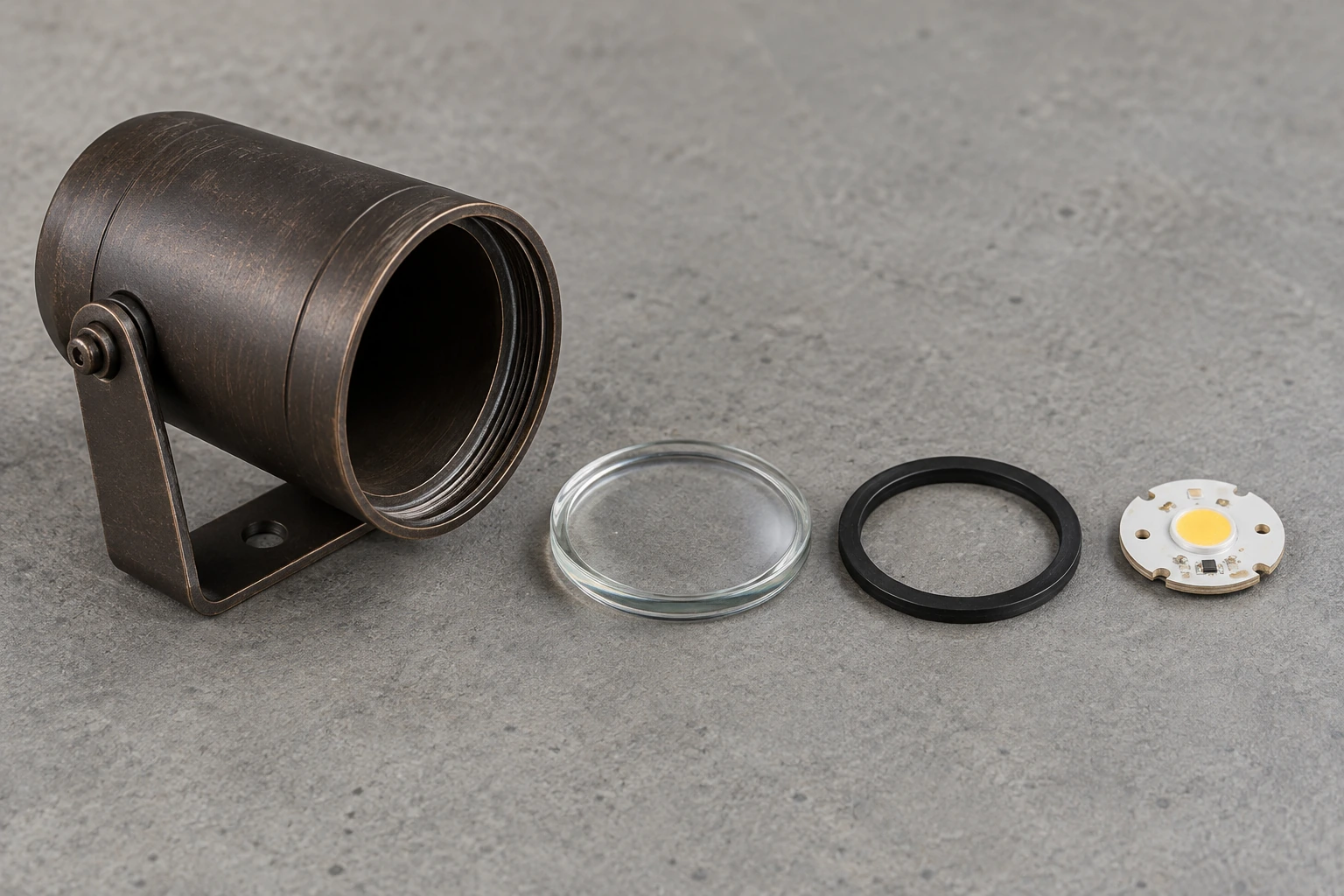
A luminaire is the whole lighting assembly. The LED source produces light, but other parts help power, protect and direct it. A lens that has become dirty, a damaged seal or an electrical fault can affect the installation’s usefulness without following the LED’s projected light-output curve.
Warranty coverage is another separate document to check. A lifetime projection, a warranty period and the availability of replacement parts answer different questions. For a purchase decision, record each one independently instead of treating the largest printed number as the expected service life.
Where a supplier provides LED-source test or projection information, ask how it relates to the complete fixture and its intended environment. Component evidence is useful, but it does not by itself establish the installed system’s lifetime.
Convert rated hours using the actual operating schedule
The conversion is straightforward: years = operating hours ÷ (hours per night × 365). The table uses two hypothetical inputs to show how much the schedule changes the calendar equivalent. Neither input represents a promised life for all commercial lights.
| Illustrative operating-hour input | 6 hours/night | 8 hours/night | 12 hours/night |
|---|---|---|---|
| 25,000 hours | 11.4 years | 8.6 years | 5.7 years |
| 50,000 hours | 22.8 years | 17.1 years | 11.4 years |
These figures assume the same operating period every night and use a 365-day year, rounded to one decimal. A dusk-to-dawn installation may have changing seasonal hours; a timer-controlled courtyard may run for a shorter, more consistent period. Use an annual operating-hours estimate when a nightly average would misrepresent the site.
For example, doubling the assumed nightly use halves the calendar equivalent of the same hour input. It does not establish that the fixture’s other failure mechanisms change in the same proportion. The arithmetic is a scheduling aid, not a reliability model.
Site conditions belong in the service-life assessment
A lighting specification describes a product under defined conditions; an installation has its own environment and operating history. The IEA 4E review identifies operating conditions and switching patterns as relevant to lifetime assessment. Its findings support examining the whole application rather than using lumen maintenance alone.
For a landscape site, a practical condition record can include signs of moisture entry, corrosion, physical damage, accumulated dirt and changed planting around a fixture. These observations help describe the maintenance problem. They do not, by themselves, diagnose the internal fault or establish a remaining-life estimate.
A group of lights becoming dim calls for a different investigation from one damaged housing or a circuit that has stopped operating. Recording the pattern, operating schedule and recent changes helps a qualified maintenance provider narrow the assessment without relying on the purchase date alone.
Electrical protection also needs its own review. A catalog of AC surge protection devices can help identify the equipment category, but adding a device does not establish a new fixture lifetime. Suitability and coordination belong to a separate equipment-selection assessment.
Plan maintenance around condition and serviceability
A useful maintenance record connects each fixture or lighting zone with its model, installation date, operating schedule and observed condition. Keep that record after repairs so the next visit does not start from an unexplained mixture of original and replacement parts.
Repair-versus-replacement planning should consider what the manufacturer permits to be serviced, whether the correct parts remain available and whether the repaired installation will meet the site’s lighting needs. A replaceable module can support a different maintenance approach from an assembly that has no supported field-replacement option.
For a dark or damaged unit, a maintenance provider can assess the cause and the appropriate next action. For gradual deterioration, compare the present lighting result with the required task rather than deciding solely from whether a lamp still turns on. Access costs and the effect of repeated visits can then inform the commercial decision, without inventing a universal replacement age.
Ask for a life claim you can use
Before approving a lighting purchase, the buyer can request a short, model-specific evidence pack:
- Rating: hours, light-maintenance criterion and the component or assembly covered.
- Conditions: the operating assumptions and intended application attached to the rating.
- Serviceability: permitted replacement parts and the manufacturer’s service instructions.
- Warranty: written coverage, exclusions and claim process, considered separately from the projected life.
- Site plan: estimated annual operating hours and a record of inspection or maintenance responsibilities.
The resulting decision is more useful than a single “years of life” claim: it explains what the rating means, what it leaves unanswered and how the site will maintain the lighting that people actually use.
References
- IEA 4E: LED Product Lifetime Testing Report — system failure modes, environment and operating patterns.
- Lumileds: Lumen Maintenance and Reliability — light-output maintenance and abrupt failure are different measures.