

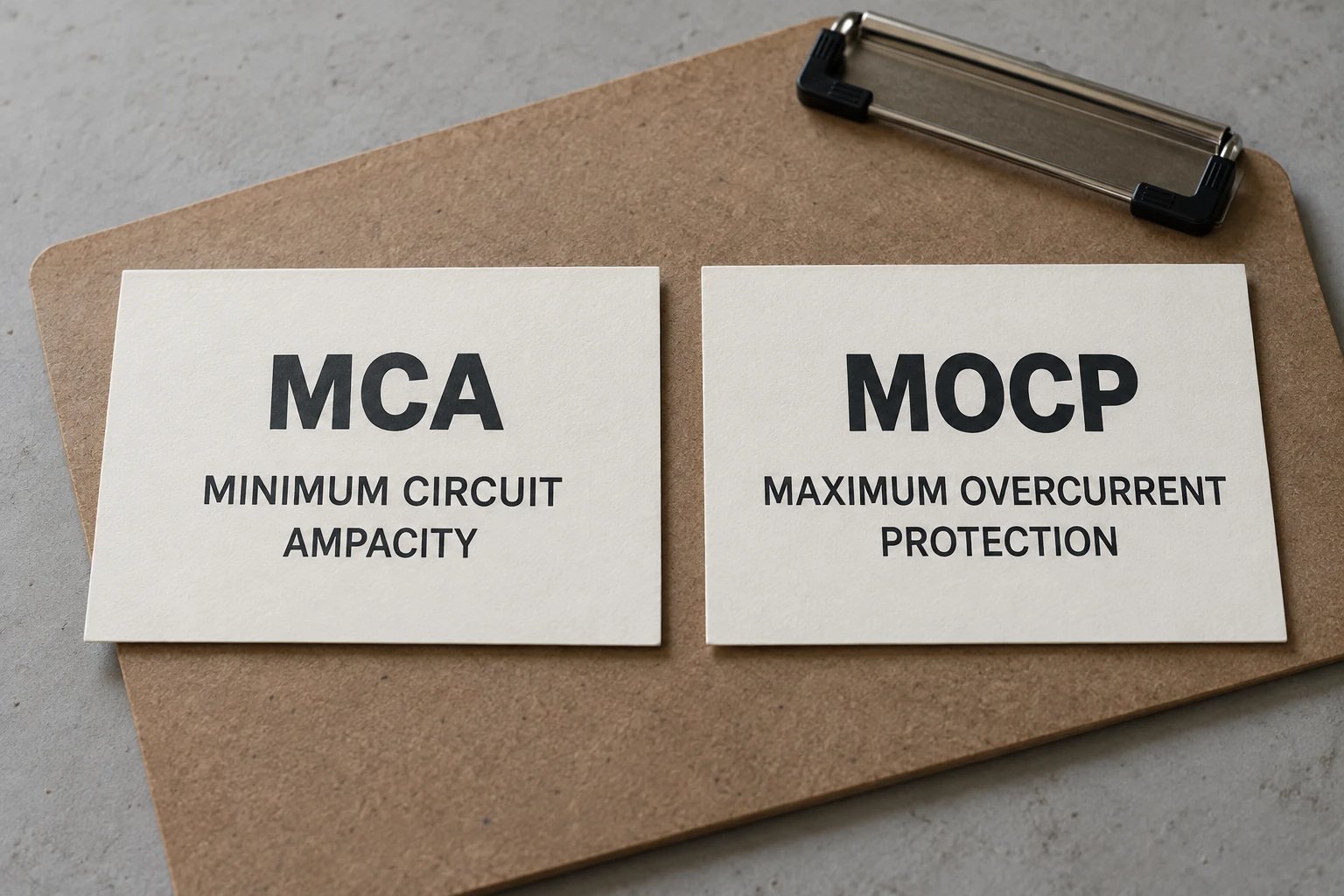
Minimum circuit ampacity (MCA) is the minimum current-carrying capacity required of the conductors supplying the specified equipment. It is expressed in amperes. MCA is not the equipment’s normal running current, and the number is not an instruction to fit a breaker of the same rating.
A nameplate may also show maximum overcurrent protection (MOCP) or a more specific field such as maximum fuse size. Reading those headings separately—and keeping them attached to the exact equipment configuration—prevents a useful rating from becoming a misleading purchasing note.
What is minimum circuit ampacity on a nameplate?
MCA describes the conductor-capacity side of the equipment’s supply requirements. Eland Cables’ engineering FAQ distinguishes that minimum capacity from the current the equipment normally draws. The two values answer different questions, even though both may be expressed in amperes.
For a buyer comparing technical sheets, that distinction matters before any installation decision is made. A spreadsheet column called “amps” can conceal whether its entries are MCA, operating current or protective-device limits. Comparing numbers under that loose heading may compare entirely different quantities.
The original field name should travel with the value. “Minimum circuit ampacity” is more informative than “required amps,” because the latter does not say which requirement has been copied. The source document and the equipment identity make that field traceable.
MCA alone does not provide the remaining information needed to choose conductors or protective devices for an installation. This guide explains how to read the equipment record; it does not supply a wire size, breaker rating or design calculation.
MCA and MOCP answer different questions
MCA identifies a minimum conductor-capacity requirement. MOCP identifies a maximum overcurrent-protection rating for the equipment described. Neither field should be relabeled as measured running current. A fuse-specific heading also needs to retain its narrower meaning.
| Field in the source | Question it answers | Misreading to avoid |
|---|---|---|
| MCA: minimum circuit ampacity | What minimum conductor current capacity does this equipment record specify? | Treating it as normal operating current or a selected breaker rating. |
| MOCP: maximum overcurrent protection | What maximum protective-device rating does the equipment documentation identify? | Treating that maximum as a complete installation choice. |
| Maximum fuse size, sometimes MFS | What fuse-specific maximum does this source list? | Replacing the word “fuse” with “breaker” without supporting documentation. |
When transferring a value into a procurement system, preserve the full heading in a note if the available column is abbreviated. A field called “maximum protection” can otherwise erase a fuse-specific restriction. Retaining the original wording lets the next reviewer see exactly what the manufacturer supplied.
Read the exact model and supply row together
A model name may appear on more than one supply-configuration row. The MCA and maximum-protection entries belong to their respective rows, rather than to the model name in isolation.
A concrete document-reading example appears in SaniServ’s scanned Technical Information Library. File page 3 contains a table headed “Minimum Circuit Ampacity & Maximum Fuse Size.” Two entries for model 401N illustrate why the supply descriptor must remain attached to the current fields:
| Model | Supply descriptor, as printed | MCA, A | MFS, A |
|---|---|---|---|
| 401N | 208/230/60/1 | 20 | 25 |
| 401N | 208/230/60/3 | 15 | 20 |
The source labels the last column MFS, under its maximum-fuse-size heading. These entries must not be converted into breaker recommendations. The scan is a legacy reference, and the table page has no revision date; these historical rows are examples of document structure, not current installation specifications.
Copying only “401N: MCA 20 A” would lose the row condition. Copying “401N: 25 A protection” would lose both the supply condition and the fuse-specific label. A traceable record preserves all four fields and the source page together.
Why a shortcut formula cannot identify the right equipment row
A calculation cannot recover a missing equipment identity or supply configuration. Those facts need to come from the applicable equipment record before a number can be associated with the right unit.
CaptiveAire’s MCA explanation discusses equipment containing combinations of motors and other loads. That context helps explain why a remembered percentage or a single motor-current figure cannot stand in for the complete equipment documentation.
For example, a quotation may provide a product family and a current figure but omit the supplied variant. Recalculating from that incomplete note would leave the identification problem unresolved. The useful next document is the matching nameplate or manufacturer data sheet, with the configuration clearly identified.
A comparison sheet can mark the MCA field “not supplied” until that evidence arrives. It should not silently substitute operating current or a value taken from a neighboring model row.
Keep MCA records separate from surge-protector specifications
MCA is an equipment-supply field. It is not a surge-protective-device model specification or evidence that a particular SPD is suitable for that equipment.
Wanze’s AC surge protection devices category provides a separate path for transient-overvoltage protection components. A project record can retain that component’s documentation alongside the equipment nameplate, while keeping their purposes distinct.
A clear handoff therefore contains the equipment’s MCA and protective-device fields in one record, and the proposed SPD’s own model documentation in another. Moving a number from one record to the other would not establish compatibility.
Build a traceable nameplate record for the next reviewer
A useful record allows another person to find the same equipment row and understand each copied field without reconstructing the original search. The following entries provide that traceability:
- Equipment identity: manufacturer, full model designation and any configuration identifier shown in the source.
- Supply description: the exact voltage and other supply information printed for that unit or table row.
- Separate current fields: MCA and any operating-current field, each with its original label and unit.
- Protective-device wording: MOCP, maximum fuse size or another literal heading, including associated notes.
- Source identity: a nameplate photograph or document title, revision when available, page and date obtained.
Consider a handoff containing a cropped table with the model column missing. Its current values may be legible, but the evidence cannot yet connect them to the proposed equipment. An uncropped source page and a matching unit identifier would resolve that specific gap.
Similarly, if a data sheet and a nameplate disagree, preserve both records and ask the manufacturer which applies to the supplied configuration. Averaging the figures, selecting the larger one or copying a nearby row would conceal the discrepancy rather than explain it.
Resolve missing or conflicting fields at the source
The final check is whether every copied value still has its original heading, unit, equipment identity and source. Missing revisions should be recorded as missing; a publication date should not be invented from a download date.
A focused supplier question names the conflicting field and attaches the relevant records. That makes the unanswered issue visible to whoever is responsible for the equipment specification. Once the correct record is established, installation decisions can proceed through the applicable design process with the actual equipment information.