

Electrical derating means that the allowable load depends on specified operating conditions. A temperature derating curve describes that relationship for a particular product and rating. To interpret it, identify the quantity being limited, the temperature reference and the conditions in the curve’s notes. One remembered percentage cannot answer those questions.
What derating means for an electrical rating
A rating is a statement with conditions attached. A power figure might refer to dissipation under a stated thermal condition, while a supply’s output rating depends on the operating conditions documented for that model. Derating describes how the permitted load changes when the applicable conditions change.
Vishay’s resistor FAQ explains a derating curve in terms of allowable power dissipation versus ambient temperature. That is a useful concrete definition, but it does not mean every electrical product has the same curve or uses ambient temperature as its reference.
It also helps to distinguish a documented operating limit from an automatic device action. A descending curve tells the reader about the allowed load under its stated conditions. By itself, it does not say that a device will automatically reduce its output, switch off or protect an attached circuit at a particular point.
The practical reading task is therefore to recover the complete rating statement: what is allowed, under which conditions, according to which model’s document?
Read the quantity and the temperature reference first
Start with the axis labels. “Load” may be presented as power, current, output or a proportion of a named rating. A percentage still needs its reference quantity. On the temperature axis, ambient air, a component body and a terminal are different references; the label and notes determine which one the curve uses.
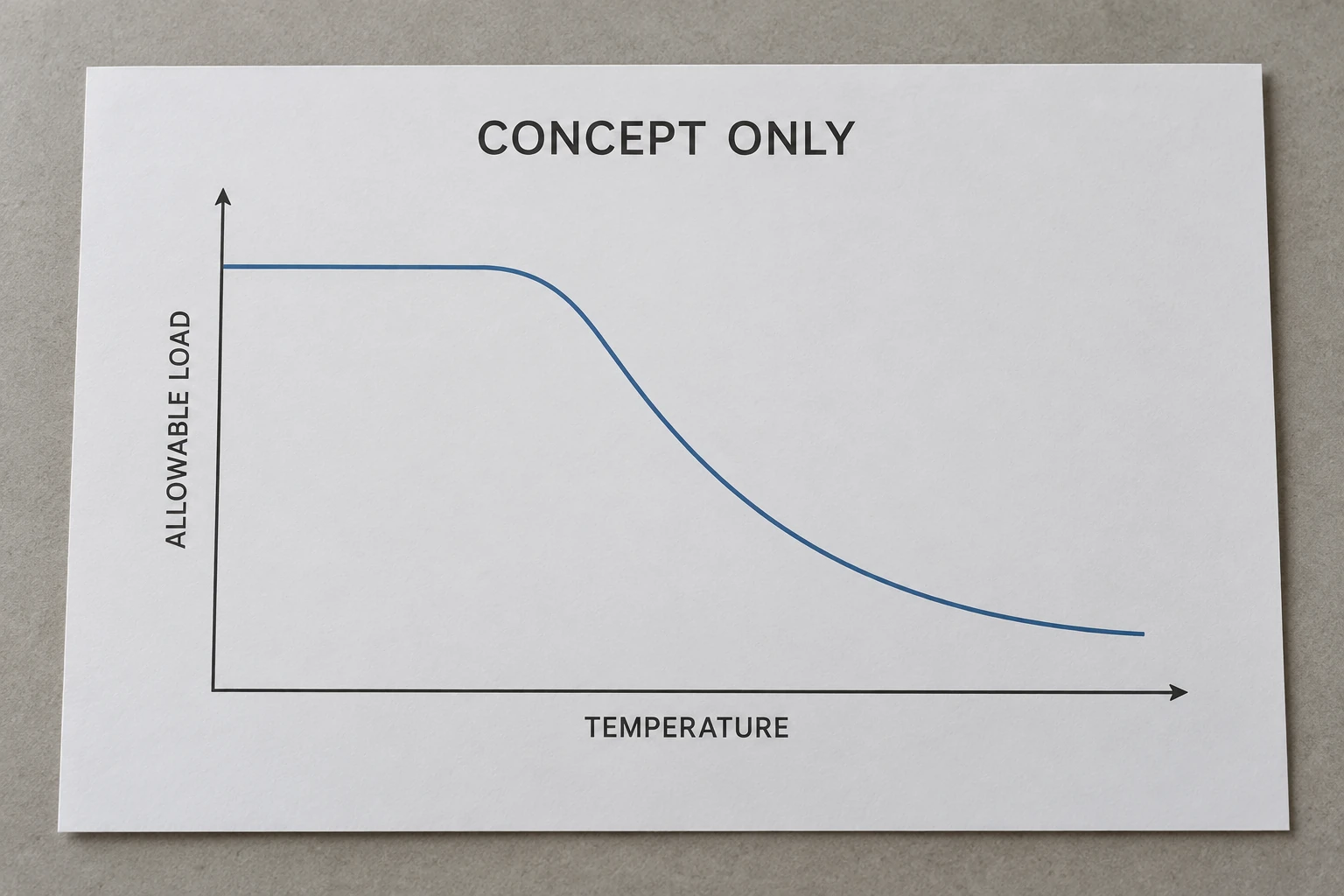
Vishay’s FAQ discusses ambient-temperature derating and also distinguishes terminal or component temperature in its Power Metal Strip discussion. These references cannot be swapped simply because both are temperatures.
| Document detail | Question it answers | What to retain |
|---|---|---|
| Vertical axis | Which electrical quantity is limited? | Quantity, units and any percentage reference |
| Horizontal axis | Which condition changes? | Exact temperature reference or other stated variable |
| Curve legend | Which line applies? | Model, configuration and named conditions |
| Notes | What qualifies the plotted relationship? | Cooling, mounting and other stated assumptions |
An operating-temperature range alone leaves a different question unanswered: how much load is permitted across that range? The rating statement and applicable curve must supply that relationship. A range on one page and a headline output on another are not automatically a full-load statement for every temperature between the endpoints.
Cooling and mounting conditions belong to the curve
MEAN WELL’s application FAQ explains that mounting orientation and cooling conditions can affect output derating for relevant power-supply designs. The implication for document reading is simple: the line and its conditions belong together. An enclosure photograph does not show which published curve governs the model.
Imagine a supplier sends a graph cropped tightly around the axes. Its line looks readable, but the legend describing the configuration has been removed. You can describe the trend in the crop; you cannot yet identify the configuration to which that trend applies. The missing legend is part of the evidence, rather than a cosmetic omission.
Request the complete specification page with its notes and model identifier. If the document presents several cooling or mounting conditions, preserve the label associated with the selected line. This avoids silently combining a headline rating from one condition with a curve from another.
The FAQ’s examples explain why these distinctions matter; they are not a general instruction to change a product’s orientation or airflow. Such details remain specific to the product documentation. Here, the task is to identify the conditions being described, not to prescribe a mounting arrangement.
A power rating and a current rating can describe different limits
Different components can use similar rating language for different physical constraints. A resistor’s allowable dissipation, a supply’s allowable output and an inductor’s rated current are not interchangeable quantities. Even within one component category, a current label needs its definition.
Murata’s explanation of power-inductor rated currents makes this distinction explicit. It describes current based on self-temperature rise and current based on inductance change. One concerns a thermal response; the other concerns a change in an electrical property. Reading both as an undifferentiated “current capacity” removes the difference that the manufacturer is documenting.
| Source example | What is being described? | Reading consequence |
|---|---|---|
| Resistor derating | Allowable power dissipation under stated conditions | Retain the temperature reference |
| Power-supply derating | Output under specified operating conditions | Retain the cooling and mounting notes |
| Inductor rated currents | Separate temperature-rise and inductance-change definitions | Retain the definition attached to each current figure |
This comparison does not calculate a load for any of these products. It shows why copying a factor across categories loses information. Before two ratings can be meaningfully compared, identify whether they describe the same quantity under comparable documented conditions. A shared unit is useful, but the unit alone does not supply the underlying definition.
A useful derating question includes the missing conditions
“How much should this be derated?” is difficult to answer from a product name alone. A better document question identifies the model, the rated quantity and the applicable operating condition. It also points to the curve or note whose meaning is unclear.
For example, suppose a purchasing note gives a supply’s headline output, while an attached graph shows allowable load against temperature. Before treating them as one specification, ask whether the graph belongs to that exact model, what its load axis references, which temperature is named and which configuration the legend describes. These questions establish what the document says without inventing an operating value.
A compact handover record can retain those details together:
- Exact product and document revision.
- Rated quantity and its stated reference.
- Curve identifier, axis labels and units.
- Applicable configuration and qualifying notes.
- Any remaining mismatch or missing information.
The result is a traceable statement another reader can check. If the configuration or reference is absent, record the missing item explicitly. An unsupported percentage would make the record look complete while leaving the original question unresolved.
Do not transfer an unrelated curve to an SPD
A resistor or power-supply curve does not establish the capability of a surge protective device. The relevant product documentation must define that device’s ratings and conditions; the examples above do not create an SPD derating rule.
For a separate SPD product enquiry, consult Wanze’s AC surge protection devices and the applicable model information. Carry the same reading discipline into that enquiry: retain the exact rating, its definition and the manufacturer’s stated conditions. No Wanze derating curve or operating limit is inferred from the generic enclosure or conceptual graph shown here.