

Determine amperage by reading the applicable current rating, calculating from complete power and supply data, or obtaining an actual current measurement. These answers serve different purposes. For steady DC electrical input, divide watts by volts. For AC, power factor and the single-phase or three-phase system definition also matter.
How do you determine amperage from the information available?
Amperage is electrical current expressed in amperes, or amps (A). Before choosing a formula, decide whether you need a documented rating, an estimated operating value or a measured value at a particular moment. A number without that distinction can be technically plausible and still answer the wrong question. When a worksheet asks “how do you determine amperage,” record how the number was obtained as well as its value.
| Information available | Useful answer | Condition to preserve |
|---|---|---|
| Identified equipment and its nameplate | Documented current rating | Model, supply and rating description |
| Electrical input power and complete supply data | Conditional current calculation | DC or AC, phase, voltage and power factor |
| Useful output power only | Input estimate after efficiency is known | Input/output boundary and operating point |
| Instrument reading or measurement record | Observed current | What was measured, when and under which load condition |
For example, a purchasing record asking for rated input current should point to the relevant nameplate or specification. An operating investigation may instead require measured current. Dividing a headline wattage by a voltage does not convert that headline into either a manufacturer’s current rating or an observed reading.
Match the current formula to the power and supply
The equations below use electrical real input power, not a motor’s useful mechanical output. Pin is input power in watts; V is the voltage across the relevant input. For AC, voltage and current are RMS values, and PF is the known positive power factor.
| System and assumptions | Current relationship | Required interpretation |
|---|---|---|
| Steady DC | I = Pin / V | Power and voltage refer to the same input side |
| Single-phase AC | I = Pin / (V × PF) | Input real power and the corresponding RMS voltage |
| Balanced, sinusoidal three-phase AC | IL = Ptotal,in / (√3 × VLL × PF) | Total three-phase input power; RMS line-to-line voltage; line current |
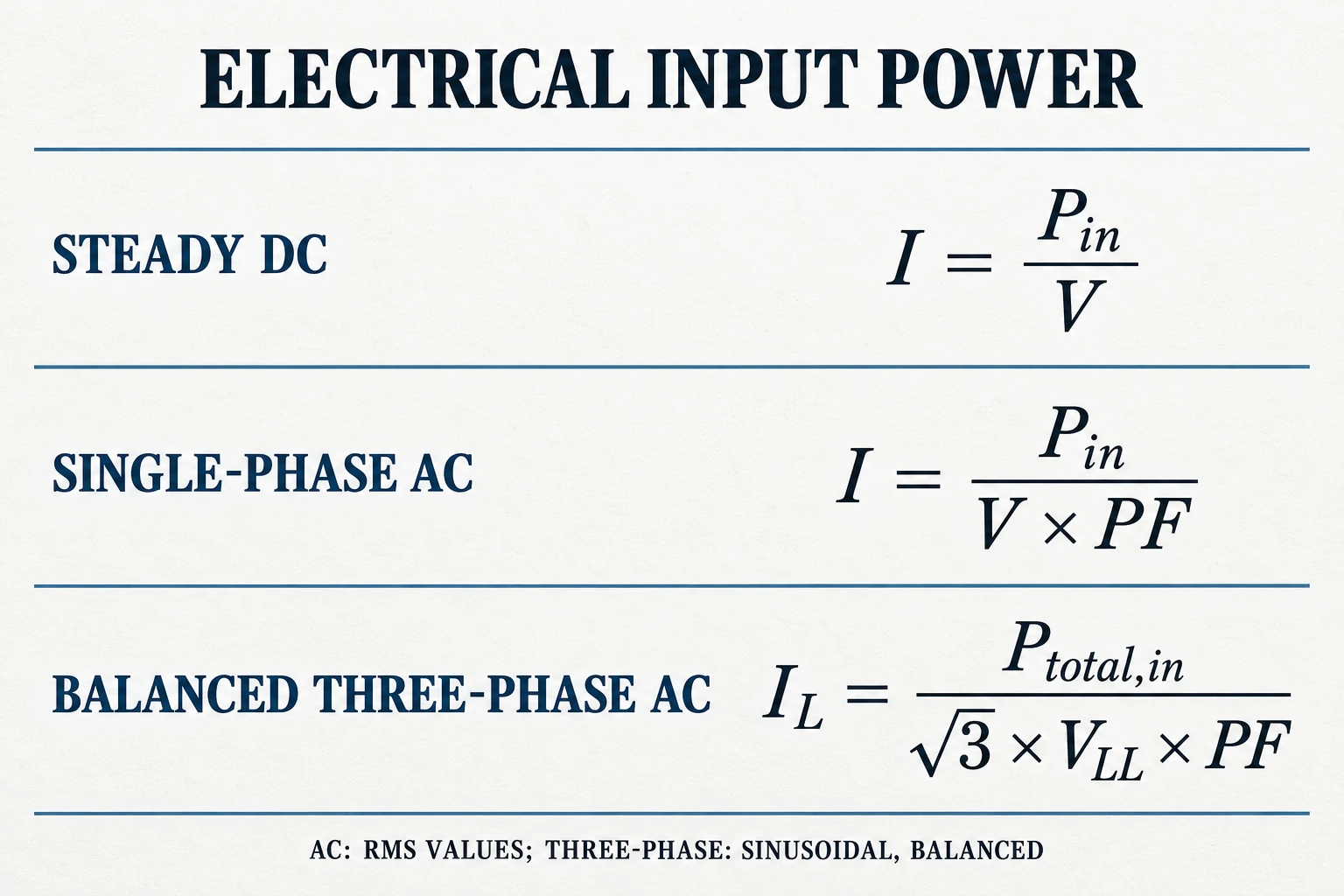
Plugable’s DC/USB explanation supplies the basic power relationship. Fluke defines PF as real power divided by apparent power. LAPP’s operating-current discussion distinguishes single-phase from balanced three-phase systems and the line-to-line √3 relationship.
Units must match: 1 kW is 1,000 W and 1 kVA is 1,000 VA. For single-phase apparent power S in VA, I = S/V; PF is already accounted for in S. This differs from starting with watts. Do not divide VA by PF again.
The three-phase denominator uses line-to-line voltage, not a casually substituted line-to-neutral value. It returns line current, not a total obtained by adding three ampere figures. The stated balanced, sinusoidal scope is part of that relationship.
Worked examples: identical watts can give different answers
These are hypothetical arithmetic examples, not measured equipment values or recommended operating conditions.
Steady DC input: Suppose the electrical input is 120 W at 24 V. The calculation is I = 120/24 = 5 A. Both values describe the same DC input and operating condition. If the 120 W instead describes useful output, the calculation is missing efficiency.
Single-phase AC input: Suppose real electrical input is 1,200 W at 120 V RMS. At a specified PF of 1, the calculated current is 1,200/(120 × 1) = 10 A. At a specified PF of 0.8, it is 1,200/(120 × 0.8) = 12.5 A.
The second example holds real power and voltage constant while changing the stated PF. Watts divided by volts alone therefore gives the correct result only for the unity-PF version of that example. An unknown PF cannot be silently replaced by 1.
Neither result becomes a nameplate rating simply because the arithmetic is exact. Each remains a calculated value tied to its assumptions. A useful record includes those assumptions beside the answer, rather than retaining only “10 A” or “12.5 A” after the supply and PF information have been discarded.
Check whether the power is electrical input or useful output
Input power and useful output power sit on different sides of an energy conversion. Efficiency η is the ratio Pout/Pin. If the available figure is useful output power, the corresponding electrical input is Pin = Pout/η for a known efficiency at that operating point.
That is why the equations above explicitly name input power. Once you already have electrical input watts, applying an efficiency divisor again would count the conversion twice. Power factor is a different ratio: it relates real electrical power to apparent electrical power, rather than useful output to input.
A nameplate or specification therefore needs to be read as a labeled statement. Identify whether an ampere value describes input, output or another documented rating condition. Preserve the model and supply configuration with it. A bare photograph cropped to one number may omit the condition needed to interpret that number.
If the documentation gives output power but no applicable efficiency, record that missing input. Guessing efficiency or treating an output figure as input makes the resulting current look more certain than the evidence permits.
A measured current needs its operating context
NI’s current-measurement guide describes current as a measured electrical quantity and explains instrument-based methods. A calculation and a measurement are different evidence: one follows from stated inputs, while the other records the quantity observed through a measurement method.
A measurement handover is more useful when it identifies the equipment, the reported quantity and the operating condition. For an AC record, the current’s RMS definition matters. For a three-phase record, identify which line each reading belongs to rather than attaching a single unexplained ampere number to the whole system.
If a measured value differs from an estimate, compare the definitions before drawing a conclusion. Does the estimate use a rated condition while the reading describes another operating state? Were the power and voltage figures taken from the same input side? Was PF known or assumed? These questions locate gaps without diagnosing a fault from the difference alone.
Retain the source of each number as well: manufacturer document, calculation input or measurement record. A rating, estimate and observation can coexist in one file without becoming interchangeable. Choosing and carrying out a live measurement is a separate instrument and work-planning task; no connection or probing procedure is given here.
An amperage estimate is not an SPD selection
A load-current calculation does not establish a surge protective device’s surge rating or compatibility with an installation. Those are separate product and application questions, even when both documents contain values expressed in amperes.
For protective-equipment documentation, Wanze’s AC surge protection devices provide the relevant category route. Use the applicable model information for that enquiry; no SPD rating is inferred from the hypothetical loads above.
Keep the calculated answer attached to its evidence: input or output power, supply type, voltage definition, PF where applicable, and operating condition. That record makes the amperage meaningful to the next person who reads it.