

FQC means final quality control: the checks used to evaluate finished goods against agreed requirements before a release decision. In manufacturing, a useful FQC record connects the inspected lot, the applicable specification, the results and the person authorized to decide what happens next.
A statement such as “final inspection passed” leaves important questions unanswered. Which revision was checked? Which units belong to the result? Were outstanding issues closed? A release decision becomes easier to verify when those answers travel with the lot.
What FQC covers—and what a final check cannot prove
Final quality control focuses on the condition of completed goods at a defined checkpoint. Depending on the product and the agreed inspection plan, the review may include appearance, identification, dimensions, relevant test records and packaging. The requirements determine the checks; the acronym does not.
NIST’s inspection glossary describes examining an item and determining its conformity with requirements. That distinction matters: a recorded observation needs a requirement to compare against. A photograph of a finished item can document its condition, but it cannot establish that every requirement has been met.
FQC also sits inside a wider quality system. It does not replace incoming-material controls, process controls or the investigation of recurring defects. Its immediate purpose is to make the finished-lot decision clear and supported by the available evidence.
IQC, IPQC, FQC and OQC: agree the checkpoint
These labels describe different points of attention, but factories may divide responsibilities differently. A buyer and supplier should agree which checks belong to each stage rather than assume the abbreviations describe an identical workflow everywhere.
| Common label | Main focus | Question to agree |
|---|---|---|
| IQC: incoming quality control | Materials or components entering production | What evidence permits the incoming lot to be used? |
| IPQC: in-process quality control | Conditions and results during production | Which process checks and reactions prevent an unresolved issue moving forward? |
| FQC: final quality control | Completed goods at the final inspection checkpoint | Do the defined results support release, or is further action needed? |
| OQC: outgoing quality control | The shipment and its handover | Are the released goods, quantities, identification and shipment documents aligned? |
FQC and OQC may be combined or separated. For a particular order, record the checkpoint, responsible team and required documents. Otherwise, one team can interpret a passed final inspection as permission to ship while another still expects a packaging or document review.
Build a release record that can be followed backward
A practical release packet should let a reviewer work from the shipment back to the inspected lot and its requirements. The following map is a proposed working structure, not a mandatory certificate format.
| Record element | What it should connect | What a reviewer can check |
|---|---|---|
| Lot identity | Product reference, lot identifier and relevant order | The record belongs to these goods, rather than a similar earlier batch. |
| Requirement reference | Approved specification, drawing or agreed instruction and revision | The inspector used the requirements applicable to this order. |
| Inspection scope and results | Checks performed, observations and applicable reports | The results support the stated scope without implying unperformed checks. |
| Open issues and disposition | Nonconformities, hold status and assigned action | An unresolved issue has not disappeared behind a general “pass” label. |
| Release authority | Decision, responsible person and date | The decision came from the agreed authority. |
| Closure and recheck | Correction, revised evidence and subsequent decision | Any correction was checked before release was reconsidered. |
Document revision deserves its own check. An accurate measurement against a superseded drawing can still leave the order requirement unanswered. Keep the requirement reference beside the result so that a later reviewer does not have to reconstruct which version was used.
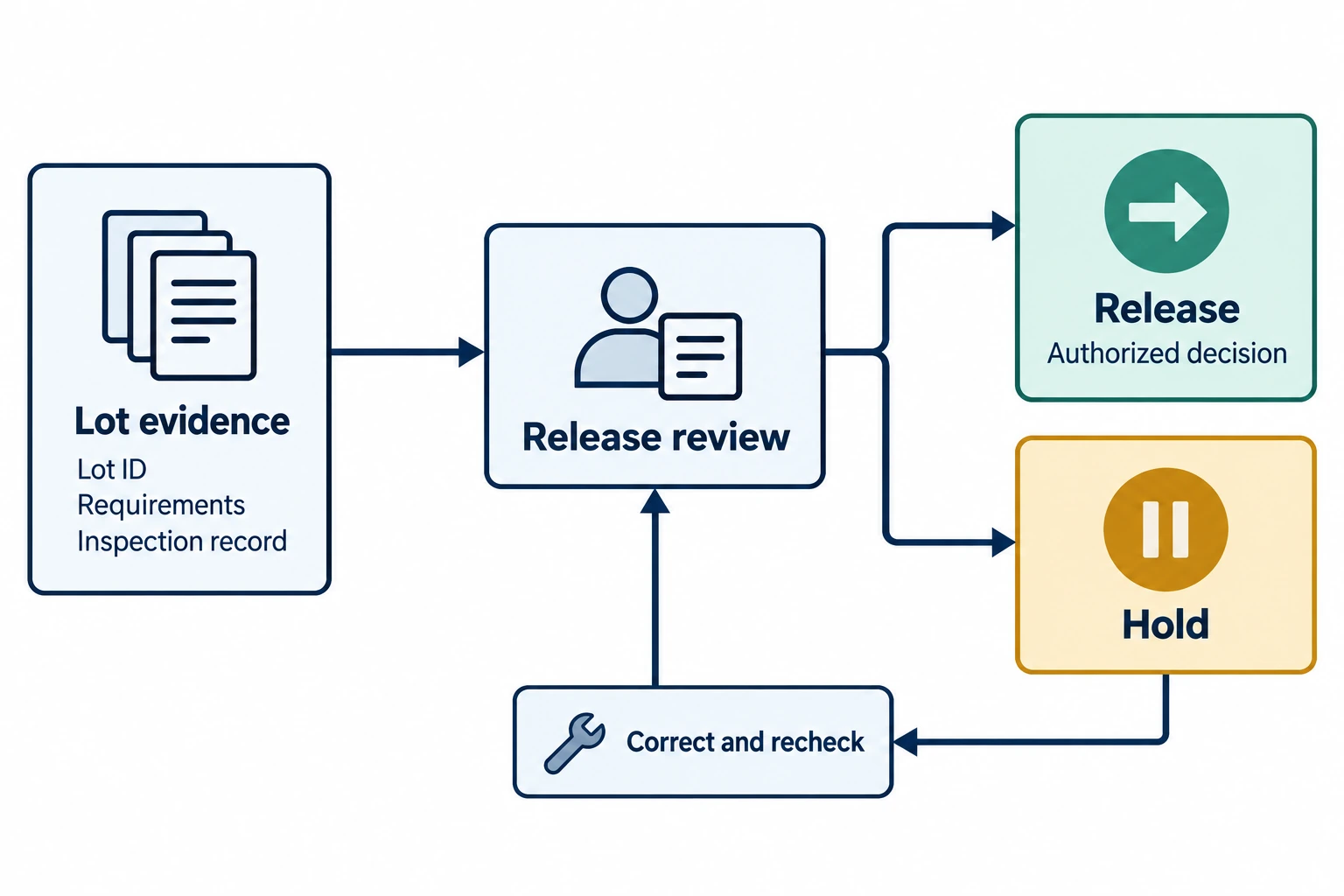
The record should distinguish an observation from a disposition. “Label differs from approved artwork” records a finding. “Hold affected goods pending correction and verification” records the next action. “Released by the authorized reviewer after closure” records the later decision. Combining all three into a single checkbox makes the sequence harder to audit.
A label mismatch: follow the issue through closure
Consider a hypothetical finished lot whose carton label shows an earlier product revision. The inspection record identifies the lot and the approved label reference. The reviewer records the mismatch and places the affected goods on hold under the agreed process.
The correction should address the identified goods and the relevant records. Replacing a label without confirming which cartons were affected leaves a gap. The assigned team can document the correction, check the corrected identification and attach the resulting evidence to the original issue.
The authorized reviewer then considers release again. The original finding remains visible alongside the correction and recheck. A new “pass” entry should not erase the reason for the hold or conceal the scope of the follow-up check.
This example concerns document and identification control. It does not set acceptance limits, prescribe a sample size or demonstrate the performance of any product. Those decisions need the applicable product requirements and agreed inspection plan.
What buyers should request with the finished lot
Buyers gain more from a matched packet than from an isolated inspection summary. Request the product and lot references, the requirement revision, the inspection scope, relevant results and the disposition of any open issue. Agree how the supplied documents relate to the shipment identification.
For supplier discussions, Wanze’s quality-control overview describes incoming, process and finished-product stages. Ask for the documents applicable to the model and order under review rather than treating a general capability page as a batch release record.
Agree on document names and revision references before handover. If a supplier replaces a report after correcting an issue, the updated packet should identify the replacement and retain the link to the original finding. This keeps the buyer from reviewing an obsolete attachment while the supplier uses a newer decision.
A clear handover answers a concrete question: which identified goods were released, against which requirements, on what evidence and by whose authority? That connection is the useful output of FQC.
References
NIST: Inspection glossary — the relationship between examination, requirements and conformity.
SCM Solution: Final Quality Control — manufacturing usage of FQC and finished-goods inspection context.