

Traceability in manufacturing connects an identified product or lot to its materials, production history and downstream shipments. A useful system lets someone start with a shipment and retrieve its history, or start with an incoming lot and find where it was used.
The important question is not whether an item carries a barcode. It is whether the identifier leads to the right records and whether the relationships between those records remain intact. A readable label with no usable history offers identification without a complete trace.
Start with the object and the two directions
The tracking unit determines what a trace can show. A lot identifier groups items under a defined batch identity. A serial identifier distinguishes an individual item. A shipment identifier describes a dispatch, which may contain goods from more than one production lot.
Choose the level needed for the product and business process. A shipment number cannot, by itself, distinguish every individual unit inside a carton. Equally, assigning serial numbers does not solve a missing link between those units and the material records.
A backward query asks where an item or lot came from. A forward query asks where an identified input went. Both need recorded relationships. An incoming-material record, a production record and a packing list may all be accurate individually yet remain difficult to connect if each uses unrelated identifiers.
Which records make traceability in manufacturing usable?
GS1’s Global Traceability Standard distinguishes events from the data describing them. Receipt, transformation, packing and shipment are examples of events. The associated data explains what was involved, where and when the event occurred, and who or which organization was responsible.
The following record map is an original working example for a manufacturing discussion. It is not a required GS1 form, a software specification or a representation of Wanze’s internal database.
| Record | Identity to retain | Relationship to preserve |
|---|---|---|
| Receipt | Supplier reference and incoming lot | Incoming goods to the relevant supplier delivery and receipt |
| Production | Work order and production lot | Inputs actually issued or consumed to the resulting output |
| Inspection | Inspection record and inspected lot | Results, applicable requirement revision and disposition to the goods reviewed |
| Packing | Carton or packing-group reference | Finished lot or units to the contents of each packing group |
| Shipment | Dispatch reference and recipient | Packed goods to their outbound movement |
| Correction | Changed record and correction reference | Original entry to the reason, responsible person and corrected information |
The relationship column does most of the work. A production report that says only “materials received” cannot identify which incoming lots contributed to an output. Likewise, an inspection file named after the product family needs a link to the particular lot it covers.
Keep the meaning of each identifier clear across departments. If stores calls something a supplier lot while production calls the same object a receipt batch, a cross-reference can preserve the relationship. Reusing a convenient label for different objects creates ambiguity that later searches must untangle.
Follow a merge into production and a split into shipments
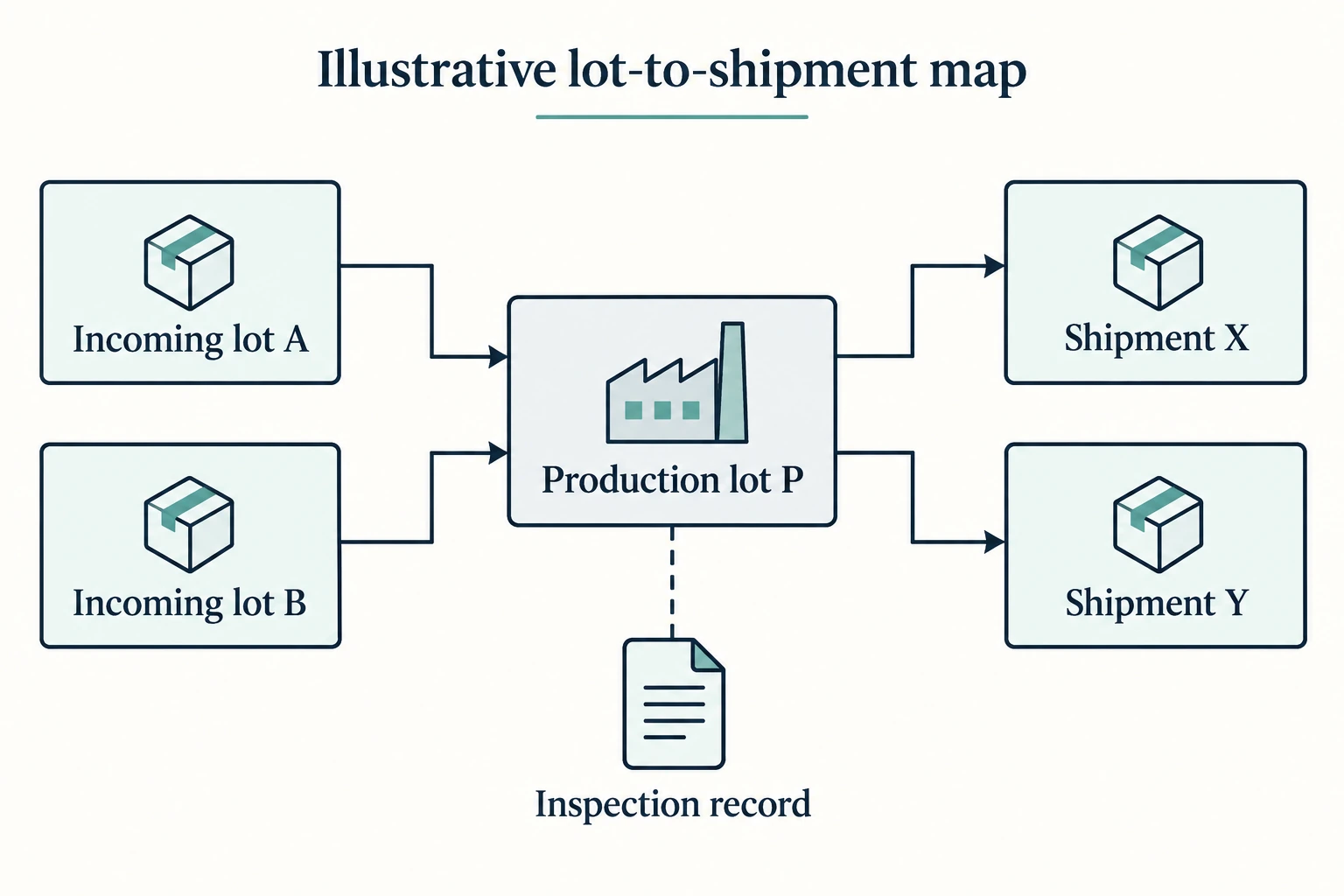
In the illustrated example, incoming lots A and B supply different inputs to production lot P. The production record preserves both input links. Finished goods from P are then packed and divided between shipments X and Y.
Starting with shipment X, a reviewer can identify the packed goods and their production lot P. From P, the reviewer can retrieve the input relationships to A and B and locate the inspection record. Shipment X is the starting point, not a substitute for the production history.
Starting with incoming lot A, the reviewer can find production lot P through the recorded consumption relationship. The packing and dispatch records then show that goods from P went to X and Y. This identifies a scope for investigation; it does not prove that either shipment contains defective goods.
The same discipline applies when goods are repacked or reworked. Preserve the relationship between the earlier identity and the resulting identity where it changes. Creating a fresh label without a cross-reference can make the new record look complete while disconnecting the earlier history.
Test retrieval before relying on the map
A small retrieval exercise can expose missing relationships more clearly than a demonstration of the label printer. Select an actual record under the organization’s agreed access rules and ask the responsible team to reconstruct its history using retained evidence.
For the backward exercise, begin with a dispatch reference. Ask which production lots it contains, which relevant inputs fed those lots and where the associated inspection records can be found. Record any point where the answer depends on someone’s memory rather than a retrievable link.
For the forward exercise, begin with an incoming lot. Ask which production outputs used it and which shipments received those outputs. Where the record cannot distinguish part of a lot, state that limitation. Do not report unit-level precision when the evidence only supports a batch-level answer.
Also test an exception. A corrected receipt identifier, repacked carton or replaced report can reveal whether the links survive routine changes. Document the missing relationship and its owner, then repeat the affected query after the record is corrected. The exercise tests the records available; it is not a certification audit or a promise of recall performance.
Preserve the history when records move between systems
A paper log, spreadsheet or manufacturing system can hold part of a trace. The practical requirement is that the necessary identifiers and relationships can be retrieved and understood across the handover. Choosing a barcode or RFID tool is a separate decision from defining those relationships.
NIST’s Digital Thread for Manufacturing work highlights the importance of associations and trustworthy lifecycle data. For a working record map, that means considering who can create or change information, how corrections remain connected to earlier entries and how an authorized reader retrieves the relevant evidence.
When discussing an order with a supplier, distinguish a general capability description from the records for the goods involved. Wanze’s quality-control overview describes its production and inspection stages. The useful follow-up is a request for the applicable lot references and matched documents, with an agreed handover format.
A traceability map is useful when another authorized person can follow it without reconstructing the process from informal messages. Test the links in both directions, record the limits of the available granularity and keep changes visible.
References
GS1 Global Traceability Standard, Release 2.0 — 2017 framework for traceability events, descriptive data and supply-chain relationships.
NIST: Digital Thread for Manufacturing — manufacturing information exchange, data associations and trustworthy lifecycle records.