

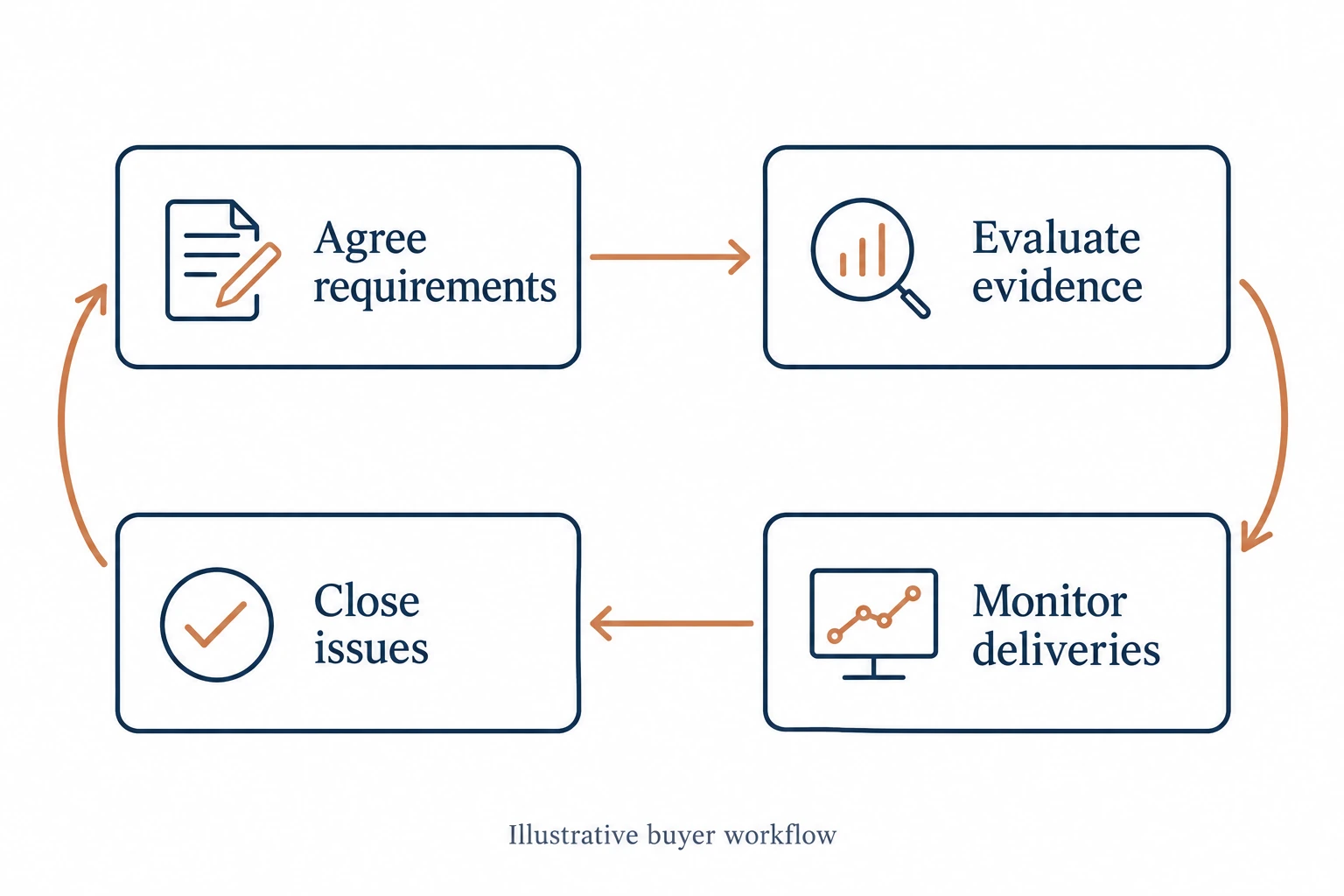
Supplier quality management is the ongoing work of agreeing requirements, evaluating suppliers, checking delivery evidence and resolving problems. It connects the buyer’s needs to the supplier’s actual performance. A successful sample or a completed inspection is one input, not the end of the relationship.
For manufacturing buyers, a useful system makes each decision explainable: what was required, which evidence was reviewed, who accepted the result and what remains unresolved. This guide offers a practical checklist for that work. It is an original buyer framework, not a description of one company’s internal supplier approval procedure.
What supplier quality management covers
Supplier selection asks whether a potential source appears capable of meeting a need. Qualification examines that capability and the offered item in more detail. Monitoring checks what happens after orders begin. Issue management handles deviations and checks whether agreed actions worked.
These activities need connections. A purchasing team cannot meaningfully compare deliveries against a specification it never agreed with the supplier. Likewise, a quality team cannot assess a revised part against an obsolete drawing without first resolving which revision applies.
NIST’s supplier-selection guidance emphasizes capability, quality documentation, rejected-part handling and lot information. As an industry example, Infineon’s public supplier-quality description distinguishes supplier qualification from evaluating the supplied material, equipment or service for its individual use. Its own supplier requirements are organization-specific; they are not a universal checklist for every manufacturer.
The distinction matters when a supplier has a strong general profile but limited evidence for your exact requirement. Record that gap. Supplier approval, product evaluation and acceptance of a particular delivery are related decisions with different scopes.
A supplier quality management checklist for buyers
Use the table as a review agenda. For each row, add the relevant document reference, an owner and the next decision. A blank field means a question still needs an answer; it should not silently become an approval.
| Review point | Evidence to connect | Decision to record |
|---|---|---|
| Requirements | Current specification, model and revision | Which requirements the supplier has accepted |
| Capability | Relevant process and capacity information | Which capabilities were evaluated and remain unverified |
| Product evaluation | Identified samples and applicable results | Whether the evaluated version matches the order |
| Delivery monitoring | Receipt, inspection and shipment records | What met requirements and what needs follow-up |
| Change communication | Proposed revision and affected records | Who reviews the change before it is accepted |
| Issue closure | Containment, cause, action and follow-up evidence | Whether the action addressed the identified problem |
Begin with a shared requirement set. Name the product clearly and identify the applicable document versions. When a requirement is unclear, ask for clarification before using it as an acceptance criterion. “Same as last time” is difficult to interpret if the earlier sample, quotation and drawing describe different versions.
Evaluate capability in relation to the work being purchased. A photograph of equipment provides different evidence from a process record or an identified sample result. Ask what each item demonstrates and where its limits lie. Record a supplier’s explanation without upgrading it into an independently verified fact.
Assign decision ownership. Purchasing can gather commercial responses while technical and quality personnel examine the evidence relevant to their roles. A shared question list helps prevent an unanswered technical issue from disappearing when a quotation becomes an order.
Define metrics before comparing suppliers
A supplier scorecard can be useful, but the labels need definitions. Decide whether delivery performance refers to order lines, shipments or units. Specify the agreed date used in the comparison. Otherwise, two reports carrying the same metric name may describe different things.
Quality measures need the same care. Separate rejected units from the number of recorded issues. Explain which receipts were inspected and which were not. A count without its population, period and evaluation scope provides limited context for a supplier decision.
Keep unexplained data gaps visible. Missing inspection records do not automatically mean a delivery failed; they also do not establish that it passed. Record the missing evidence and decide how it affects the review. Do not create a precise-looking overall score from incompatible or incomplete inputs.
Review changes alongside trends. A material, process, site or document revision may alter the relevance of earlier evidence. Agree how proposed changes will be communicated and who decides whether further evaluation is needed. The appropriate response depends on the actual change and purchase requirements.
Close an issue with evidence, not a promise
Consider a hypothetical shipment whose labels use an obsolete product revision. The immediate question concerns the affected goods: which items carry the label, where are they and what is their current disposition? Recording that scope is different from establishing why the obsolete label was used.
A supplier may then explain that an outdated label file remained available at the packing station. That explanation is a proposed cause to examine. The buyer can ask what evidence supports it, what action removes the cause and how the supplier will check later work.
Replacing the labels addresses the identified shipment. Updating the controlled label file and checking subsequent records address a different question: whether the same problem is likely to recur. Keep those actions separate in the record so an immediate correction does not masquerade as verified long-term closure.
When follow-up evidence arrives, relate it to the agreed action and scope. Record who reviewed it and any remaining limitations. If the evidence does not answer the question, leave the item open with a specific next request rather than closing it because a due date has passed.
Apply the checklist to the actual purchase
For AC and PV surge protective devices, supplier background and model-specific evidence serve different purposes. A general quality page does not establish every rating or approval for every model. Request the documents applicable to the item and revision under consideration.
The site’s quality-control background can orient that discussion. Use the checklist to turn the discussion into defined requirements, reviewable evidence and accountable follow-up. The useful result is a clearer purchase decision, with unresolved questions still visible.
References
- NIST: Supplier selection guidance — manufacturing supplier evidence and capability questions.
- Infineon: Supplier quality management — an organization-specific qualification and monitoring example.