

Bismaleimide-triazine, usually shortened to BT, is a thermosetting resin system used in electronic laminate applications. You may see the name written as bismaleimide triazine, BT resin or BT laminate. These terms are related, but they do not all describe the same supplied item.
A resin system describes the material chemistry. A laminate or prepreg describes a material form. A package substrate is a fabricated part. Keeping those levels separate makes a material specification easier to read and helps a buyer ask a supplier for the right evidence.
Bismaleimide-triazine: resin, laminate and substrate
Mitsubishi Gas Chemical describes BT as a thermal-hardening resin material used in laminated materials for electronic substrates. Its technology overview places BT laminate in chip-packaging applications. That establishes the family and application context; it does not assign one set of properties to every BT product.
The distinction between material and part is useful when reading quotations. “BT resin” does not identify a complete substrate construction. “BT laminate” still leaves the grade, thickness and supplied form to resolve. A finished substrate adds its own drawing, construction and fabrication requirements.
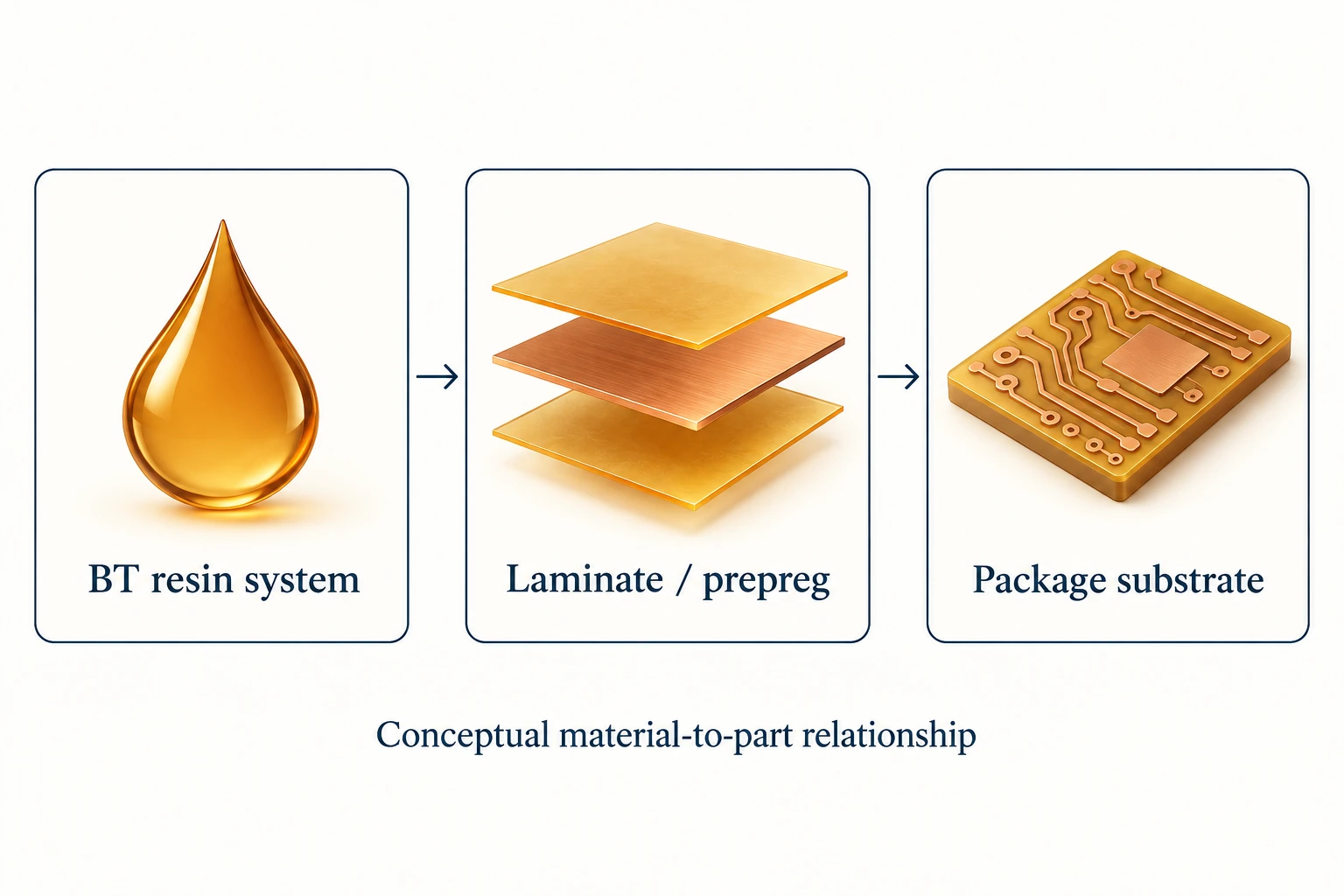
Use the name at the level the question concerns. If you need a supplied sheet, request its exact material designation and form. If you need a finished package substrate, request the part drawing and the material construction it specifies. A broad chemistry name cannot replace either document.
What core laminate and prepreg mean in a product listing
The manufacturer’s BT-materials overview distinguishes core laminate from prepreg. In that supplier’s naming convention, the prefix CCL identifies core laminate, while GHPL or GEPL identifies B-stage prepreg. Preserve the complete designation when comparing a quotation with its supporting material information.
Do not shorten a code until important differences disappear. A suffix, type designation or revision may distinguish one offered item from another. Ask the supplier which document applies to the exact designation on the quotation, including whether the listing concerns laminate or prepreg.
This is also why a photograph has limited identification value. The amber sample in the cover illustration conveys a materials context, but it cannot establish resin chemistry or a particular grade. The product designation and applicable records carry that identification.
A Tg example: the method belongs with the value
A useful example appears in the manufacturer’s typical-properties table for its listed HL832NX(A) grade. The glass transition temperature, Tg, is shown as 230°C by DMA and 200°C by TMA. Both values appear for the same listed grade, under different methods.
The reading lesson is narrower than a material recommendation: a value without its method is incomplete. Copying only the higher number into a comparison sheet would remove information needed to interpret it. Neither figure should be relabeled as a universal BT property or a maximum operating temperature.
The table labels these as typical properties. Keep that status attached when discussing the data. A typical-property entry is not automatically the acceptance limit in a purchase agreement. Ask which specification and acceptance conditions apply to the offered material.
Apply the same discipline to other properties. Preserve the row label, units, method and stated conditions together with the grade. If two supplier sheets use different conditions, mark the comparison unresolved rather than treating the numbers as directly interchangeable.
How to compare a BT material offer fairly
Start with the decision you need to make. A general question about the meaning of BT needs a short definition. A proposed material substitution needs a much more specific comparison. The following original worksheet helps identify the missing information before technical evaluation begins.
| Field | What to capture | Question if missing |
|---|---|---|
| Identity | Manufacturer, full grade and document revision | Which exact supplied material does this document describe? |
| Form | Core laminate or prepreg designation | Does the quotation concern the same form? |
| Construction | Applicable thickness and construction description | Which drawing or specification controls the offered construction? |
| Property | Value, units, method and stated conditions | Are the comparison conditions equivalent? |
| Acceptance | Agreed requirement and supporting evidence | Is this a typical value or a specified acceptance criterion? |
Keep unknowns visible in the worksheet. For example, an offer that says only “BT substrate” still needs clarification even if an attached brochure contains many numerical values. The brochure may concern several grades, and the supplier has not yet connected one of them to the offered part.
Likewise, a broad BT-versus-FR-4 comparison does not settle a specific selection. It leaves the actual grades, construction, requirements and evaluation conditions unresolved. Compare the exact candidates against the intended requirement rather than choosing a winner from family names.
The useful outcome is a complete document request: the exact material designation, supplied form, applicable construction, current data and the conditions under which its properties are stated. That gives the responsible technical team a defined basis for evaluation.
BT is an electronics-materials topic. This glossary does not establish that any Wanze AC or PV surge protective device contains BT resin, nor does it offer BT laminate for sale. Model-specific material claims require their own verified evidence.
References
- MGC: BT laminate technology — resin-family and application context.
- MGC: BT materials overview — core laminate and prepreg naming.
- MGC: BT laminate grade tables — the stated typical Tg example and method labels.