

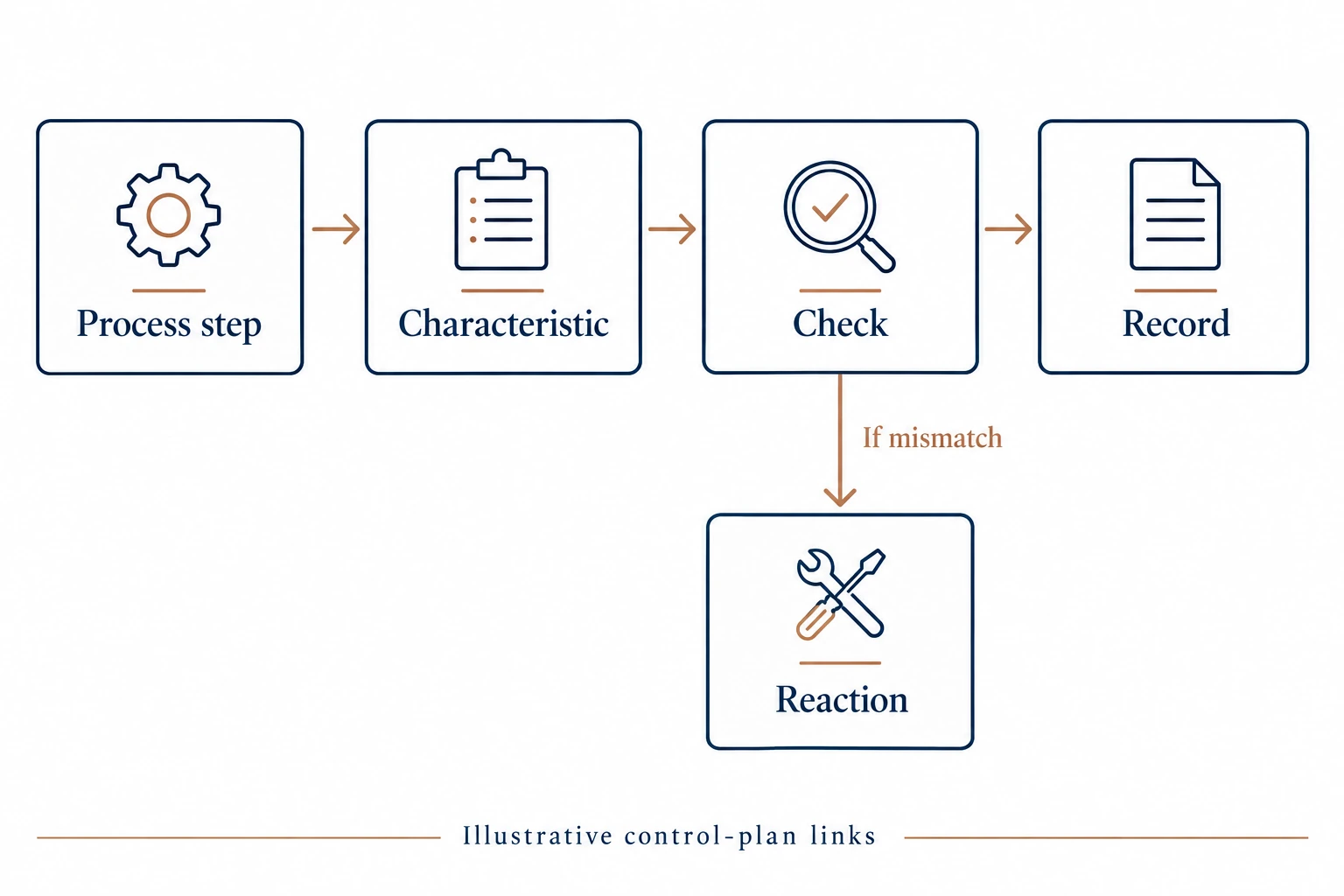
A control plan documents how a process characteristic will be checked, against which requirement, and what happens when a problem is found. It connects the process step to the check method, timing, record and reaction. A list of inspections becomes much more useful when those connections are explicit.
The document describes planned controls. Completed records show what happened when those controls were used. Keeping that distinction clear helps buyers and manufacturing teams ask better questions about a process without confusing a well-formatted plan with proof of execution.
What belongs in a control plan?
At a practical level, a reader needs to identify the process step, the characteristic being controlled, its requirement, the check method and frequency, and the response to a mismatch. Document identity, revision and responsibility give those fields context.
Quality-One’s explanation distinguishes a control plan from detailed operator instructions and describes it as a document that changes with the process. That distinction matters: the plan can reference an applicable instruction without repeating every operational detail inside a table.
Industry-specific formats also have a context. AIAG’s current public page describes a standalone first-edition Control Plan manual linked to APQP. This article uses that public overview only. The worked example below is original and does not reproduce a paid manual form or assert that one format is mandatory for every manufacturer.
Worked example: checking a packing-label revision
Imagine a packing operation where a team wants to prevent use of an obsolete label file. The following example is hypothetical. It demonstrates how fields connect; it is not Wanze’s internal control plan or an approved production instruction.
| Field | Illustrative entry |
|---|---|
| Process step | Packing-label setup |
| Characteristic | Product identifier and label revision |
| Requirement | Match the approved label master applicable to the order |
| Check method | Compare the setup label with the controlled master |
| Check timing | At setup and after a label-revision change |
| Record | Master reference, observed revision, result and reviewer |
| Responsibility | Assigned packing checker; quality owner handles mismatches |
| Reaction | Keep affected labels separate, notify the quality owner and record the disposition |
The requirement needs a reference. “Correct label” leaves the reader guessing. In the example, the approved master provides a defined comparison point. The actual operation would need its own controlled reference and a clear way to identify which version applies to the order.
The method needs to answer the requirement. Looking at whether a label is attached would not answer whether its revision matches the approved master. The example uses a comparison because that is the question being controlled. A check that measures the wrong characteristic can produce a record without resolving the intended issue.
The timing has a stated scope. Setup and revision-change checks are chosen for this fictional example. They are not a universal sampling rule, nor do they establish that every packed item was checked. The actual timing and coverage need to be defined for the real process and its requirements.
The record connects the decision to evidence. A result becomes easier to interpret when the reader can identify the order, the master used and the observed revision. A standalone tick mark provides much less context when a later question arises.
Make the reaction plan specific enough to use
“Inform quality” names a communication step but leaves important questions open. Which labels are affected? Who receives the information? What happens while the mismatch is unresolved? Which record captures the eventual decision?
The example’s reaction separates the affected labels and routes the mismatch to an assigned owner. The detailed disposition remains a separate decision. That prevents the example from quietly granting every checker authority to approve a deviation or resume a process.
A useful reaction description connects three things: the identified condition, the responsible role and the record of the response. Detailed work instructions can supply the operational steps. The control plan should make the route visible rather than relying on an unwritten assumption that someone will know what to do.
Check the connection in both directions. If the method can detect a label mismatch but the reaction mentions a different condition, the row is inconsistent. If a reaction requests a record that no one creates, the apparent control has a gap.
Keep the plan aligned with changes
Review the document when a relevant requirement, process or check method changes. In the label example, a revised master may affect the comparison reference and the record field. Updating only a heading while leaving the earlier reference in the row would leave the plan ambiguous.
A process-flow description helps locate the operation. A risk analysis helps explain the concern being addressed. A control plan describes the selected checks and response. Completed inspection or process records then provide evidence of execution. Each document answers a different part of the review.
For a supplier discussion, request the applicable plan and its revision, then ask how its records connect to the order under consideration. The site’s quality-control page provides background for that conversation; the fictional label example above does not establish any model-specific control or test result.
References
- Control plan development overview — document purpose, fields and relationship to instructions.
- AIAG: Control Plan public manual overview — current publication context; full manual not reproduced.