

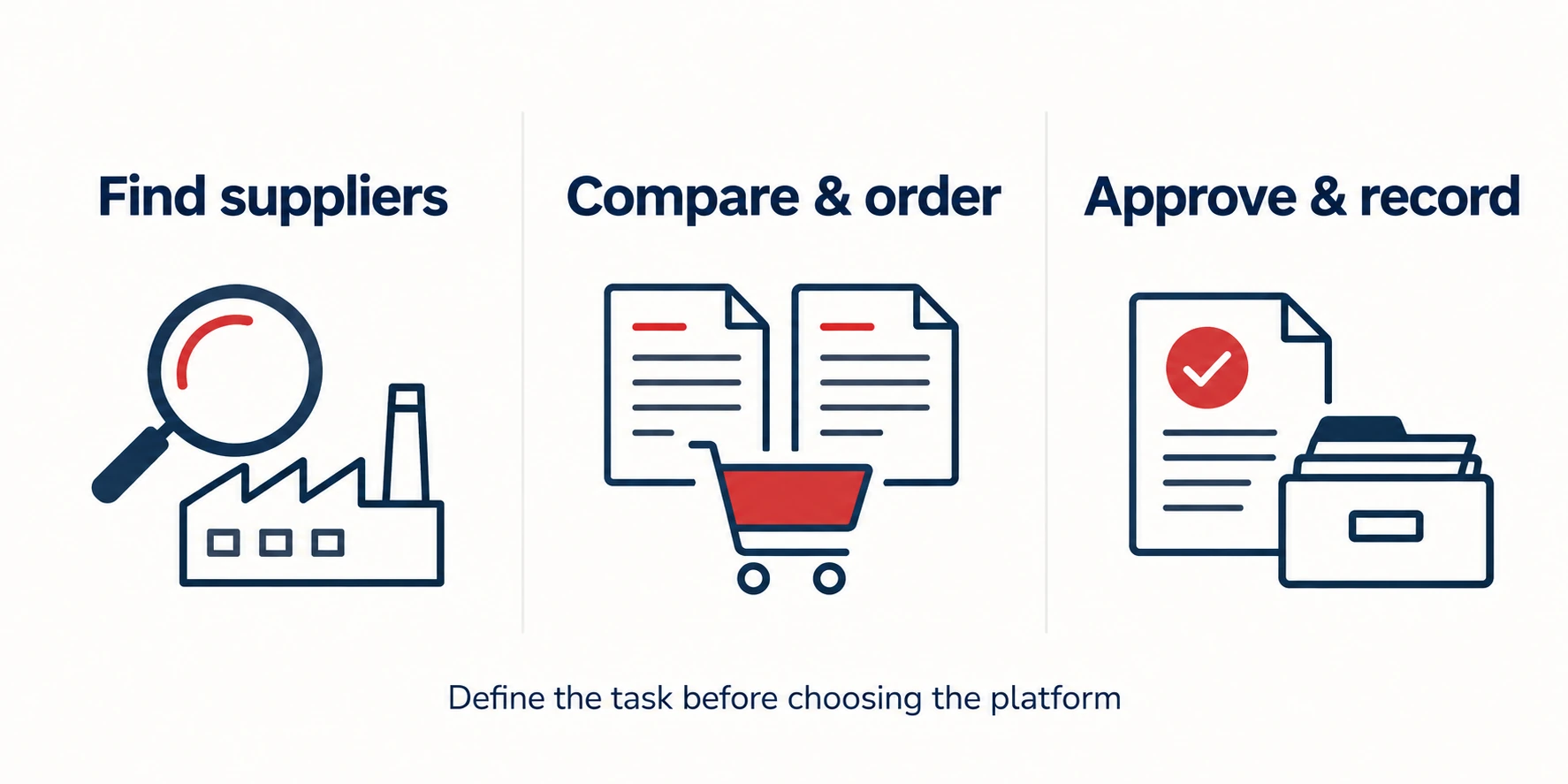
A B2B procurement platform can support supplier discovery, buying transactions, internal purchasing controls, or a combination of these tasks. The useful starting point is the work your team needs to complete: finding a qualified source, comparing offers, placing orders, or preserving approvals and records. Define that job before comparing software feature lists.
This guide uses a task-based framework and an illustrative demonstration case. It is not a hands-on software review or a ranking of vendors.
Match the B2B procurement platform to the buying task
| Primary need | Platform category to investigate | Evidence to request |
|---|---|---|
| Find potential suppliers and understand their profiles | Supplier discovery or intelligence tools | Relevant search results, data sources, update history and supplier identity records |
| Compare available offers and order from participating sellers | Multi-supplier marketplace or buying portal | Usable product information, quotation or ordering flow, and clearly assigned transaction responsibilities |
| Route requests, control approvals and preserve purchasing records | Internal procurement workflow or purchasing software | Role-specific permissions, revision handling, approval history and usable exports |
These categories describe buyer needs, not a formal standard or mutually exclusive product classes. One system may cover several areas; another may connect to separate tools. A platform that finds a suitable supplier does not, by that fact alone, prove that it can authorize a purchase or preserve the final order record.
For a narrow public example, Virto Commerce describes a procurement marketplace with contract controls and supplier onboarding rules. That vendor description illustrates a marketplace scope; it does not establish what a specific customer configuration includes. The proposed implementation still needs to be demonstrated against your requirements.
Use one purchase scenario throughout the demonstration
Prepare a fictional request for quotation, or RFQ, with a specification attachment. A buyer invites suppliers, receives offers, and then changes one requirement before approval. The evaluator’s job is to follow that change through the proposed workflow and inspect what evidence remains.
Use neutral sample information rather than customer records or confidential pricing. Give each vendor the same scenario and identify which parts are essential. A supplier-discovery tool may only need to complete the first step; an end-to-end purchasing proposal needs to show the later steps or explain the handoff.
| Demo action | Question to resolve | Record to inspect |
|---|---|---|
| Identify a candidate supplier | Can the team distinguish the legal entity from a similar name or trading name? | Profile identity and the source or provenance of relevant information |
| Issue the RFQ with its attachment | Can the recipient tell which specification applies? | RFQ identifier, attachment revision and recipient record |
| Replace the specification | How are recipients informed, and what happens to existing offers? | Revision history and visible treatment of superseded material |
| Compare a revised offer | Can the evaluator see the assumptions and exclusions behind the price? | Offer linked to the applicable requirement version |
| Request approval | Who can approve, reject or change the request? | Role permissions and an approval event tied to the relevant version |
| Export the completed record | Can another team reconstruct the decision outside the interface? | Readable files and identifiers linking requirements, offer and approval |
Do not turn a missing step into an automatic rejection without considering scope. An intentional handoff to an existing purchasing system may be acceptable. Record who owns the transfer, which identifiers survive, and how a failed or incomplete transfer becomes visible.
Pay particular attention to the revised specification. A polished initial ordering flow is less useful evidence for this scenario than a clear account of which offer was approved after the change. Ask the demonstrator to show the record, rather than simply confirming that revision control is supported.
Set ownership rules before discussing integrations
For each important field, identify the system that controls it. Supplier identity, item descriptions, negotiated terms and accounting codes may have different owners. Ask how a correction reaches connected systems and which record takes precedence when values conflict.
If the proposal connects to an enterprise resource planning system, or ERP, request a demonstration using representative sample records. Specify the direction of transfer, the fields involved, who resolves errors and the evidence available afterward. An integration logo or general API statement is not a demonstration of your required exchange.
Permissions deserve a separate check. Have the vendor show the same request through a requester, reviewer and administrator role. Define what each person should be able to view or change, including after approval. These are evaluation requirements, not claims that any named product provides a particular permission model.
Also ask what can be exported when the contract ends: records, attachments, identifiers and relevant history. Confirm the proposed format and scope before relying on an exit process that has not been shown.
Keep a decision record that distinguishes evidence from promises
Use three evidence labels for each requirement: observed in the demo, requires configuration or integration, and not yet demonstrated. Add the responsible party, the unresolved question and the acceptance evidence still needed. Keep commercial terms separate from functional observations.
This avoids treating a public feature description, a planned customization and an observed behavior as equivalent. Where a requirement is critical, agree how it will be checked in the proposed implementation. Where it is optional, record that choice so it does not become an assumed commitment later.
The resulting shortlist should reflect the task you need to complete and the evidence available for it. No pricing, performance benchmark, implementation experience or savings outcome is claimed here.
References
- Virto Commerce: procurement marketplace description — primary vendor source for the bounded marketplace example.