

Short circuit current rating, or SCCR, describes an equipment assembly’s capability under specified short-circuit conditions. It is reviewed at a stated voltage and with any applicable conditions. The available fault current describes the supply at the relevant point; it is not another name for the equipment’s SCCR.
For purchasing, keep the rating attached to the object it describes. A large kA figure on an SPD or circuit breaker cannot automatically answer whether a complete control panel has an adequate SCCR.
Short circuit current rating is not the other kA number
Several electrical specifications use current units while describing different events or functions. Comparing the numbers without their labels can produce an invalid selection.
| Term | Object or question | Evidence to request |
|---|---|---|
| Available fault current | Supply conditions at a specified point. | Relevant site fault-current information. |
| Equipment SCCR | The identified equipment or assembly under stated conditions. | Assembly rating, voltage and supporting conditions. |
| Interrupting rating | A protective device’s ability to interrupt a fault under its rated conditions. | The exact protective device’s documentation. |
| SPD In or Imax | Specified surge discharge-current characteristics. | SPD data with the relevant test conditions. |
In particular, surge discharge-current ratings do not establish a short-circuit rating. A specification sheet that lists SCCR, In and Imax separately is identifying different properties. Their shared current unit does not make them interchangeable.
A complete assembly needs its own evidence
A component rating belongs to that component and its stated conditions. A complete assembly needs an established rating for the offered configuration. Selecting a highly rated part does not, by itself, establish the rating of everything around it.
Likewise, an upstream protective-device entry is not a universal shortcut. Applying current limitation involves specific conditions and assessment; simply adding a fuse or breaker does not prove an assembly’s adequacy.
A buyer should ask the equipment manufacturer how the supplied assembly rating is established and what conditions accompany it. That is a request for documented evidence, rather than an instruction to calculate SCCR from a few component labels.
Ask for evidence at three boundaries
The first boundary is the site supply. Identify the point to which the available fault-current information applies. A value for a different location or a different supply arrangement may not answer the question for the proposed equipment.
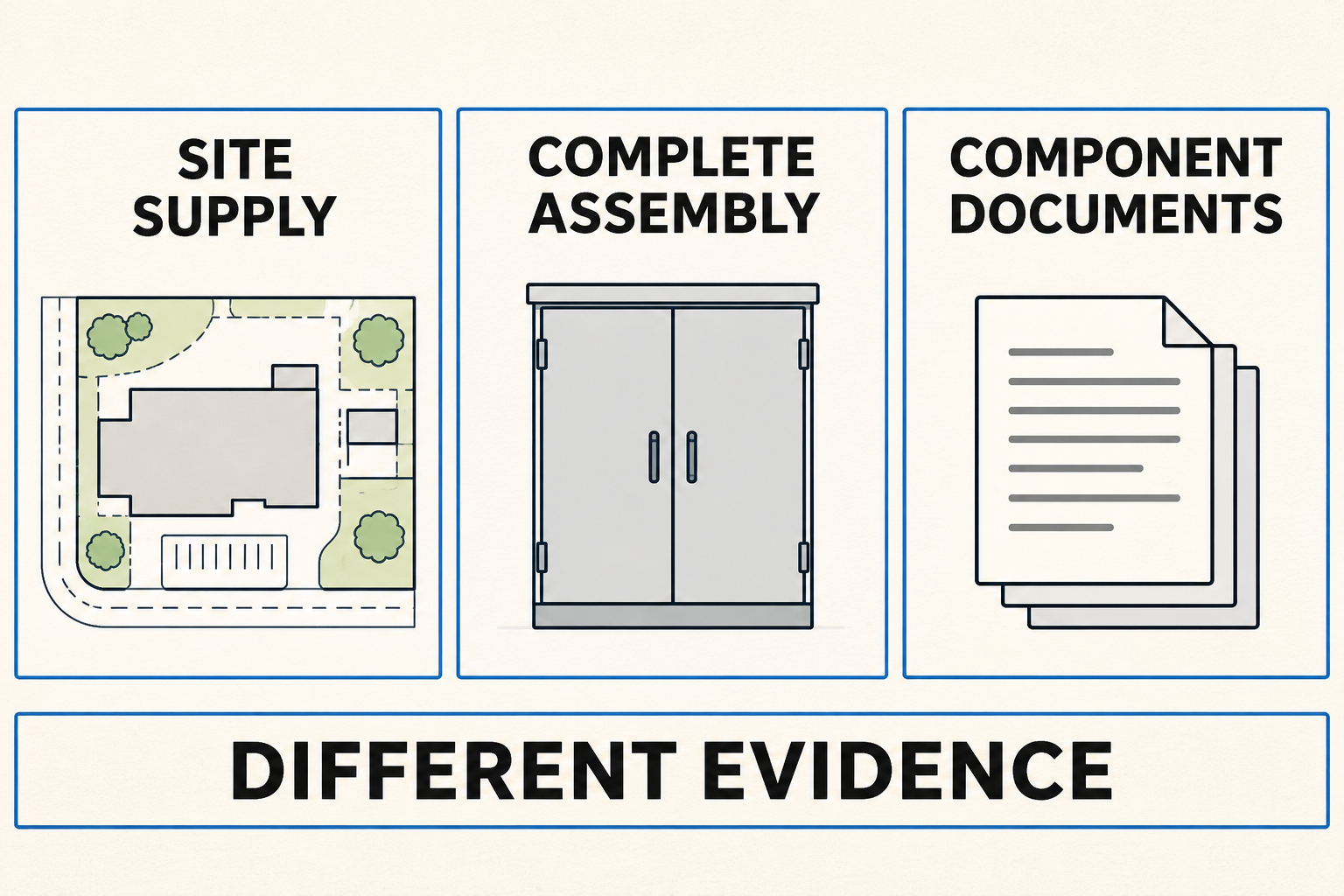
The second boundary is the complete assembly. Request the exact offered model or configuration, its SCCR, the associated voltage and any specified protective-device conditions. Keep those details together instead of transcribing only the kA number into a quotation comparison.
The third boundary is the component documentation. It supports review of the parts and conditions used in that assembly. It should agree with the supplied configuration, rather than describe a different product in the same family.
These records need to be reconciled by the responsible technical review. If the site conditions or assembly evidence are missing, record the unanswered point in the submittal. A purchasing spreadsheet should not turn missing information into an assumed pass.
An arc-flash label answers a different question
Arc-flash assessment and equipment SCCR are related to electrical hazards, but they are different evaluations. An arc-flash label does not correct an assembly with inadequate SCCR.
For procurement, ask whether the equipment rating has been reviewed against the relevant supply conditions. Keep that question separate from incident-energy assessment and work-practice decisions. This explanation supplies no energized-work permission, PPE selection or fault-test procedure.
The referenced historical technical articles are used for these distinctions. Their edition-specific code statements are not presented as the latest adopted requirement for a particular US project.
For an SPD, keep SCCR separate from surge capacity
When sourcing AC surge protection devices, ask for the exact model’s short-circuit documentation when the assembly review requires it. Do not substitute its maximum surge-current figure for an SCCR.
This article does not establish an SCCR for a Wanze model. A useful supplier reply identifies the product, its rating evidence and the applicable conditions. The assembly reviewer can then consider that evidence alongside the other components and the site information.
The document trail should preserve every rating’s name, object and conditions. That makes a quotation technically reviewable without inventing a result.