

The thermal conductivity of Cu, the chemical symbol for copper, is often summarized as about 400 W/(m·K) near room temperature. That is a useful orientation value. The number used for an actual material review still needs its grade, condition, temperature and source.
Thermal conductivity describes a material property. It is not a finished part’s heat-flow capacity, a temperature-rise limit or an allowable electrical current.
Thermal conductivity of Cu: two published examples
The following entries preserve their original conditions. They illustrate why a property should travel with its source context.
| Published source | Material and condition | Thermal conductivity |
|---|---|---|
| NIST reference table | Copper; selected metal properties at 295 K. | 400 W/(m·K). |
| KME Cu-ETP sheet | C11000 / Cu-ETP; typical value in annealed temper at 20°C. | 394 W/(m·K). |
These entries are not a controlled comparison of two copper grades. Their different contexts do not justify a performance ranking, a measured uncertainty claim or a temperature curve drawn between the two values.
The AIST compilation also presents multiple near-room-temperature copper entries tied to separate references. That is a reminder to follow the data record, rather than select whichever number looks most favorable.
Conductivity is not a finished part’s heat-flow rating
The unit W/(m·K) means watts per meter-kelvin. In a simple uniform, steady-state conduction model, heat-flow rate can be written P = kAΔT/L. Here k is thermal conductivity, A is cross-sectional area, ΔT is the temperature difference and L is the conduction length.
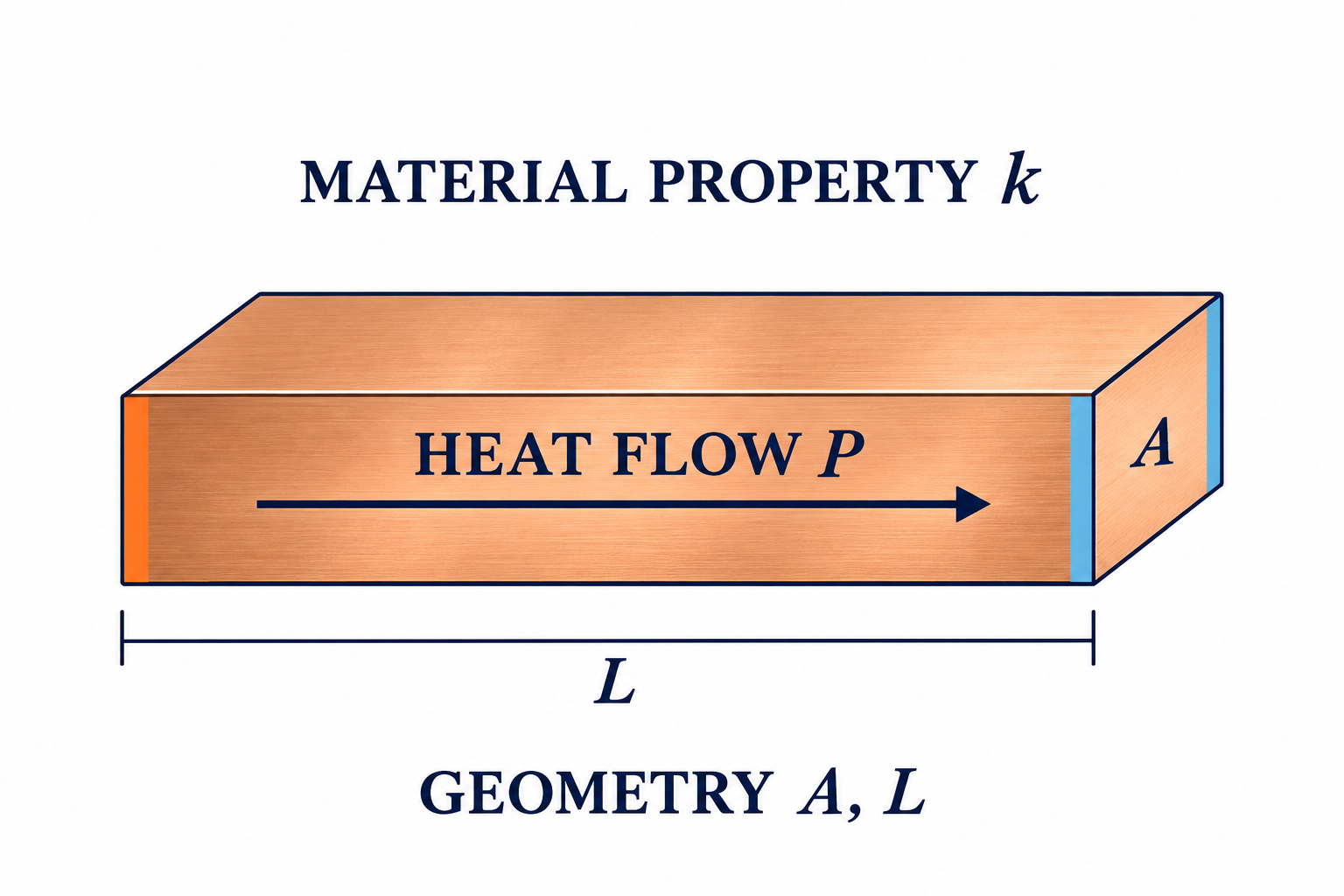
The equation shows why knowing k alone does not give a heat-flow rate. Geometry and the imposed temperature difference still matter. For this ideal model, kA/L is thermal conductance, expressed in W/K. Conductance and conductivity are related quantities with different units.
A real equipment assembly can involve additional heat-transfer paths and boundary conditions. The ideal slab is a way to read the property, rather than a prediction of a cabinet’s temperature or a device’s cooling performance.
Why temperature and grade belong with the value
A data entry at room temperature is not automatically a value for every operating temperature. Use temperature-dependent data when the intended analysis requires it. Do not extend a single point across an unspecified range.
Material identity and condition also need to match. A generic copper entry does not identify the grade or temper of a delivered part. Conversely, a supplier sheet giving a typical property does not necessarily state a guaranteed minimum for every shipment.
The important distinction is between an introductory reference value and the data required for a specific engineering task. The former helps explain copper’s ability to conduct heat; the latter needs the relevant material record and its limitations.
Read a thermal-property entry before using it
Start with the property name and unit. Check that the entry describes thermal conductivity, rather than electrical conductivity, heat capacity or the thermal conductance of a particular part.
Then identify the material and stated condition. Keep the grade, temperature and any typical-value qualification beside the number when moving it into a comparison sheet. Removing those details makes unlike records appear directly comparable.
Finally, identify what the calculation or decision needs. A preliminary explanation may only require an approximate reference value. A component assessment may require more specific material data and a validated model. The source should answer the actual task, rather than merely contain the word copper.
This sequence is an original data-reading aid. It does not create new material measurements or establish a finished component’s performance.
Keep equipment performance separate
When reviewing AC surge protection devices, do not convert copper’s conductivity into an SPD temperature-rise or current claim. Those are product and configuration questions.
This article does not identify Wanze’s internal copper grade or report a thermal test. Request the offered model’s documentation when the enquiry concerns equipment performance.