

Are surge protectors necessary for industrial and commercial equipment? Often, a documented surge-protection review is sensible when a facility has sensitive electronics, costly downtime, long outdoor conductors, frequent switching or known lightning exposure. The answer is not a universal yes for every load or a universal no because a panel already has one device.
The practical question is whether a transient can reach a consequential load and whether the existing protection layers, system data and project requirements have been reviewed. “Do I need surge protection?” should therefore lead to an evidence checklist, not a headline kA value or an automatic model choice.
When are surge protectors necessary for priority loads?
Start with consequences. A short disturbance may reset a controller, interrupt a process, corrupt a building-management system or stop a communications path. Replacement cost is only one factor; restart time, lost production, unavailable spares and safety-related process dependencies also affect priority.
Then review exposure. Internal switching from motors, drives, contactors and capacitors can create recurring transients. Utility switching and lightning can add external events, especially when conductors enter from outdoor areas or connect separate buildings. These conditions do not automatically specify an SPD, but they justify a closer system review.
Keep the operational and electrical questions separate. Operations can rank the cost of a controller reset or an extended restart. Electrical staff can map the feeder, grounding and existing SPD layers. Combining those two views produces a priority list that is more defensible than calling every connected device “critical” or treating every unexplained fault as surge damage.
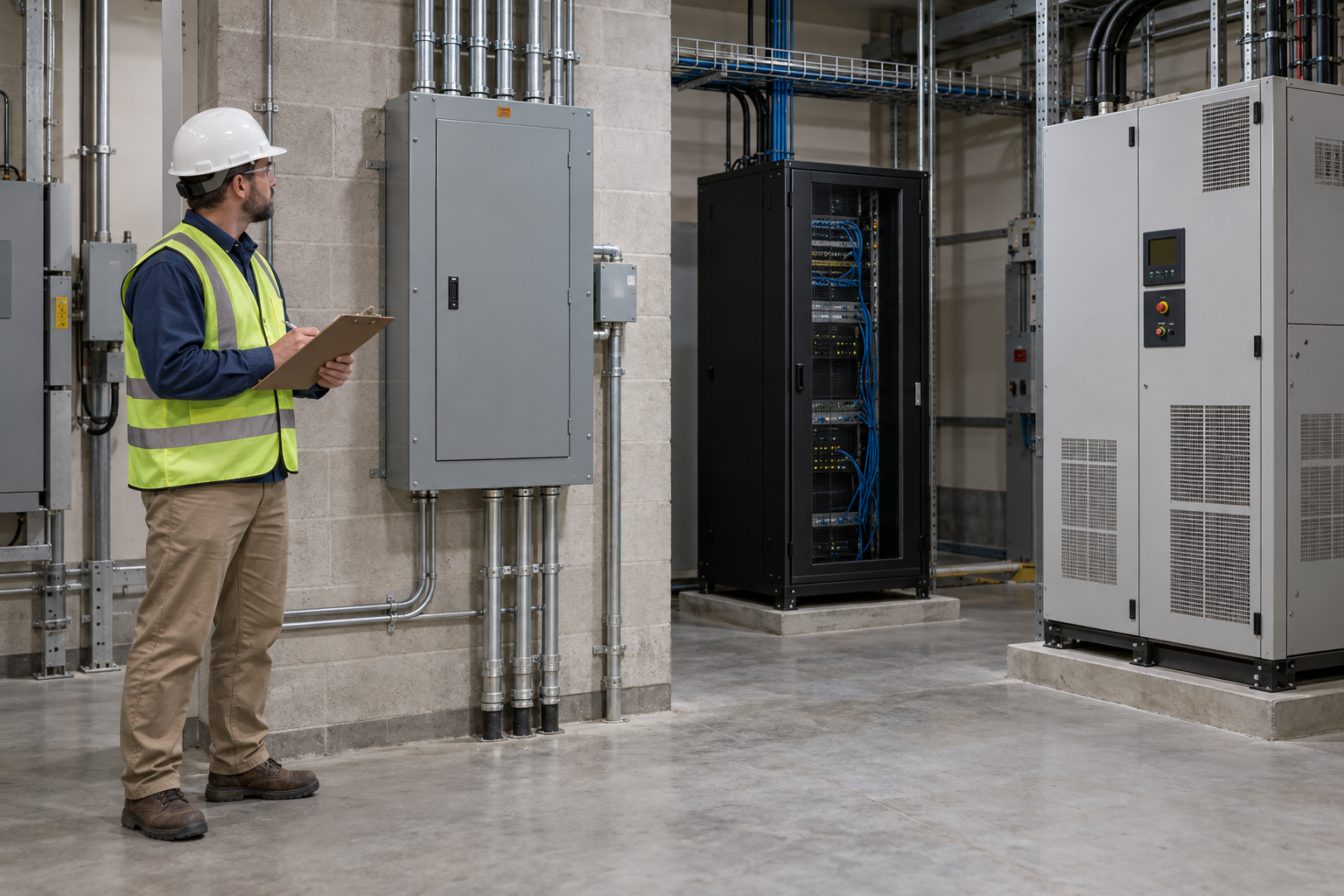
Priority framework for commercial equipment
| Question | Higher-priority signal | Evidence to request |
|---|---|---|
| What happens if the load resets? | Long restart, lost process data or difficult replacement. | Business impact, recovery time and equipment owner. |
| What exposure exists? | Frequent switching, outdoor conductors or lightning activity. | One-line, facility layout and event history. |
| What protection already exists? | Unknown device role, age or downstream path. | SPD records, panel schedules and current instructions. |
| What does the equipment require? | Manufacturer specifies a power-quality or transient review. | Equipment datasheet and installation documentation. |
This framework helps a team decide where to spend review time. It does not say that every listed load needs a dedicated unit. Electrical compatibility, topology, grounding and documentation still determine whether a proposed device fits.
A useful review record names the equipment owner and the person responsible for electrical approval. It also distinguishes a known transient exposure from a suspected one. A load with high downtime impact but little event history may still justify investigation, while a low-impact load with frequent resets may point to a broader power-quality problem that should be measured before an SPD is specified.
Is panel-level protection enough?
Panel-level protection can be an important layer, but it may not describe every path into a facility. A downstream machine panel, transfer switch, generator connection or long communication run can have a different protection role. Schneider’s application guidance illustrates why service, distribution and downstream locations are reviewed together rather than treated as interchangeable.
Review the one-line diagram, feeder lengths, equipment locations and existing devices. A panel SPD also does not automatically protect a separate signal or data circuit. Keep AC power, DC PV and communication paths distinct until the exact protection family and documentation are known.
Coordination is not demonstrated by device count. Record the role and location of each existing SPD and check whether a proposed downstream layer is compatible with the system and equipment. If the facility has changed panels, added drives or extended outdoor circuits since its last review, the old protection map may no longer describe the actual exposure.
When a review may be less urgent
Not every facility has the same exposure or consequence profile. A low-consequence load with documented upstream layers and stable operating history may not need the same immediate attention as a critical controller connected to long outdoor conductors. That is a prioritization decision, not permission to ignore the project requirements or the equipment documentation.
Do not use absence of a past failure as proof that protection is unnecessary. Transient damage can be cumulative or appear as unexplained resets and shortened component life. Conversely, do not attribute every power-quality problem to a surge; sags, harmonics and sustained overvoltage require separate analysis.
Evidence checklist before a commercial SPD request
- List critical loads, owners, restart impact and acceptable downtime.
- Map service, distribution, equipment and outdoor-connected paths on the current one-line.
- Record system voltage, phase, grounding, existing SPDs and recent changes.
- Collect equipment instructions and any event, utility or maintenance records.
- Ask for a model shortlist only after assumptions and unresolved questions are written down.
For AC family discovery, use the Wanze AC surge protection device category. The category is not a universal necessity decision or a substitute for project review.
FAQ
Which commercial equipment is most vulnerable to surges?
Prioritize sensitive or operationally critical equipment such as controls, automation, communications and instrumentation, especially when exposure or existing protection is uncertain. Verify the actual equipment requirements.
Is panel-level protection enough by itself?
Not necessarily. A panel device is one layer; downstream equipment, transfer points and signal paths may need separate review. Confirm the full facility path and current documentation.