

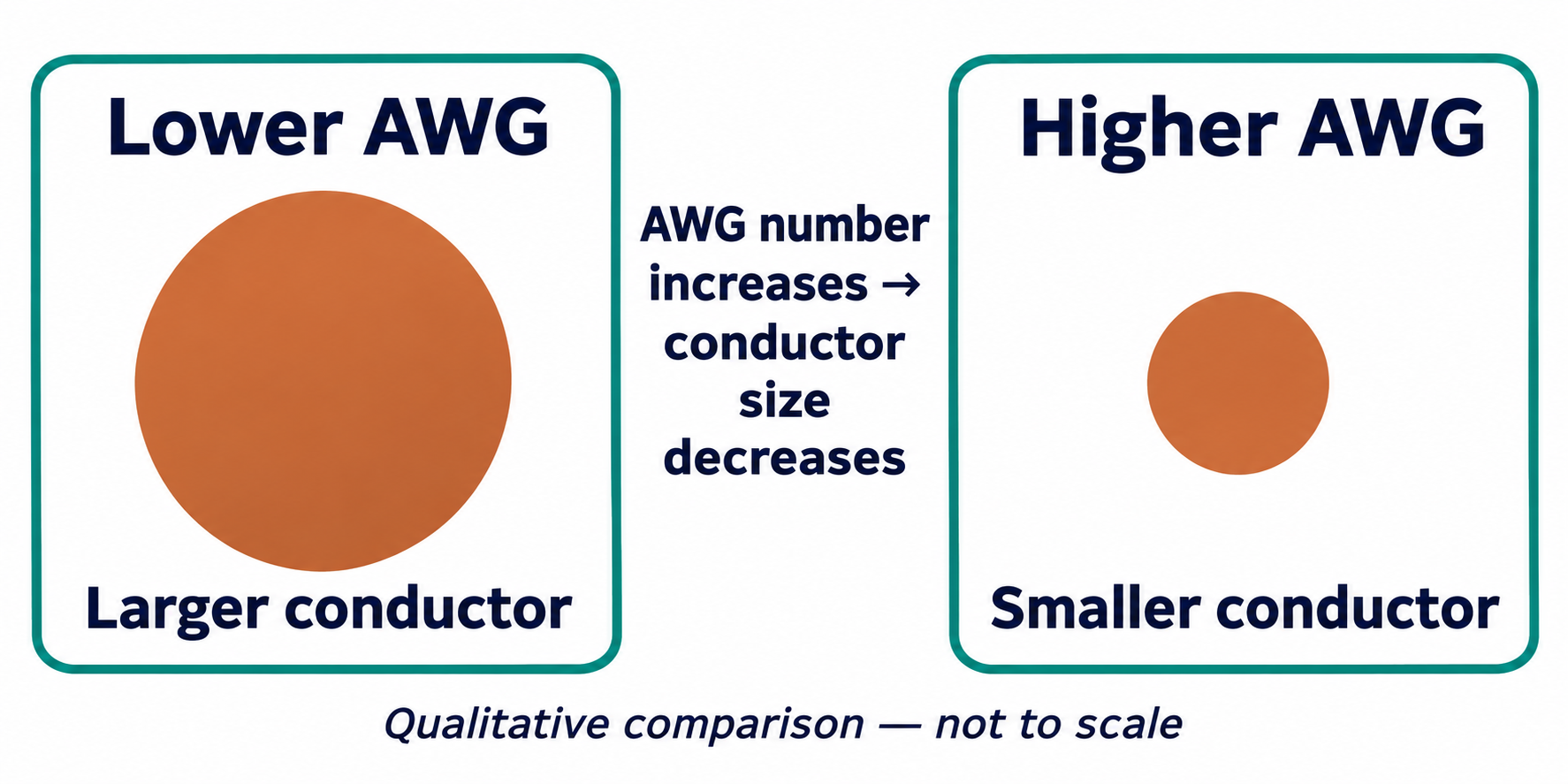
The AWG meaning on an electrical wire specification is American Wire Gauge. It identifies conductor size. A lower AWG number corresponds to a larger conductor diameter; a higher number corresponds to a smaller one. AWG is not an ampere rating, and it does not describe the outside diameter of an insulated cable.
That distinction matters when two documents appear to describe the same wire in different ways. One may list a gauge number, another a conductor area in square millimeters, and a third an overall cable diameter. Those entries answer different questions and should not be compared as though they were the same measurement.
AWG meaning starts with the direction of the scale
In the usual AWG size sequence, the conductor becomes smaller as the gauge number rises. This is the reverse of the intuition that a larger number must mean a larger physical object. The number is a size designation within the gauge system, not a direct diameter written in millimeters.
For a quick comparison, a lower-numbered gauge and a higher-numbered gauge can be ordered by conductor size without first converting either to metric units. That establishes their relative size. It does not establish a current rating or prove that either one fits a particular terminal.
A specification using AWG therefore still needs its units and construction details beside it. A bare number copied from a drawing can lose its meaning if the next reader cannot tell whether it is a gauge designation, a dimension or an equipment identifier.
Conductor diameter, area and cable diameter are different quantities
Diameter is a linear dimension across a round conductor. Cross-sectional area describes the amount of conductor in a section perpendicular to its length. Diameter is expressed in units such as millimeters; area uses squared units such as mm². A diameter and an area cannot be substituted for each other simply because both numbers describe wire size.
Insulation and jackets describe additional parts of the construction. A cable’s visible outside surface is not the same thing as the conducting material inside it. Two specimens that look equally thick from the outside do not, on that appearance alone, establish equal conductor sizes.
Construction also matters when interpreting a dimension. A solid conductor and a conductor assembled from multiple strands should be read with their own product descriptions. The total size of a strand bundle, an individual strand dimension and an insulated outside diameter are not interchangeable entries in a specification.
| Specification entry | What it describes | What remains a separate question |
|---|---|---|
| AWG | Conductor size designation | Construction and terminal acceptance |
| Conductor diameter, mm | A linear conductor dimension | Area and overall insulated size |
| Conductor area, mm² | Cross-sectional conducting area | Actual cable outside diameter |
| Overall diameter | The size of the complete described construction | Conductor dimensions within it |
| Ampacity | Current-carrying information under stated conditions | Whether those conditions match the application |
A nominal diameter example shows why units matter
The referenced electronics glossary gives 24 AWG a nominal diameter of 0.511 mm. For a circular solid conductor, that nominal diameter can be used in the ordinary circle-area formula:
Area = π × diameter² ÷ 4
Using the stated rounded diameter gives π × 0.511² ÷ 4 = 0.2050839… mm², or approximately 0.205 mm². This is a geometric calculation from a nominal value. It is not a measurement of a sample, a manufacturing tolerance or a permissible-current figure.
The squared diameter explains why a linear-size comparison and an area comparison can give different ratios. For an ideal circular cross-section, doubling its diameter multiplies its area by four. Doubling a gauge number does not mean doubling its diameter, because the gauge designation is not a diameter expressed in linear units.
The example also shows a simple way to catch a document error. If a value is presented as an area, its unit should be squared. A copied “mm” beside an area figure is not a harmless formatting change; it changes the type of quantity the reader is being told to interpret.
AWG alone does not give a usable current rating
A wire-gauge designation describes size, while a current-carrying statement needs its conditions. The referenced cable manufacturer’s ampacity resource separates conductor materials and temperature columns. A gauge value taken out of that context cannot stand in for the complete information in the table.
This is why a definition of AWG should not become a universal gauge-to-amp chart. A size comparison can be correct while a current conclusion remains unsupported. The missing information belongs in the applicable conductor and equipment documents, not in an assumed conversion from the acronym.
For the same reason, conductor area and a component’s published electrical rating answer different questions. A terminal specification describes what the terminal accepts under its stated conditions. A wire-size definition cannot establish those conditions for an unidentified piece of equipment.
Read the conductor entry before matching equipment documents
A useful first pass through a wire specification keeps the gauge designation, conductor material and solid-or-stranded construction together. Overall diameter and insulation details stay as separate entries. This makes it possible to see whether two documents describe the same quantity before comparing their numbers.
For example, a document stating only “24 AWG” and a drawing showing only a cable outside diameter have not yet provided directly comparable dimensions. The nominal conductor example above cannot fill that gap: it describes a particular geometric quantity, not the outside of the complete cable.
When reviewing Wanze’s AC surge protection devices, the next step is the actual model’s terminal documentation. The AWG explanation helps read that information; it does not assign an accepted conductor range to every SPD in the category.
References
Analog Devices — AWG definition and nominal 24 AWG diameter example
EXFO — Gauge-number and conductor-diameter relationship
American Wire Group — Conductor, insulation, jacket and stranded-conductor terminology
Cerrowire — Ampacity table headings and stated material/temperature conditions