
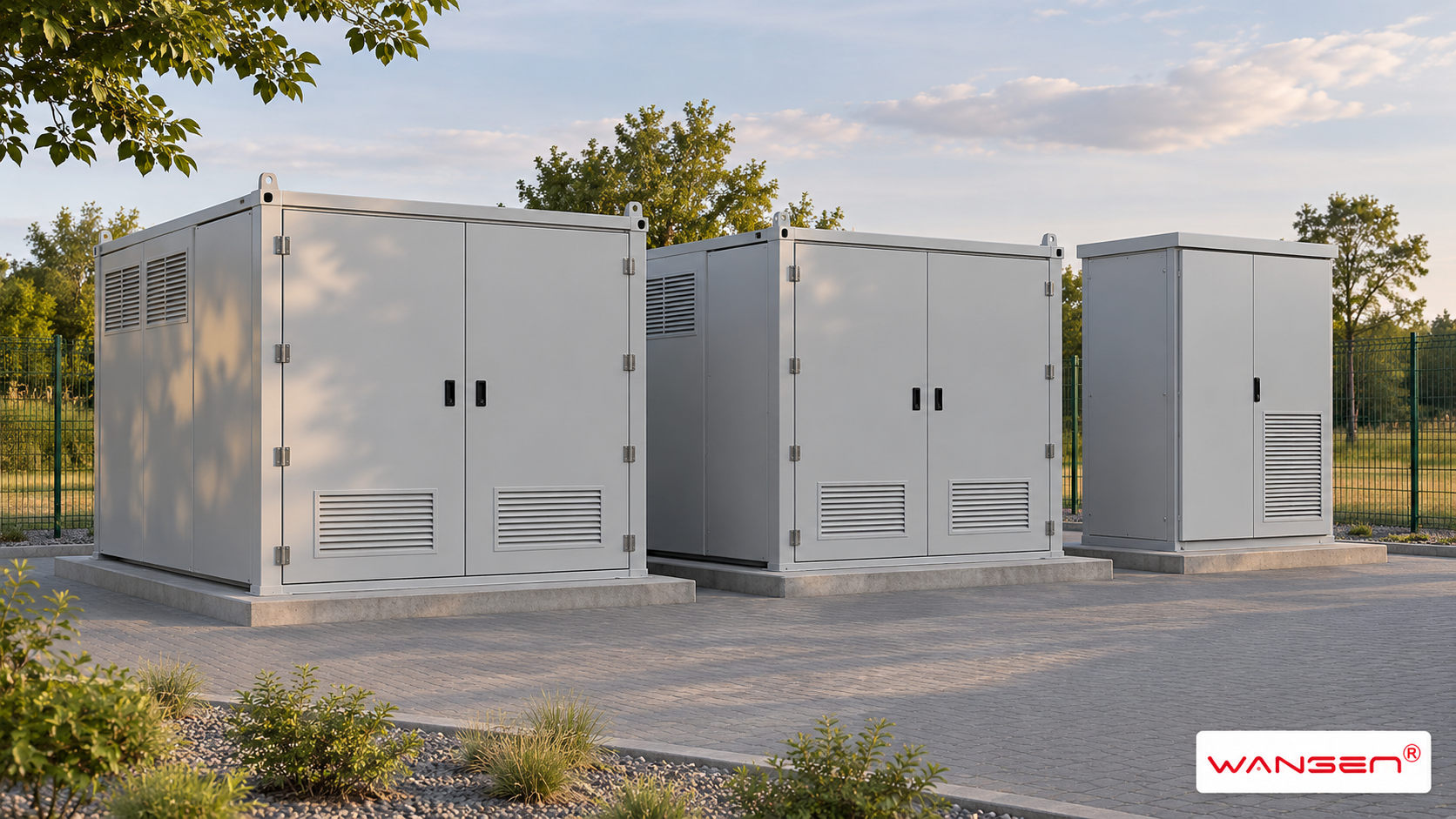
BESS stands for battery energy storage system. It stores energy in rechargeable batteries and makes that energy available later through the system’s conversion and control functions. In a project specification, BESS meaning includes the integrated equipment and its intended application.
The acronym alone does not specify storage size, backup duration, grid-independent operation or the protection required at every electrical interface.
BESS meaning goes beyond the battery
The battery stores energy. Its configuration and operating limits form one part of the system specification. The battery management system, or BMS, monitors battery conditions and supports battery-level management.
The power conversion system, or PCS, provides the power-conversion interface. In a typical grid-connected arrangement, it interfaces the battery’s DC side with the AC network and supports charging and discharging within the specified operating conditions.
Controls coordinate operation. An energy management system, or EMS, can manage site-level operating objectives, while battery-level monitoring remains a different function. The exact allocation of responsibilities depends on the offered architecture.
These are functional roles, rather than a universal bill of materials. A complete project also needs its defined supporting equipment and interfaces. A list of familiar acronyms cannot establish that the integrated system satisfies the project requirements.
Follow the power path separately from the control signals
On a conceptual power diagram, the battery side is DC and the network side is AC. The conversion interface connects those power domains. Charging and discharging involve opposite directions of power flow under the system’s control.
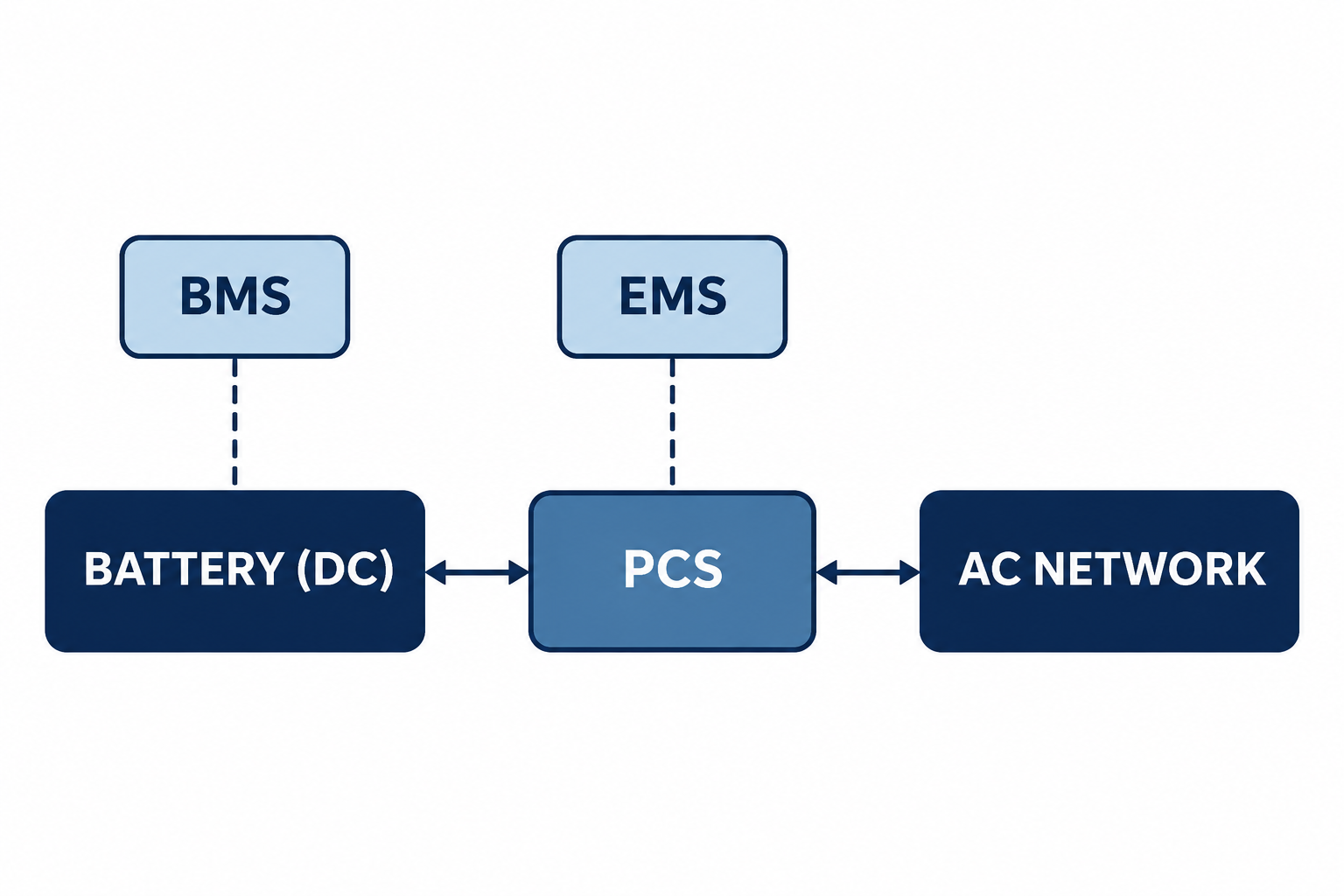
Monitoring and control signals serve a different purpose from the main power path. A BMS connection on an architecture drawing does not represent the conductor carrying the system’s full charging power.
The illustration deliberately shows only selected relationships. Actual systems can include further communication links, conversion stages and supporting equipment. Use the supplier’s current system documentation to identify those details.
For a component enquiry, name the interface being discussed. “For a BESS” is less specific than identifying whether the question concerns the AC connection, a PV circuit, the battery DC side or a control interface.
Read kW and kWh as different requirements
Power describes the rate at which energy is delivered or absorbed. Storage specifications commonly express it in kW or MW. Energy capacity describes an amount of stored energy, commonly expressed in kWh or MWh.
A large energy capacity does not, by itself, establish the maximum output power. A high power rating does not establish how long that output can be sustained. Both quantities need to be stated for a meaningful comparison.
Duration also needs its conditions. Usable energy, the specified discharge power and the relevant operating assumptions belong with a duration claim. A headline energy figure should not be presented as a guaranteed runtime for an unspecified facility load.
This article provides no system-sizing calculation. The distinction helps a buyer request the right specification rather than compare unlike quantities.
Coupling does not establish every operating mode
Solar-plus-storage arrangements can use AC-coupled or DC-coupled architectures. The coupling description identifies how the power-conversion arrangement connects the PV and storage functions. It does not make their component requirements identical.
Likewise, a system intended for one grid service is not proven suitable for every backup task. Confirm the specified operating mode, the loads served and the required interface arrangements. The label BESS is not evidence of automatic islanding or black-start capability.
The historical institutional sources cited below support the terminology and architecture distinctions. Their older market totals, prices and growth forecasts are not presented as current data.
A project review needs the actual configuration and operating requirements. This overview does not supply an installation procedure, fire-protection design or certification approval.
Separate AC, PV and battery-side protection enquiries
Wanze’s verified catalog includes AC surge protection devices and solar PV surge protection devices. Those product domains help identify the starting point for an enquiry.
They do not establish that a PV SPD is suitable for the battery DC side of a BESS. The exact electrical interface and the offered model’s supporting documentation need their own review. Sharing the letters DC is insufficient evidence of interchangeability.
Identify the circuit and system conditions, then request documentation tied to the proposed model. This article claims no Wanze battery, PCS, BMS, BESS integration service or battery-side product approval.
The useful outcome is a specific, answerable component question within the documented system architecture.