

The basic bronze vs brass distinction concerns alloy families: brass is copper–zinc, while tin bronze is copper–tin. Additional alloying elements and commercial naming conventions make the exact grade important. A family name is a useful starting point for a materials discussion.
Selection becomes more precise when the comparison includes grade, temper, product form and the relevant conditions. These details explain why broad claims such as “bronze is stronger” leave too much unanswered for a real part specification.
Bronze vs brass: understand the family names
Kupferverband’s materials guidance describes brass as a copper–zinc alloy and tin bronze as a copper–tin alloy. Both families can include additional elements. The bronze name also has a broader history in commercial alloy naming, so read the grade designation alongside the familiar name.
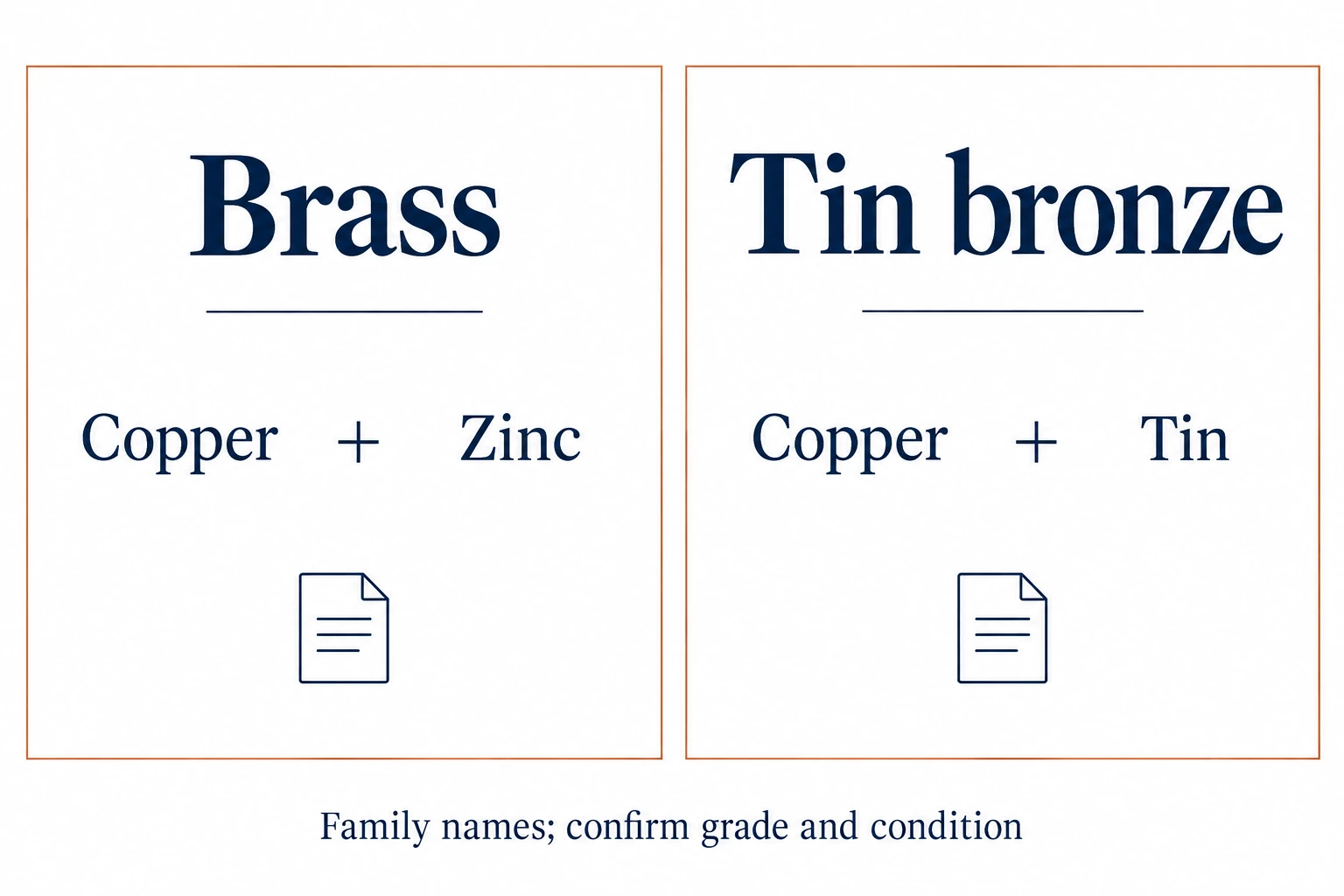
For example, a producer may list phosphor bronze and aluminum bronze under different grade designations. Calling both “bronze” leaves important material information unresolved. Likewise, a brass designation can include additional alloying elements that need to be considered in the actual specification.
| Family example | Basic description | Grade example in the cited listings |
|---|---|---|
| Brass | Copper–zinc family | C26000 cartridge brass |
| Tin bronze | Copper–tin family; additions depend on grade | C51000 phosphor bronze |
These examples identify two documented materials. They do not describe every brass or bronze, and they do not establish which alloy appears in a particular company’s product. The warm metal colors in the cover illustration provide visual context; a photograph cannot verify a grade.
Grade and temper answer different questions
A grade identifies the specified alloy. Temper identifies a material condition. Product form and size add further context to a property table. Preserve all of them when comparing a supplier’s data with a requirement.
Wieland Concast’s C26000 listing provides a useful reading example. For rod under 1/2 inch in diameter, its published minimum tensile strength is 50 ksi in H01 quarter-hard temper and 70 ksi in H04 hard temper.
| Listed material and form | Temper | Published minimum tensile strength |
|---|---|---|
| C26000 rod, under 1/2-inch diameter | H01 quarter hard | 50 ksi |
| C26000 rod, under 1/2-inch diameter | H04 hard | 70 ksi |
The alloy grade remains the same while the listed condition changes. The example shows why a property comparison needs more than the word “brass.” These are source-specific minimum tensile values for the stated form and size range, rather than universal brass properties or design allowables.
Tensile strength and hardness are different characteristics. A tensile row should keep its own name and units when copied into a comparison. Replacing the label with “hardness” would change what the source actually reports.
The C51000 listing separately describes a copper, tin and phosphorus alloy and identifies its available temper contexts. Compare the relevant data for that grade and offered form. Moving a value from a different product form into the comparison can leave the apparent precision unsupported.
Make selection trade-offs against the actual requirement
Begin with what the part needs to do. A material comparison may involve mechanical behavior, electrical behavior, forming, machining, joining or exposure conditions. Identify which characteristics matter and request evidence for the exact candidate materials.
For a mechanical comparison, preserve the property name, material condition, form and stated evaluation context. Ask whether a reported value is a minimum, a typical value or another type of entry. Those descriptions affect how the information can be used.
For an electrical comparison, request grade-specific data with its units and conditions. The broad family label alone does not answer the question. Keep any surface finish or finished-part requirement visible as a separate part of the discussion.
For manufacturing, describe the intended operation and offered material condition. A general statement that an alloy is suitable for forming leaves the actual operation and part geometry to resolve. Ask for the evidence relevant to that proposed use.
For exposure and service context, define the conditions being evaluated. A general corrosion-resistance description provides background, while a material decision needs the evidence applicable to the actual environment and part.
Turn an incomplete material request into a reviewable one
Consider a hypothetical drawing note that says only “brass.” A supplier proposes C26000, but leaves its temper and supplied form unclear. The next useful request is the complete material designation, condition, form and applicable specification.
If another supplier proposes a bronze grade, compare both candidates against the same requirement set. Record the property sources and unresolved questions. An overall family preference cannot fill missing evidence for a specific characteristic.
A useful materials handoff therefore includes the exact grade, temper or condition, product form, relevant dimensions and the requirements to evaluate. Attach the applicable documents and preserve their versions. That gives the responsible technical reviewer a defined comparison rather than an unsupported bronze-versus-brass winner.
References
- Copper–zinc alloy guidance — brass family and additions.
- Copper–tin alloy guidance — tin bronze terminology and forms.
- C26000 producer listing — the stated rod and temper example.
- C51000 producer listing — phosphor bronze grade context.