

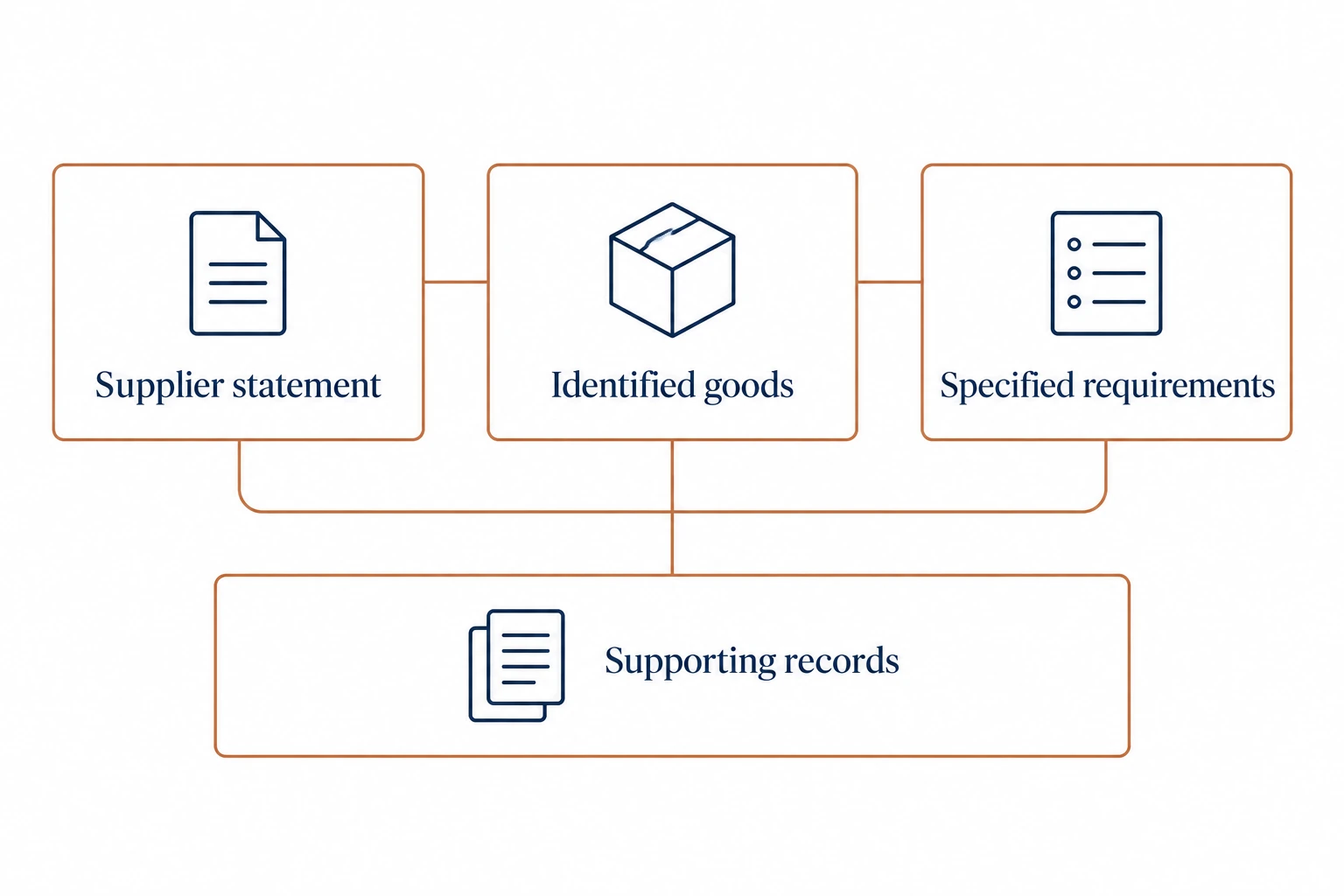
A certificate of conformance commonly records a supplier’s or manufacturer’s declaration that identified goods meet specified requirements. Buyers often shorten the name to CoC. The useful questions are what the document declares, who issued it, which goods it covers and which requirements it references.
The title alone does not establish that an independent body evaluated the product, that every item was tested or that a shipment meets every requirement relevant to its use. Read the statement and its scope before deciding what evidence the document provides.
What a certificate of conformance tells a buyer
In the industrial buyer context described here, the document connects an issuer’s declaration to a product and a requirement set. A manufacturing-company explanation from ARRK uses that declaration-based meaning. Document terminology can vary across industries and purchasing arrangements, so inspect the actual wording rather than relying on an acronym.
NIST distinguishes supplier declarations, testing, inspection and certification as separate conformity-assessment activities. It also distinguishes the roles of the supplier, purchaser and an independent third party. Those distinctions help explain why different documents in the same supplier pack may provide different kinds of evidence.
A test report describes the evaluation and results within its stated scope. A supplier declaration states what the issuer declares. A certification document needs its own issuer and scope review. Do not infer that the word “certificate” makes all three equivalent.
A practical certificate of conformance checklist
The following original checklist is a document-reading aid. It does not prescribe a legally complete certificate format or determine whether a particular purchasing arrangement permits acceptance on a declaration. Use it to identify the questions that need resolution.
| Check | What to connect | Question to ask |
|---|---|---|
| Issuer | Name and role on the declaration | Who makes the statement, and how does that entity relate to the supplier? |
| Product identity | Model, part and applicable revision | Does the document identify the item ordered? |
| Order or batch | Purchase and shipment references where applicable | Which delivered goods does the declaration cover? |
| Requirements | Referenced specifications and versions | Which requirements are actually being declared? |
| Statement and date | Scope, qualifications and issue information | What does the issuer state, and what limitations appear? |
| Supporting records | Reports or other evidence referenced | Do the records concern the same item and scope? |
Begin by matching identities across the quotation, order and declaration. A different company name may have an explanation, but the reader needs that explanation. Do not assume that a distributor, manufacturer and testing organization are the same entity because their documents arrived in one email.
Next, read the requirement references carefully. “Meets specifications” is difficult to interpret when no applicable specification is identified. Ask which document and revision the statement concerns. A precise reference makes a later comparison possible; a generic assurance leaves the requirement unresolved.
Then check the scope of supporting evidence. A report for an identified sample may support a particular question without covering every unit in a later shipment. Keep the report’s item identity, conditions and stated scope attached when discussing its relevance.
Example: the declaration and order do not match
Consider a hypothetical order for a product revision C. The supplier provides a declaration naming revision B, while the packing list uses the ordered revision C. The documents do not yet form a clear account of what was supplied and what the declaration covers.
A useful follow-up names the discrepancy directly: ask which revision was shipped, why the declaration names another revision and which declaration or explanation applies to the delivered goods. Keep the supplier’s response with the original records so the change remains understandable.
The mismatch does not, by itself, prove that the product failed a requirement. It does mean the document cannot simply be assumed to cover the order. Avoid solving the problem by editing the supplier’s statement yourself or treating a verbal reassurance as though it were a corrected record.
If a revised document arrives, compare what changed. Check whether it resolves the identity and scope question or merely updates the heading. A corrected title with an unchanged product reference can leave the original issue in place.
Do not decide from the document name alone
Certificates of conformance can appear alongside documents called declarations of conformity or certificates of compliance. The names are a starting point for reading, not a universal rule about who issued them or which obligations they satisfy. Examine the issuer, content and applicable purchasing requirements.
Likewise, a supplier’s general quality-system background does not establish the scope of a product-specific declaration. A quality page can help orient a conversation, while the actual order still needs the evidence and decisions applicable to it.
For AC or PV surge protective devices, begin with the exact model and the documents relevant to the purchase. The site’s quality-control background is separate from a declaration for particular goods. Do not infer a model’s ratings or approvals from a generic document title.
A productive review ends with clear links: an identifiable issuer, the correct goods, defined requirements and relevant supporting records. When a link is missing, record the specific question and obtain the applicable explanation before treating the document as evidence for that point.
References
- NIST: Conformity assessment basics — activity types and issuer roles.
- Manufacturing document terminology example — supplier-declaration usage; broader terminology claims are not adopted as universal rules.