

Common resistor values are usually organized into preferred-number series such as E12, E24 and E96. The numbers identify how many nominal values occur within a decade, a range that scales by a factor of ten. A table is a nominal-value reference, not a complete specification for a physical resistor.
Use it to find a preferred number and apply the correct multiplier. Then verify the actual part’s tolerance and other required characteristics from its specification. A familiar resistance value alone does not establish that two components are interchangeable.
Common resistor values in E12 and E24
The following table shows a complete decade of E12 and E24 nominal values from 10 Ω up to, but not including, 100 Ω. Each row places an E12 value beside two successive E24 values. Read both E24 columns across each row, then continue downward.
| E12 value, Ω | E24 value, Ω | Next E24 value, Ω |
|---|---|---|
| 10 | 10 | 11 |
| 12 | 12 | 13 |
| 15 | 15 | 16 |
| 18 | 18 | 20 |
| 22 | 22 | 24 |
| 27 | 27 | 30 |
| 33 | 33 | 36 |
| 39 | 39 | 43 |
| 47 | 47 | 51 |
| 56 | 56 | 62 |
| 68 | 68 | 75 |
| 82 | 82 | 91 |
These are preferred nominal numbers, not a list of the most frequently purchased parts. Availability depends on the actual product series and supplier. The reference does not establish that every number is offered in every package or tolerance.
How to read an E96 table
E96 provides 96 preferred values per decade. The table below is only its first 16 entries in the same resistance decade. The linked manufacturer reference contains the complete table; this excerpt is deliberately labeled so it cannot be mistaken for the whole series.
| E96 excerpt — nominal values in Ω | |||
|---|---|---|---|
| 10.0 | 10.2 | 10.5 | 10.7 |
| 11.0 | 11.3 | 11.5 | 11.8 |
| 12.1 | 12.4 | 12.7 | 13.0 |
| 13.3 | 13.7 | 14.0 | 14.3 |
Use the published rounded entries for a lookup. If a requirement calls for an exact listed nominal value, copying that entry is clearer than recreating the sequence and introducing a different rounded number. Keep the series and decade visible while transferring values into a comparison sheet.
The source is Vishay document 31001, revised October 4, 2006. It is a preferred-value reference, not a current stock report or a new edition of a standard. Its tolerance headings provide context for the table, but the tolerance of an offered component still needs its own specification.
Scale a preferred number by powers of ten
The same preferred number can appear in different resistance decades. For example, 22 Ω multiplied by ten becomes 220 Ω. Another multiplication gives 2,200 Ω, normally written 2.2 kΩ. One more gives 22,000 Ω, or 22 kΩ.
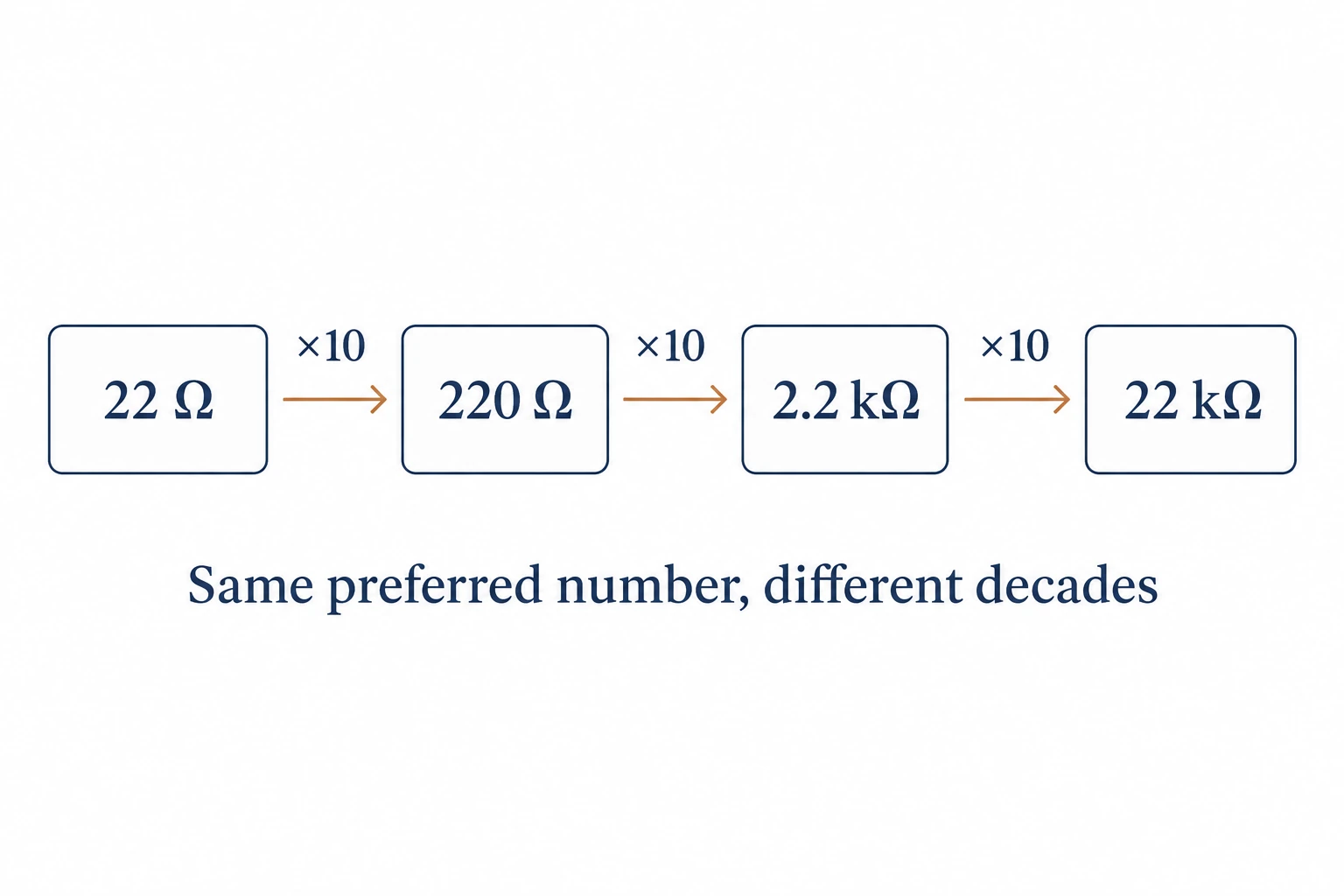
The unit is part of the value. Writing “22” without Ω, kΩ or another explicit multiplier leaves a reader unable to reconstruct the intended resistance. Preserve the unit when moving a number from a drawing to a quotation or bill of materials.
A useful transcription check is to express the value in ohms as well as its compact form. Thus 2.2 kΩ equals 2,200 Ω. The two expressions should describe the same number. This simple arithmetic check can reveal a misplaced decimal or lost prefix before a supplier comparison begins.
Nominal value and tolerance are separate information
Consider a hypothetical specification that explicitly calls for 2.2 kΩ with a tolerance of ±5%. The tolerance is given for this example; it has not been inferred from the preferred-number series.
Five percent of 2,200 Ω is 110 Ω. Subtracting and adding that amount gives an arithmetic interval of 2,090 Ω to 2,310 Ω. This calculation illustrates the stated tolerance around the nominal value. It is not a measurement result for any resistor in the cover image.
Do not reverse that reasoning by looking at a nominal number and assuming its tolerance. The same nominal resistance can appear in different offered components. Ask for the actual part designation and the applicable specification rather than filling an unanswered field from a familiar table heading.
What to include in a resistor request
A clear request identifies the nominal resistance with units, the required tolerance and the exact part or documented component requirements. Keep unresolved characteristics visible for the responsible technical review. “Common value” is not an approval to substitute a different component.
If a supplier proposes an alternative, compare the actual specifications and the intended requirement. The preferred-value table answers the nominal-number question. It does not settle suitability, package compatibility or the other conditions relevant to a design.
This page is an electronics reference. It does not establish which resistors appear in a Wanze surge protective device or offer discrete resistors as a company product line.
References
Vishay: Standard Electronic Decade Value Tables, document 31001 — complete manufacturer table and stated revision.