
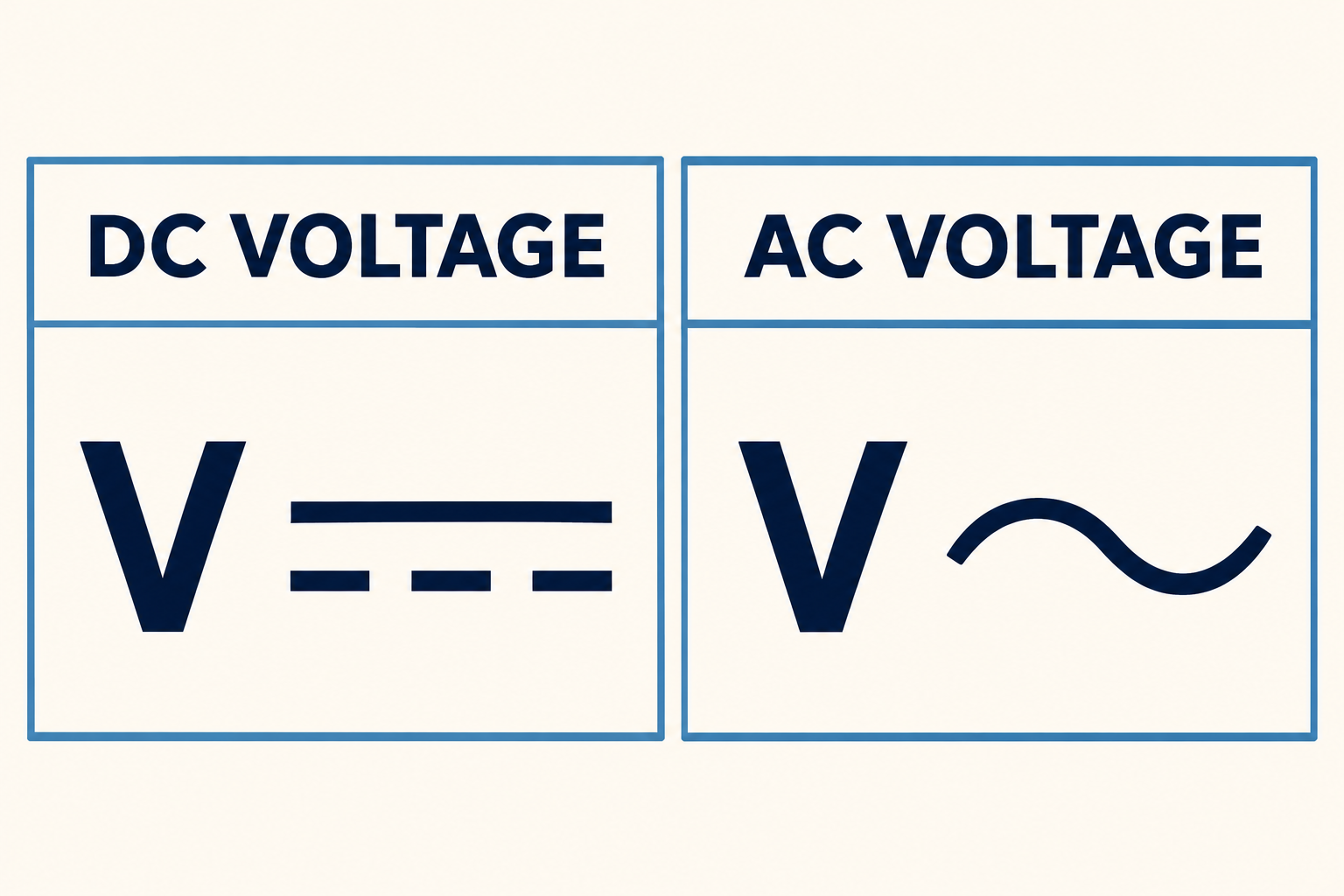
The DC voltage symbol is V beside a straight line above a broken line, commonly written V⎓. The straight-and-dashed sign identifies direct current or direct voltage context; V identifies the quantity as voltage. The AC voltage symbol, V~, uses a wave instead.
These markings help a reader identify a function on a diagram, instrument or equipment label. They do not, by themselves, establish an appropriate measurement setup or a component’s suitability for a circuit.
Read the DC voltage symbol beside the quantity
Look at both parts of the marking. The letter V means volts. The adjacent sign has one continuous horizontal line above short separated dashes. Together they identify DC voltage. Typography and the position of the sign can vary between printed manuals and instrument displays.
Written specifications may use VDC or DC V instead of the graphical sign. The job is the same: identify the electrical quantity and the stated supply or measurement context. A symbol on an input label should be read as an input marking; one on a display can identify a selected measurement function.
The distinction between a label and a display matters. A screen icon is information about the instrument’s function, rather than a complete description of the circuit connected to it.
The AC voltage symbol uses a wave
The wave beside V identifies AC voltage. Written alternatives include VAC and AC V. The symbol distinguishes alternating from direct context; it is not a full waveform specification.
A wave icon does not state the frequency, waveform quality or every condition under which a meter provides a valid reading. Likewise, the DC sign should not be read as proof that an actual supply has no ripple. Those details require the relevant source and instrument specifications.
When a manual shows several function symbols together, check whether it describes one model or illustrates a family of instruments. A composite educational drawing is not evidence that every feature exists on a particular meter.
V and A answer different questions
V denotes voltage; A denotes current. AC and DC markings can accompany either quantity. Recognizing the wave or straight-and-dashed sign is therefore only part of reading a function label.
A specification written in amps does not become a voltage rating because it also says DC. Similarly, a millivolt label still describes voltage, with a different unit prefix. Keep the quantity, unit and AC/DC context together when transcribing a nameplate or preparing a technical enquiry.
This article explains the vocabulary. It does not provide probe placement, terminal selection or an energized test sequence. Those tasks require the exact instrument documentation and the appropriate technical competence.
A label is not a complete measurement setup
Consider a hypothetical document review: a photograph shows V⎓ on a display, while a separate equipment sheet describes an AC input. That difference is a reason to clarify what the photograph represents. It is not enough information to diagnose the equipment or tell someone to move a test lead.
The reviewer can first identify the instrument model and the source of the photograph. Next, compare the documented function with the quantity the test record was intended to report. The question is whether the evidence answers the specified measurement task.
A complete record also needs the relevant equipment and instrument conditions. A familiar symbol cannot substitute for those conditions. Avoid extracting operating limits from a generic symbol chart or from a manual for another model.
Older manuals can illustrate established symbol vocabulary, but their product ratings and cited standards remain tied to that document. The historical manual referenced below is used for its symbol explanation only; its specifications are not presented as current general requirements.
Keep AC and PV equipment documentation separate
AC and DC markings also help organize component enquiries. For solar PV surge protection devices, the relevant model documentation must address the actual PV application. An AC product with a similar housing is not established as suitable by appearance.
The symbol is an entry point to that review. System type, operating conditions and the offered model’s specifications still need to agree. No single DC symbol proves that a device is suitable for every DC circuit, battery system or installation.