

A DIN rail surge protector is a modular SPD mounted in a control or distribution cabinet. The DIN rail solves the mounting problem, but it does not by itself establish the circuit, topology, voltage, environment, or compatibility required for a safe selection.
Buyers should therefore treat “DIN rail” as one field in a larger specification. Start with the protected path and the cabinet constraints, then compare the current product documents.
DIN rail surge protector context
In a procurement request, “DIN rail” should describe the cabinet mounting context. It should not replace the electrical fields that define the protected path. Name the rail, cabinet, circuit, and device documentation as separate parts of the request.
This distinction matters when several modular devices share a cabinet. Similar housings can still have different operating values, protection modes, accessories, and documentation requirements.
What DIN rail changes—and what it does not
| Question | DIN-rail answer | Still requires separate review |
|---|---|---|
| Mounting | The device is intended for a rail-mounted cabinet context. | Rail geometry, clearances, terminal arrangement, and enclosure space. |
| Electrical path | Not identified by the rail format. | AC system voltage, phase arrangement, grounding, topology, and upstream protection. |
| Environment | Cabinet integration can organize the device. | Temperature, moisture, contamination, vibration, and enclosure requirements. |
| Procurement | Modular packaging can simplify a cabinet bill of materials. | Current datasheet, installation manual, accessories, and project approval. |
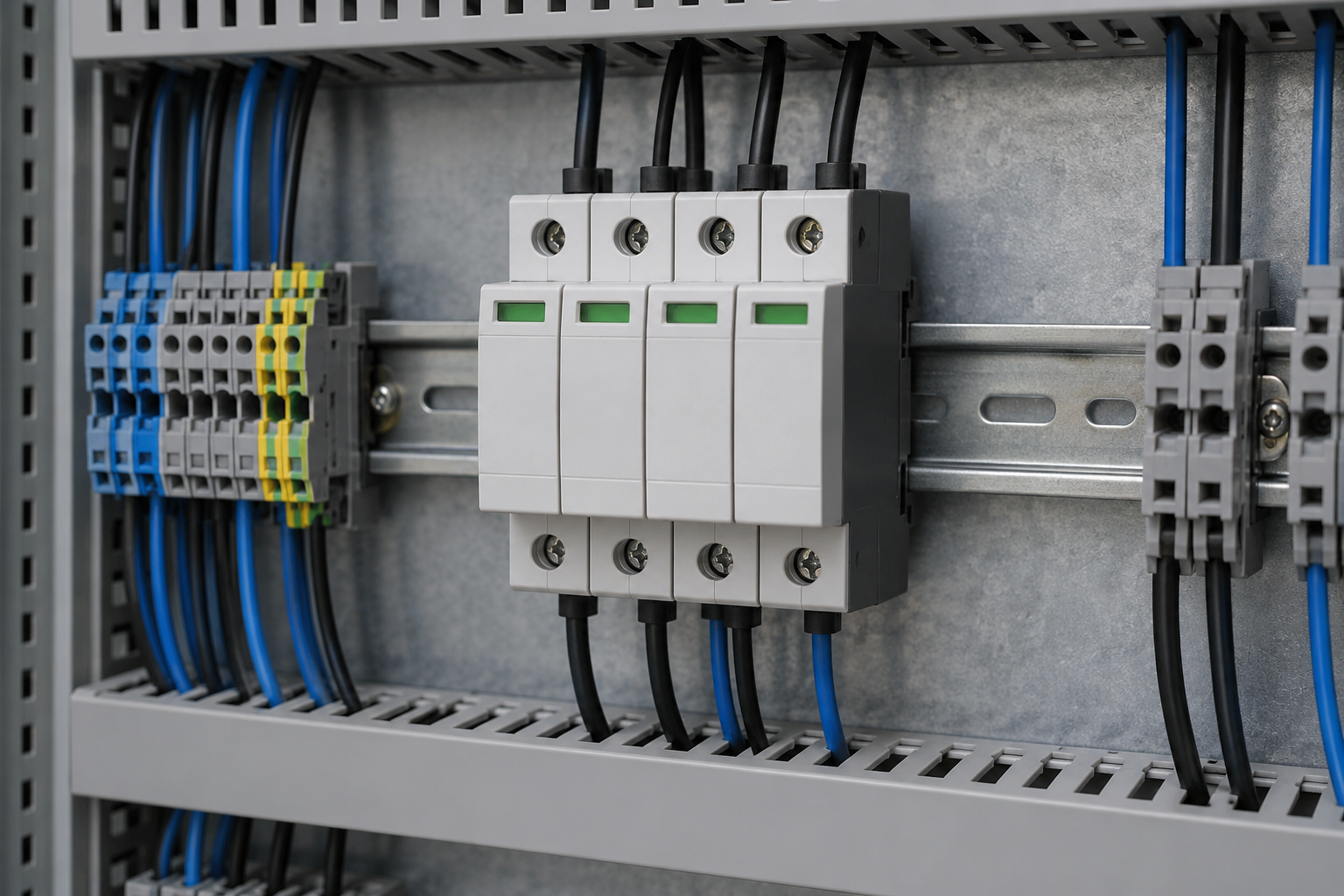
Selection factors for a DIN-rail SPD
- Identify the protected circuit, system voltage, phase arrangement, grounding, and topology.
- Measure the available cabinet space and record rail, terminal, conductor, and enclosure constraints.
- Compare the current product datasheet for continuous operating values, discharge ratings, protection modes, and indication features.
- Review conductor routing, bonding, upstream protection, environmental conditions, and service access.
- Ask a qualified designer or integrator to confirm that the selected module and accessories belong in the project documentation.
For AC family discovery, see the Wanze AC surge protection device category. It does not prove a particular DIN-rail module fits a project.
Before a buyer compares price or footprint, the request should include the panel drawing, available rail space, conductor entry, ambient conditions, and the current product document. That record keeps a mounting-format search connected to the actual protection task.
It is also useful to state whether the cabinet is a new build, a retrofit, or a replacement project. A retrofit may have limited terminal access or an existing upstream device that changes the review. A new build may allow the designer to coordinate the rail layout, conductor route, enclosure, and maintenance access from the start.
Do not treat a familiar module silhouette as evidence of interchangeable ratings. Compare the exact model, accessories, terminal arrangement, status indication, and installation instructions. Keep the approved drawing and the selected document revision together so a later buyer does not substitute a visually similar part without review.
FAQ
Does DIN rail mean every modular SPD is interchangeable?
No. The rail is a mounting context. Electrical ratings, topology, terminal arrangement, accessories, enclosure, and manufacturer documentation still control fit.
Are DIN-rail SPDs only for industrial cabinets?
They are commonly considered in control and distribution cabinets, but the application depends on the system and enclosure. Use the project documentation rather than the mounting format alone.
What should a buyer request?
Request the current datasheet, installation instructions, dimensional information, accessories list, and the system inputs used for the selection.