
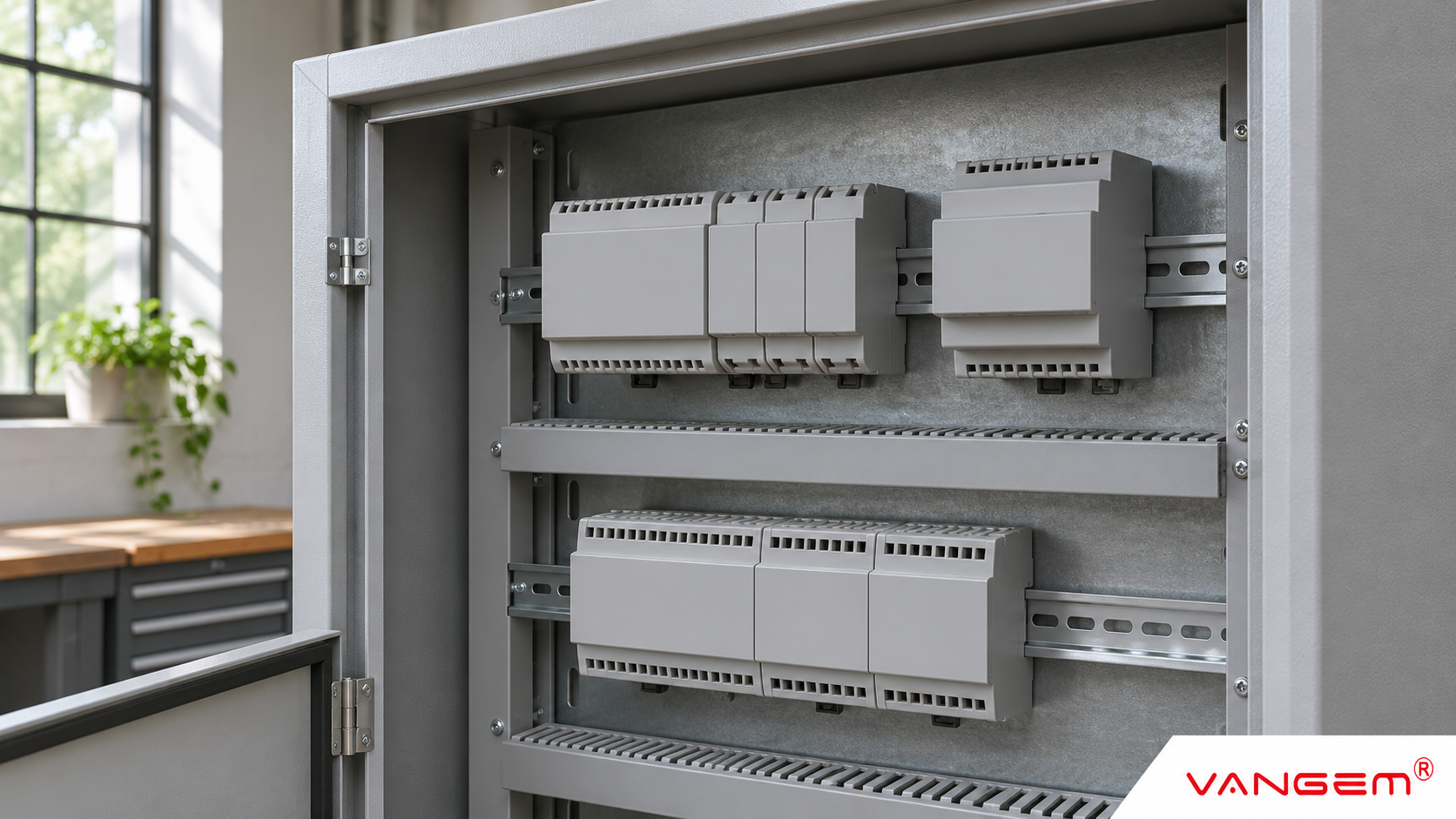
An IP20 rating describes an enclosure’s protection against access and solid objects under defined conditions, with no rated protection against water ingress. The first digit, 2, concerns access and solid-object protection. The second digit, 0, does not claim a water-protection level. IP20 therefore does not mean waterproof, dust-tight or suitable for every indoor location.
For equipment selection, the next question is which enclosure carries that rating. A component housing, a surrounding cabinet and an installed assembly are different objects to evaluate.
What does IP20 mean?
IEC 60529 classifies degrees of protection provided by enclosures. Its two characteristic numerals address different conditions. Reading them separately prevents a protection claim in one category from being extended to another.
| Part of IP20 | What it describes | What it does not establish |
|---|---|---|
| First numeral: 2 | A defined level of protection concerning access to hazardous parts and ingress of solid objects. | A dust-tight housing or unrestricted permission to touch internal equipment. |
| Second numeral: 0 | No rated protection against water ingress. | Resistance to rain, splashing, jets or immersion. |
IP20 is commonly discussed as finger-access protection. That is a description of a defined assessment, rather than a claim that every opening, terminal or part of an installation can be touched. Exact test probes, forces and acceptance criteria belong to the applicable standard and product documentation.
The classification also has a defined object and configuration. A short specification entry should lead back to the manufacturer’s description of the housing, mounting arrangement and relevant limitations.
What IP20 leaves unproven
The zero in IP20 is the important limitation when water exposure is possible. An indoor location can still raise questions about splashing, cleaning or moisture. Its address does not turn an IP20 component into a water-protected device.
Dust-tight protection is also a different claim. A housing that limits access by larger objects should not be described as sealed against dust. Small particles and water are not covered simply because a person cannot easily reach an internal part.
An IP code is not a complete description of every environmental or electrical hazard. Enclosure ingress protection does not establish protection against other conditions, including humidity and corrosive gases. The appropriate equipment review therefore considers the actual exposure, rather than using one IP label as a general statement of suitability.
Nor does the label establish the component’s surge rating, insulation performance or compatibility with a particular electrical system. Those questions require their own specifications.
An IP20 component and its cabinet have different boundaries
A component can sit inside a cabinet without sharing every property of that cabinet. The component’s IP20 field describes the component’s stated enclosure protection. A separate cabinet rating concerns the enclosure and configuration to which that claim applies.
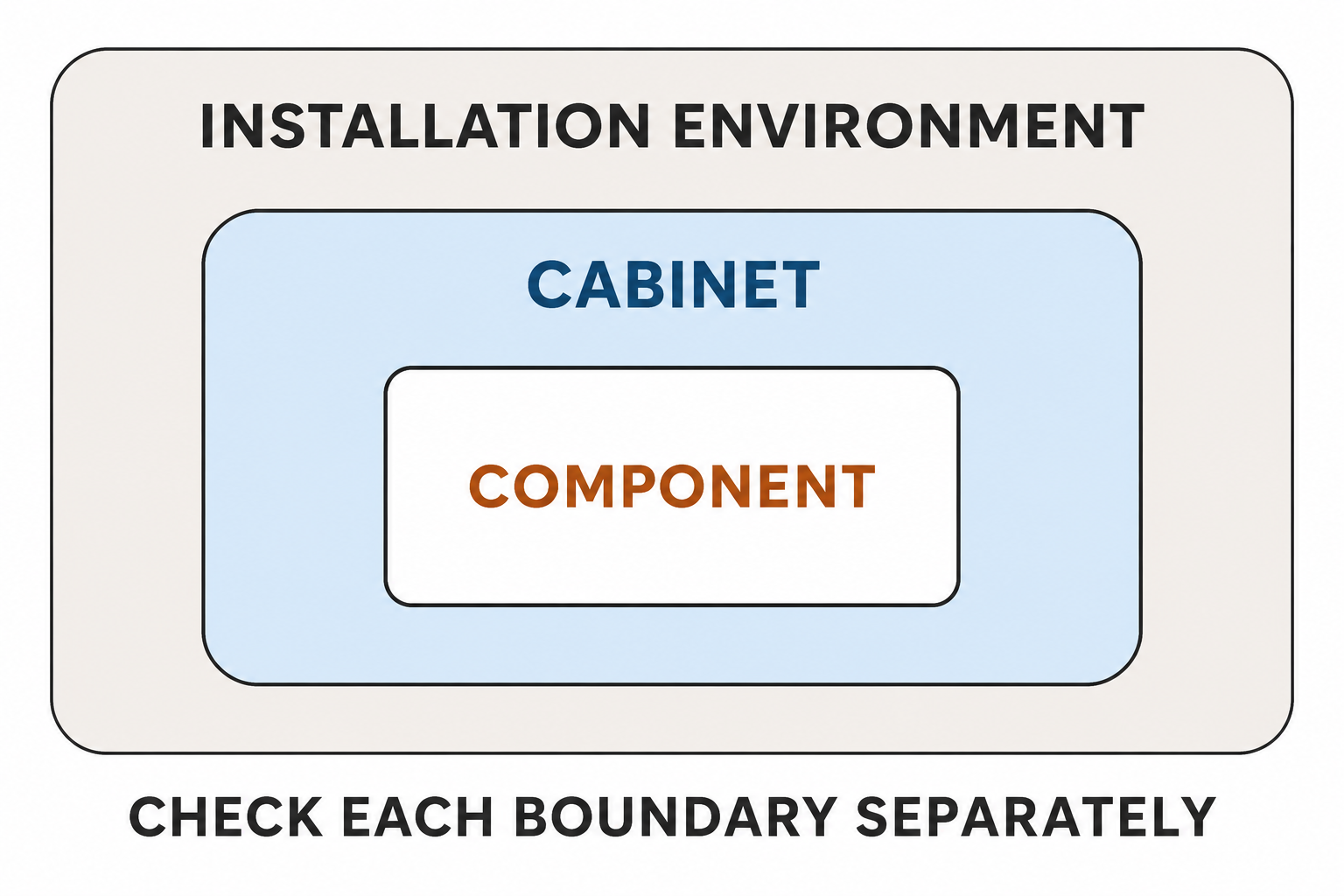
Some equipment is designed to rely on the enclosure into which it is mounted. Other products have different degrees of protection at different parts. The relevant documentation should identify the arrangement being described.
Suppose a supplier offers an IP20 module for a project that also specifies an external cabinet. The module entry alone does not answer whether the completed assembly satisfies the cabinet requirement. The cabinet entry alone does not establish every condition needed by the module. A useful submittal identifies both objects and the configuration assessed.
This distinction avoids an unnecessary argument about whether IP20 is universally “good enough.” The answer depends on the specified object, its location and the protection required there.
Three questions before selecting equipment
Which object carries the rating?
Identify whether the stated degree applies to a complete device, a housing, a particular face or the surrounding enclosure. Keep the model and configuration with the rating. A photograph of a similar-looking cabinet cannot establish that scope.
What exposure does the location present?
Describe the conditions the selection needs to address, including relevant water or dust exposure. “Indoor” is useful context, but it is less informative than a description of the actual environment and the protection requirement.
Which mounting conditions accompany the claim?
Request the manufacturer’s installation and enclosure documentation for the offered configuration. Where equipment contributes to an enclosure boundary, the completed arrangement needs its own assessment. The component label should not be used as a substitute.
These questions form a document-review sequence. They do not provide a field test, establish a US installation approval or authorize work on energized equipment. The project specification and responsible technical review determine the required equipment conditions.
Read an IP20 product field in context
The public Wanze N8UE2-40 Type 2 AC surge protection device page lists IP20. That field can help a buyer identify an enclosure-related condition to review alongside the model’s electrical specifications.
It should not be expanded into a claim that the product is waterproof or that a completed cabinet meets a particular protection degree. For a project enquiry, identify the installation environment and surrounding enclosure, then request the current model documentation relevant to that arrangement.
A complete selection record states the rated object and its limits. A lone “IP20” entry is a starting point for that record, rather than the whole decision.