

Made in PRC means made in the People’s Republic of China. In ordinary product-label language, it refers to China, just as “Made in China” does. PRC is the country’s abbreviated formal name. The wording identifies a stated origin; it does not tell you whether a particular item meets your specification.
For a buyer, the useful next question is therefore about the product and supplier behind the label. Which model is being offered? Who manufactured it? What requirements were agreed, and what records relate to the shipment? Those questions need evidence beyond the country name.
What does Made in PRC mean on a label?
The letters PRC stand for People’s Republic of China. The Asian Development Bank uses the full name and abbreviation together in its country profile. On a product or carton, the phrase “Made in PRC” is commonly understood as an origin statement referring to China.
You may also encounter “Made in P.R.C.” with punctuation. The periods separate the initials; they do not identify a different country or a separate quality category. Likewise, changing between the abbreviated and shorter country wording does not, by itself, describe a change in materials, manufacturing process or product design.
That answers the language question. Whether particular wording is acceptable for a specific shipment is a different matter. The product, destination and applicable marking requirements need separate consideration. A glossary definition cannot settle that decision, and an attractive label is not evidence that the decision has been checked.
Country of origin and quality answer different questions
Country wording describes where an item is stated to have been made. Product quality concerns how the actual item compares with requirements. A label does not contain the measurements, inspection observations or acceptance criteria needed for that comparison.
NIST’s inspection glossary describes examining an item and determining its conformity with requirements. The practical distinction is straightforward: knowing a country name does not establish that a particular shipment was inspected, or explain what any inspection covered.
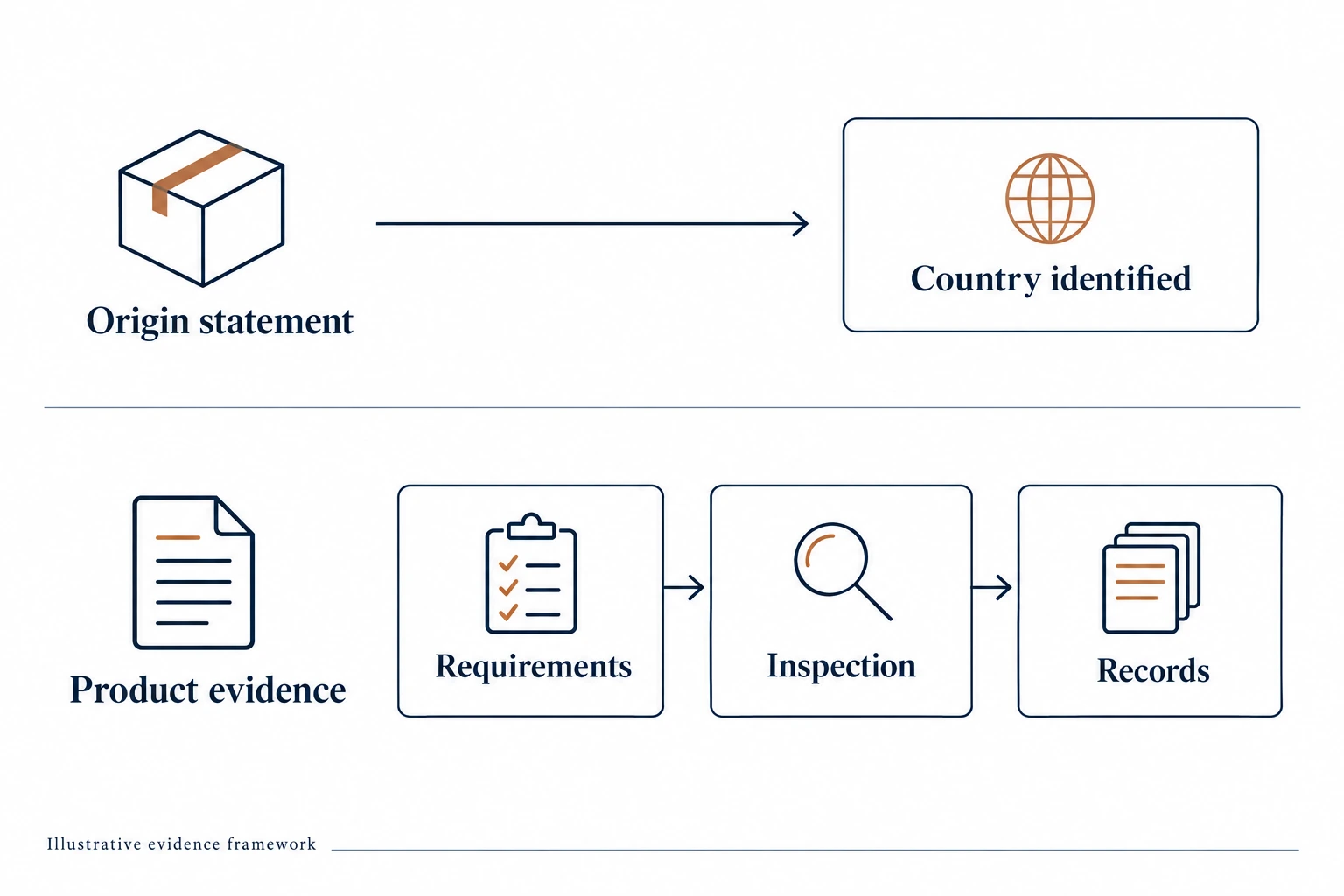
A country label also cannot establish the identity of the seller, the manufacturing site or the owner of a report. Treat these as separate fields in a supplier review. This avoids both assuming quality from an origin statement and dismissing a suitable product because of one.
Five questions to ask before placing an order
The following matrix is an original buyer aid, not a customs checklist or a record of a company audit. It helps turn a general origin question into specific requests. Adapt the requested evidence to the item and the purchase agreement.
| Question | Useful evidence to request | What to resolve |
|---|---|---|
| Who is supplying the item? | Supplier identity and stated manufacturer relationship | Names that differ across the quotation and records |
| Which product is offered? | Model, revision and current specification | Generic descriptions or unexplained substitutions |
| What was agreed? | Approved requirements and acceptance criteria | Units, conditions or requirements left undefined |
| What was evaluated? | Sample identity and relevant inspection or test records | Results that cannot be tied to the offered version |
| Which shipment is covered? | Batch identity and applicable release records | A report with no clear shipment connection |
Start with identity. A seller may be a manufacturer, distributor or another supply-chain participant. Ask the seller to explain its role rather than guessing from a website or packaging photograph. Record the response alongside the quotation so later documents can be compared with the same account of the supply arrangement.
Then align the product description. A broad category name is less useful than the exact model and revision being quoted. When the product changes, request an explanation of which drawings, specifications and evaluation records still apply. A previous sample photograph alone cannot answer that question.
Finally, connect the evidence to the order. A detailed report may be useful background, but its relevance still depends on the item, conditions and scope it covers. Ask for missing links explicitly. Do not fill them in because the document looks formal or carries a familiar logo.
How to handle a mismatch without guessing
Consider a hypothetical purchase: the quotation uses “Made in China,” while a sample carton says “Made in PRC.” Both phrases refer to the same country in ordinary usage. The wording difference alone does not explain whether the sample and quotation concern the same product version.
A sensible document check starts with the model, supplier identity and revision on both records. Ask why the wording differs and which label version is intended for the order. Keep the response with the documents. If a report names another model or entity, ask for the relationship and supporting explanation before treating it as evidence for your purchase.
This approach separates a straightforward abbreviation from a potentially significant record mismatch. It also prevents an unhelpful shortcut: assuming that matching country wording makes every other document consistent. The origin phrase may be clear while the batch connection remains unresolved.
The same reasoning applies when evaluating electrical products such as AC or PV surge protective devices. An origin label cannot supply model-specific performance ratings or approvals. Those details need their own applicable documents and review.
What to do with the information
If your question is simply “Which country is PRC?”, the answer is China: the abbreviation expands to People’s Republic of China. If you are deciding whether to buy, move from that definition to the evidence matrix above. Identify the supplier, fix the product version, agree the requirements and connect the records to the goods.
For a look at this site’s stated manufacturing background, see the quality-control page. That background is separate from the evidence needed for a particular order. When a destination-specific labeling question remains, obtain a current answer for that product and destination rather than relying on a general sourcing article.
References
- Asian Development Bank: People’s Republic of China country profile — formal country name and abbreviation.
- NIST: Inspection — inspection and requirements terminology.