

The difference between off grid and on grid solar is the utility connection: an on-grid system remains connected to the electricity network, while an off-grid system supplies an independent site. Backup is a separate question. A grid connection, solar panels or a battery alone does not establish what will keep operating during an outage.
For a commercial building, remote workshop or equipment site, compare the required service before comparing equipment packages. Is the goal daytime solar use, operation without a utility connection, or continued supply to specified loads when the utility fails? Those are different purchase requirements.
Off grid and on grid solar: compare connection and backup separately
An off-grid and on-grid solar system comparison needs two answers: where normal energy comes from, and what can supply the load when that source is unavailable.
| Question | On-grid solar | Off-grid solar |
|---|---|---|
| Utility connection | Remains connected to the electricity network. | No utility supply connection. |
| After solar production falls | The grid remains a supply option when available; storage depends on the package. | Supply depends on stored energy or other resources included in the design. |
| During a utility outage | Independent operation must be an explicitly supported system function. | A utility outage does not remove a supply the site never had; local supply still has limits. |
| What the label does not prove | Backup loads, duration or independent operation. | Unlimited energy, adequate power or continuous service. |
The DOE glossary defines off-grid generation by its lack of direct interconnection to an electrical grid. Whether a proposal supports independent supply is a separate design question. Neither definition establishes utility terms, export compensation or project approval.
Keep connection and backup as separate lines in a comparison sheet. Otherwise, two quotations can look equivalent even when one addresses normal daytime consumption and the other includes an independently supplied load group.
Trace the energy path in daylight, darkness and an outage
The useful comparison is not the number of boxes in a diagram. It is whether the proposed arrangement can supply the intended load under each operating condition.
During solar production
PV modules generate direct current, or DC. An inverter converts it to alternating current, or AC, for AC loads. The US Department of Energy explains that grid-following inverters use an external grid reference; equipment intended to establish an independent AC supply has a different control role. Do not infer that role from the presence of an inverter enclosure.
When sunlight is insufficient
Solar production changes with time and weather. Storage makes energy available at a different time from when it was generated. DOE distinguishes power capacity, commonly expressed in kilowatts, from energy capacity, commonly expressed in kilowatt-hours. One describes delivery rate; the other describes an energy quantity. Neither is a complete statement of the service a site will receive.
A useful proposal therefore names the loads to be served and the operating conditions assumed. Ask the supplier to identify which documents support those expectations. Comparing only panel capacity leaves the nighttime question unanswered.
When the utility is unavailable
DOE describes solar-plus-storage operation without grid support as conditional on system design. For an on-grid proposal, request the documented backup function and its supported load scope. For an off-grid proposal, request the assumptions behind local supply continuity. These are checks on a proposal, not instructions for creating an islanded electrical system.
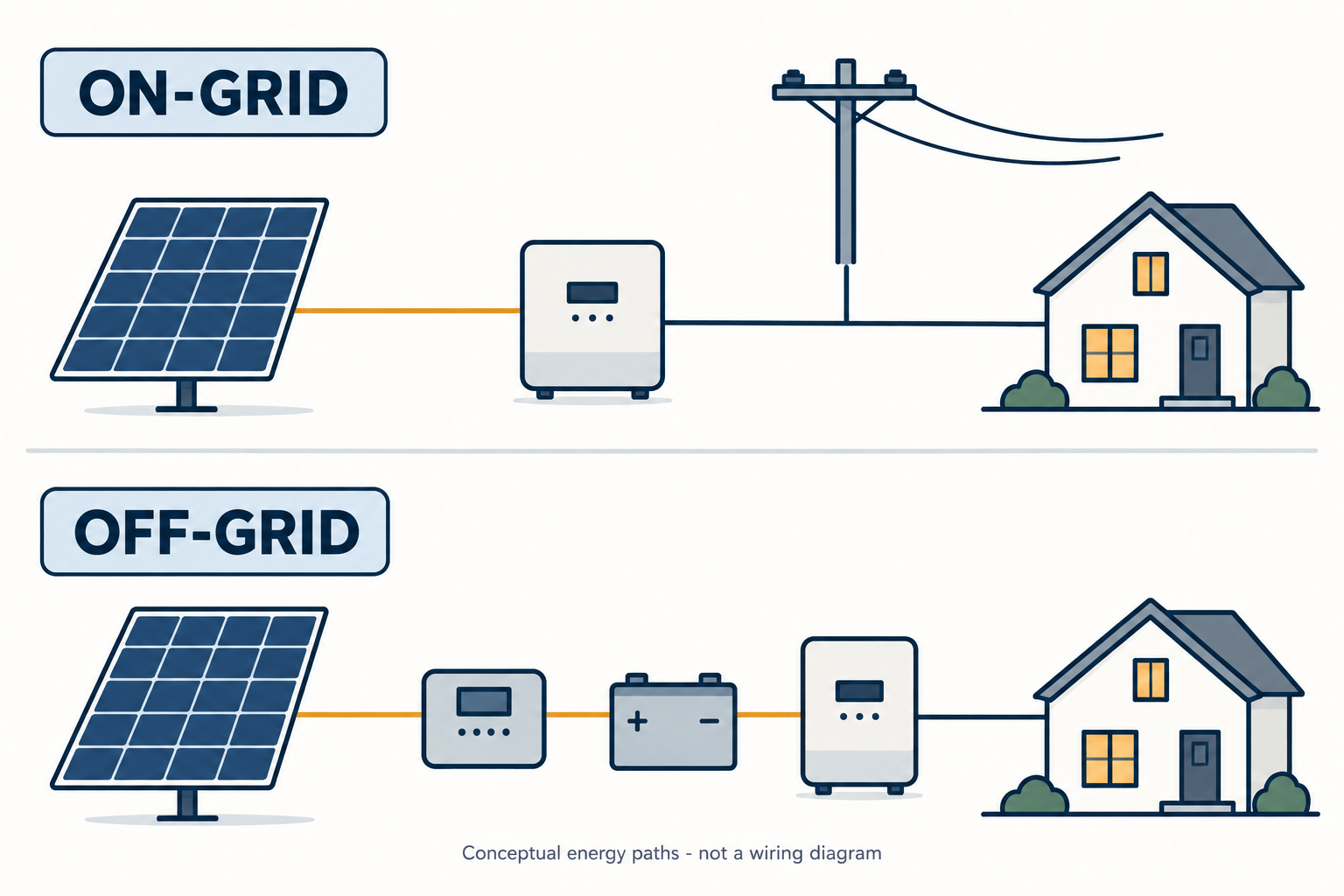
Choose by the service objective, not the system label
A practical shortlist starts with a written objective. The following comparison prompts help expose differences before a buyer treats two packages as substitutes.
- Daytime consumption at a connected building: Ask how the proposal uses solar energy while the grid is available. Record outage supply separately rather than assuming it is included.
- A site without utility supply: Ask which local resources support each operating period and what happens when the assumed solar resource is insufficient.
- Specified loads during a utility outage: Ask for the supported operating mode, named loads and documented limits. A general battery description is not that answer.
For each quotation, use the same comparison headings: utility connection, normal supply, insufficient-sunlight supply, outage function and supporting documents. Mark an unanswered field as unresolved instead of filling it with a favorable assumption. This makes the difference between a missing feature and an undocumented feature visible.
For example, a connected workshop seeking daytime solar use has not necessarily asked for independent overnight operation. A remote equipment building has a different service objective. Those are illustrative purchasing scenarios, not evidence that a particular equipment package will suit either site.
Once the service objective is clear, the engineering team can assess the actual configuration. A generic comparison cannot establish inverter compatibility, battery sizing or a complete system design.
Separate AC and PV surge protection from energy supply
Surge protection addresses a different problem from backup. An SPD limits transient overvoltages and diverts surge current; it does not store energy or create an independent AC reference. A transient-protection proposal should therefore sit beside the supply proposal, not stand in for it.
Wanze publishes separate categories for solar PV surge protection devices and AC surge protection devices. These give buyers distinct product-information starting points for PV DC circuits and AC distribution. They do not show that one model fits every connected or off-grid installation.
When comparing product documentation, identify the circuit being discussed and ask the project designer to state the applicable electrical conditions and acceptance criteria. Keep the proposed SPD model and its supporting documents attached to that circuit description. Do not use the overall label “off-grid” or “on-grid” as a substitute for those details.
The final comparison should leave three decisions visible: the utility relationship, the required supply service and the transient-protection scope. Keeping them separate makes proposals easier to compare without turning a solar-system name into a promise it cannot support.