

PFMEA means Process Failure Mode and Effects Analysis. It is a structured way to examine how a process could fail, what the consequences could be, why the failure could occur and which controls or actions address the concern.
The useful output is an understandable failure chain connected to evidence and follow-up. A completed-looking spreadsheet or a low-looking score cannot explain that chain on its own. Start with the process function and requirement before discussing how risk is prioritized.
PFMEA starts with a process and a requirement
A failure mode describes how a process function or requirement is not met. An effect describes a consequence. A cause describes why the failure could occur. Keeping those terms separate helps a team choose an action that addresses the concern it actually identified.
Quality-One’s process-FMEA explanation covers those relationships together with prevention controls, detection controls and action ownership. The following fictional packing example makes the vocabulary concrete without assigning any risk ratings.
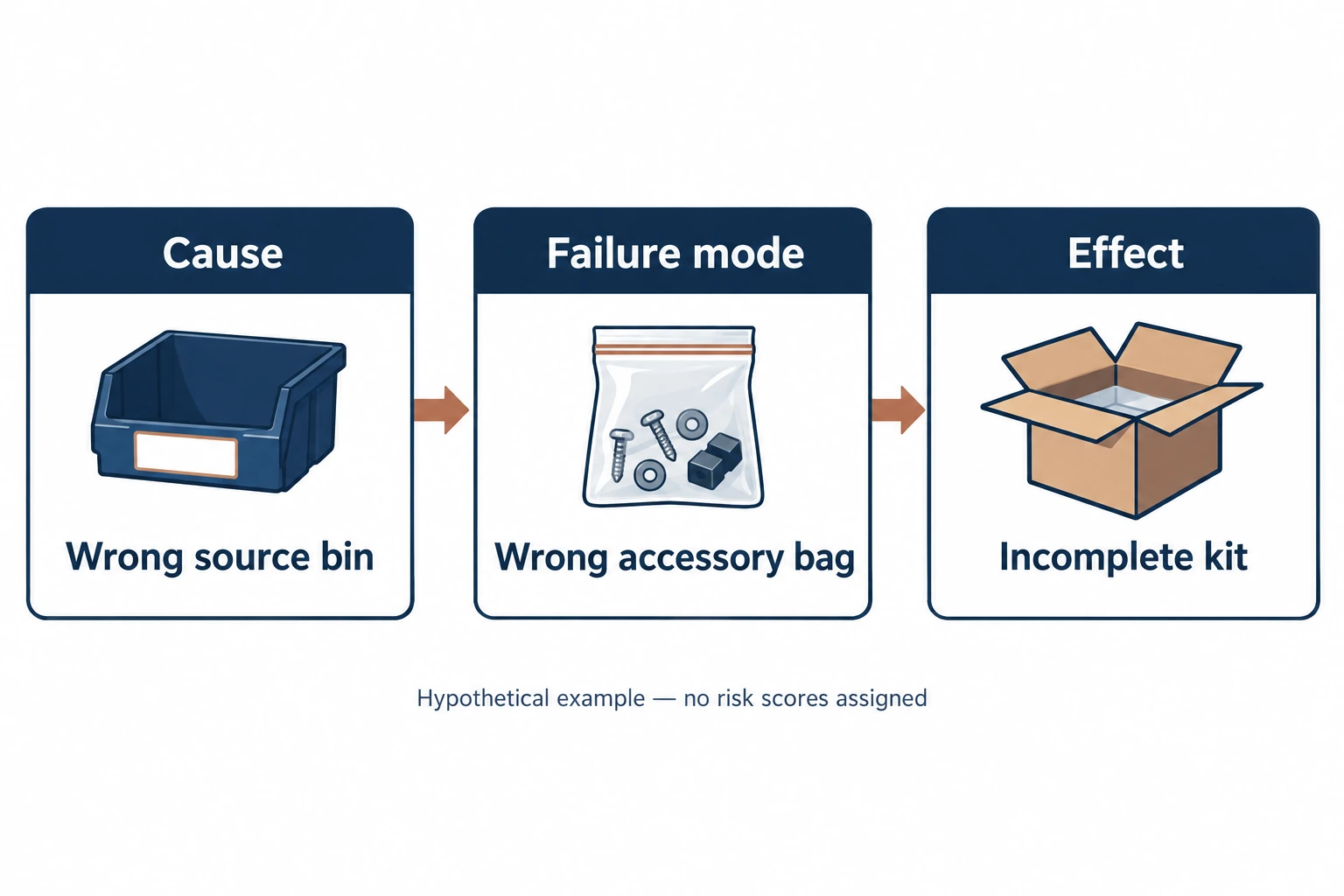
Suppose a kit-packing step is intended to include the accessory bag specified on its packing list. Choosing from the wrong source bin could result in the wrong bag being packed. The recipient could then receive a kit missing the required accessories.
“Wrong accessory bag” is the failure mode in this example. “Wrong source bin” is a possible cause to investigate. “Incomplete kit” describes an effect. Simply writing “packing problem” in every field would hide the distinctions that make the analysis useful.
Prevention and detection address different questions
A prevention control addresses the cause or its occurrence. A detection control checks for the cause or failure mode. Naming an inspection does not show that it prevents the underlying error, and naming a preventive idea does not establish that it works.
| Example concept | Question addressed | Evidence still needed |
|---|---|---|
| Defined source-bin setup | How could selection from the wrong bin be reduced? | Evaluation of the setup and its actual use |
| Bag comparison against the packing list | How could a wrong bag be detected? | Whether the check detects the relevant mismatch |
| Action assigned to an owner | Who develops or changes the control? | Implementation and effectiveness evidence |
These are ideas for a hypothetical discussion, not validated controls for a real packing line. A team would still need to understand the actual operation, existing controls and applicable requirements. That work cannot be replaced by copying the example into a company form.
The example also shows why vague causes are difficult to act on. “Operator error” leaves the mechanism unclear. A question about access to similar-looking source bins directs attention to a specific condition that can be investigated. Evidence may support that explanation or reveal a different cause.
RPN and Action Priority need a named method
PFMEA resources do not all use the same methodology. Some explain Risk Priority Numbers, or RPN. The 2019 Plexus/AIAG whitepaper about the AIAG-VDA approach describes Action Priority, or AP, replacing RPN within that approach.
The whitepaper discusses severity, occurrence and detection together when determining action priority. It also describes a seven-stage development structure, beginning with preparation and process understanding, then moving through failure and risk analysis, improvement and reporting of results.
That is an explanation of the identified methodology. It does not make a particular rating table mandatory for every business or show which customer requirements apply to an order. Before interpreting a supplier’s priority label, ask which method, edition and agreed criteria it uses.
No RPN, AP category or severity rating is assigned to the fictional kit example. Assigning one without the applicable criteria and process evidence would create false precision. The purpose here is to understand the relationships that a real analysis must make clear.
An action needs an owner and evidence of what changed
Consider a proposed action to improve the source-bin setup. Record the specific change being considered and the role responsible for it. Distinguish an idea awaiting review from a change that has been implemented. A scheduled completion date alone does not establish effectiveness.
When evidence becomes available, relate it to the concern. Does it show that the source-bin arrangement changed? Does it examine whether the intended control works under relevant conditions? Those are different questions, and the record should make clear which one the evidence answers.
Keep unresolved issues visible. If a team has implemented a comparison check but has not evaluated its ability to detect the relevant mismatch, that limitation remains part of the analysis. A more favorable rating cannot substitute for the missing evaluation.
Document changes in a way that another reader can follow. Identify the process and revision covered, the action taken, the supporting record and the remaining decision. This makes the analysis useful during later changes rather than leaving a table whose judgments no one can reconstruct.
How PFMEA relates to a control plan
A PFMEA explains process risks and the reasoning behind actions. A control plan describes the selected operational checks and reactions. Completed records provide evidence that those activities occurred. The documents can inform one another while retaining different purposes.
For a supplier discussion, ask for the scope and applicable version before interpreting a generic assurance that “PFMEA is complete.” Then trace a relevant concern through its cause, controls, actions and evidence. This article supplies vocabulary for that discussion; it does not perform a safety assessment or establish a product’s conformity.
References
- Process FMEA overview — process functions, failure chains and controls.
- Plexus/AIAG 2019 FMEA whitepaper — historical explanation of the AIAG-VDA structure and Action Priority approach.