

Product sourcing is the work of finding and obtaining products for a business. Retail guides commonly use the term for goods bought from suppliers and resold to customers. Industrial finished-product buyers face a related task: identify a suitable source, compare an actual offer and gather enough evidence for a defined first order.
The useful endpoint is a decision with a clear basis. Know which product was offered, what the quotation includes, what the sample represents and how a trial will be evaluated. Those details turn a promising search result into a reviewable sourcing option.
Product sourcing begins with discovery and supplier roles
Supplier websites, sourcing platforms, trade events and direct manufacturer contact can all introduce candidates. ShipBob’s retail-focused guide describes these routes alongside samples and trial evaluation. The appropriate route depends on the product and purchasing need.
For industrial goods, establish the supplier’s role early. Ask whether the organization manufactures the offered product, distributes it or arranges supply through another party. Record the stated manufacturer and offered model so later documents can be connected to the same item.
A discovery channel provides leads. Your comparison still needs the product requirements and evidence relevant to the purchase. A marketplace profile, trade-show conversation and direct quotation each supply different information; keep their sources visible as the candidate list develops.
Write a short sourcing brief before requesting detailed offers. Identify the intended product scope, required documents, expected ordering context and questions that need a response. This gives suppliers a common starting point and makes differences between their answers easier to interpret.
Put offers on the same comparison basis
Imagine two hypothetical quotations for apparently similar finished products. One includes identified packaging and documentation; the other leaves those items unspecified. The quoted unit prices would describe different scopes until the missing details are resolved.
A useful follow-up asks each supplier to confirm the same product version and included items. Keep proposed alternatives in a separate field so a different configuration remains visible. Then compare the responses against the common brief rather than silently treating all offers as equivalent.
| Decision gate | Evidence to align | Question that keeps the gate open |
|---|---|---|
| Candidate fit | Product scope and supplier role | Who supplies the exact offered item? |
| Quote comparability | Version, quantity basis and included scope | Are the offers answering the same request? |
| Sample relevance | Sample identity and evaluation scope | What does this sample represent? |
| Trial readiness | Defined order, criteria and review ownership | What outcome would justify the next step? |
NIST’s manufacturing supplier-selection guidance highlights capability, quality documentation and logistics as useful review topics. Bring those questions into the comparison where they affect the purchase. A technical match and a delivery assumption need their own evidence.
Keep missing information visible. A supplier may have answered the model question while leaving the documentation scope unresolved. Record the specific gap and the next request. An overall impression of a responsive supplier should not erase an unanswered requirement.
Make the sample answer a defined question
Identify the sample and the offered version it represents. Ask whether it uses the intended configuration and which supporting documents apply. If the sample differs from the proposed production item, record the difference before interpreting the evaluation.
Define what the sample review is intended to establish. Packaging fit, document clarity and a technical characteristic require different observations or evidence. Assign the relevant reviewers and preserve their scope. A positive result for one question leaves other questions to be evaluated separately.
A sample can also reveal how the supplier handles the transaction: whether the item identity remains clear, the requested records arrive and discrepancies receive useful answers. Record these observations as evidence from that interaction, with their limits intact.
Set trial-order criteria before the result arrives
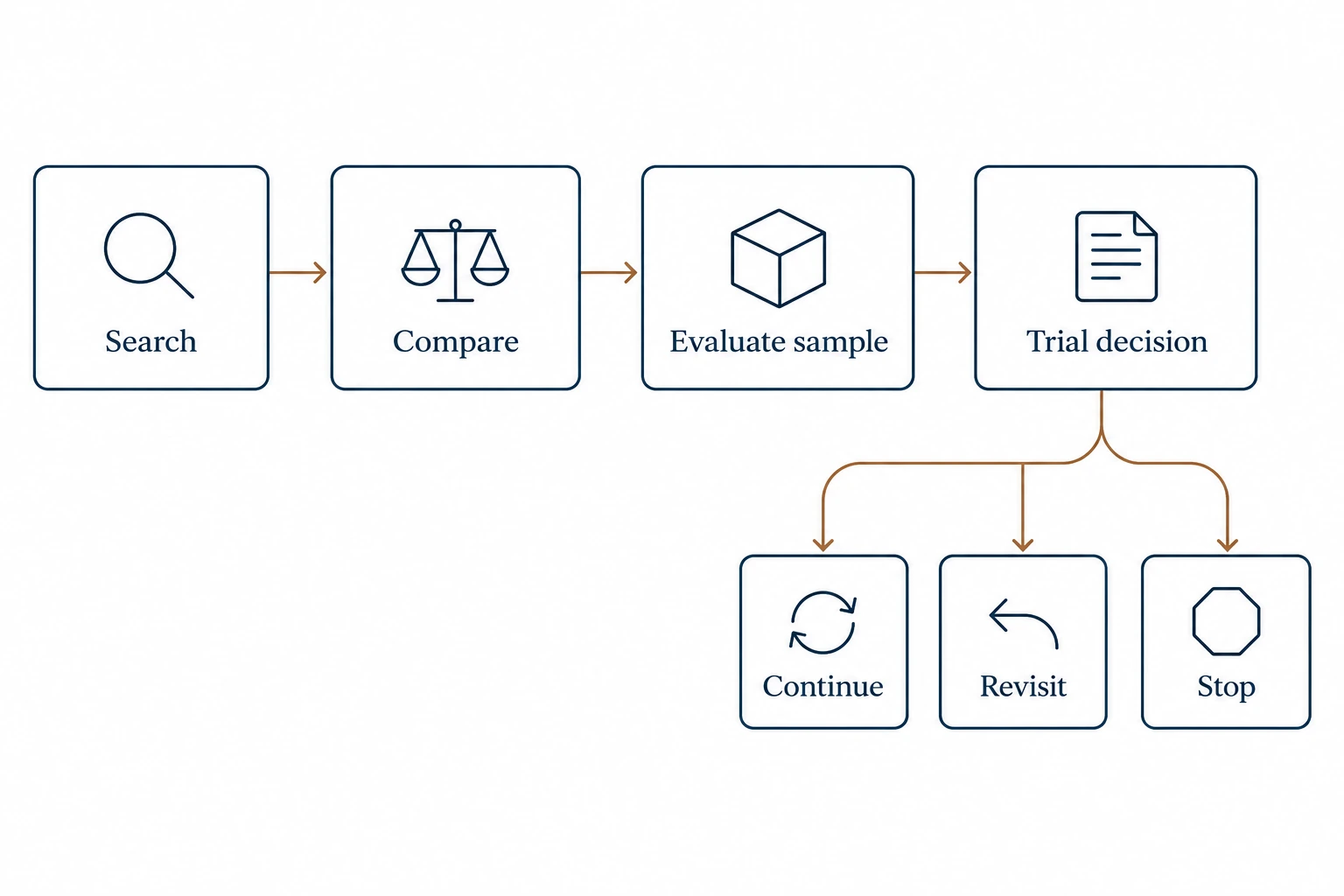
A comparable trial order starts with an identified product, agreed scope and documented review criteria. Decide who evaluates the goods and records, which questions the trial should answer and how discrepancies will be handled. Choose the actual trial size and timing for that purchase rather than borrowing a universal number.
Continue when the relevant criteria have been evaluated and the responsible reviewers have enough evidence for the proposed next step. Record the decision’s scope, including any conditions carried forward into a repeat order.
Revisit when a resolvable gap prevents a decision. For example, the delivered item may match the order while a supporting record identifies an unclear revision. Name the missing link and obtain the applicable explanation before expanding the commitment.
Stop when the offered product or supply arrangement cannot address an essential requirement, or when the team decides the unresolved evidence makes the proposed next step unsuitable. Preserve the reason so future searches do not restart the same incomplete comparison.
These are original decision questions for industrial finished-product sourcing, rather than results from an actual supplier trial. Use them to define an evidence-based review before placing the order.
For an AC surge-protection sourcing task, the AC surge protection device catalog is a route to identifying product families. Continue with the exact model, applicable documents and a common quotation basis. That keeps product discovery connected to a purchase the responsible team can assess.
References
- Product sourcing guide — retail meaning, discovery routes and trial context.
- NIST: Supplier selection guidance — manufacturing capability, records and logistics questions.