

A surge arrester and a low-voltage surge protective device share a protective purpose, but the terms should not be treated as universal synonyms. In current standards usage, “surge arrester” commonly belongs to the power-system domain above 1 kV, while “SPD” is the clearer term for low-voltage AC applications at 1,000 V and below.
That distinction is a specification boundary, not a claim that every project uses the words consistently. Legacy documents, local practice, and informal product names can overlap. Before selecting a device, confirm the system voltage, protected asset, installation location, and governing standard. The product name comes after those facts.
Why “surge arrester” and “SPD” still overlap
Both devices respond to transient overvoltage by providing a path for surge current and limiting the voltage imposed on equipment. A power-system surge arrester limits equipment voltage by discharging or bypassing surge current. A low-voltage SPD similarly limits transient voltage by diverting or limiting current. The functional resemblance explains why buyers sometimes use one term for the other.
Terminology also carries history. TVSS and “secondary surge arrester” were used in older low-voltage documents. In the cited US low-voltage context, those legacy designations were replaced by “surge protective device.” A replacement request copied from an old drawing may therefore say “secondary surge arrester” even when the required product is now classified as an SPD.
“Lightning arrester” creates another ambiguity. It may describe a power-system arrester in informal use, but the phrase does not state voltage class, system configuration, energy duty, or installation position. Lightning can be one source of transients, yet a low-voltage SPD may also address switching-related events. The event source alone does not identify the device family.
Compare the terms by system context
IEEE C62.11 uses “surge arrester” for metal-oxide arresters applied on AC power circuits above 1 kV. Low-voltage SPD terminology, by contrast, applies to the building and equipment distribution context described by the cited low-voltage sources. The table is a screening tool, not a substitute for the governing project specification.
| Decision point | Surge arrester context | Low-voltage SPD context |
|---|---|---|
| Voltage domain | IEEE C62.11 addresses metal-oxide surge arresters on AC power circuits above 1 kV. | Current US terminology uses SPD for low-voltage AC systems at 1,000 V and below. |
| Protected asset | Power-system apparatus and insulation in utility, substation, distribution, or industrial power applications. | Low-voltage distribution panels, equipment, controls, and downstream loads. |
| Typical selection context | System voltage class, arrester class, temporary overvoltage duty, insulation coordination, and power-system installation. | Nominal voltage, conductor and grounding arrangement, SPD type or class, protection level, installation point, and coordination. |
| Terminology clue | “Surge arrester” is a current standards term in its defined power-system scope. | TVSS and “secondary surge arrester” are legacy low-voltage terms; SPD is clearer for a current request. |
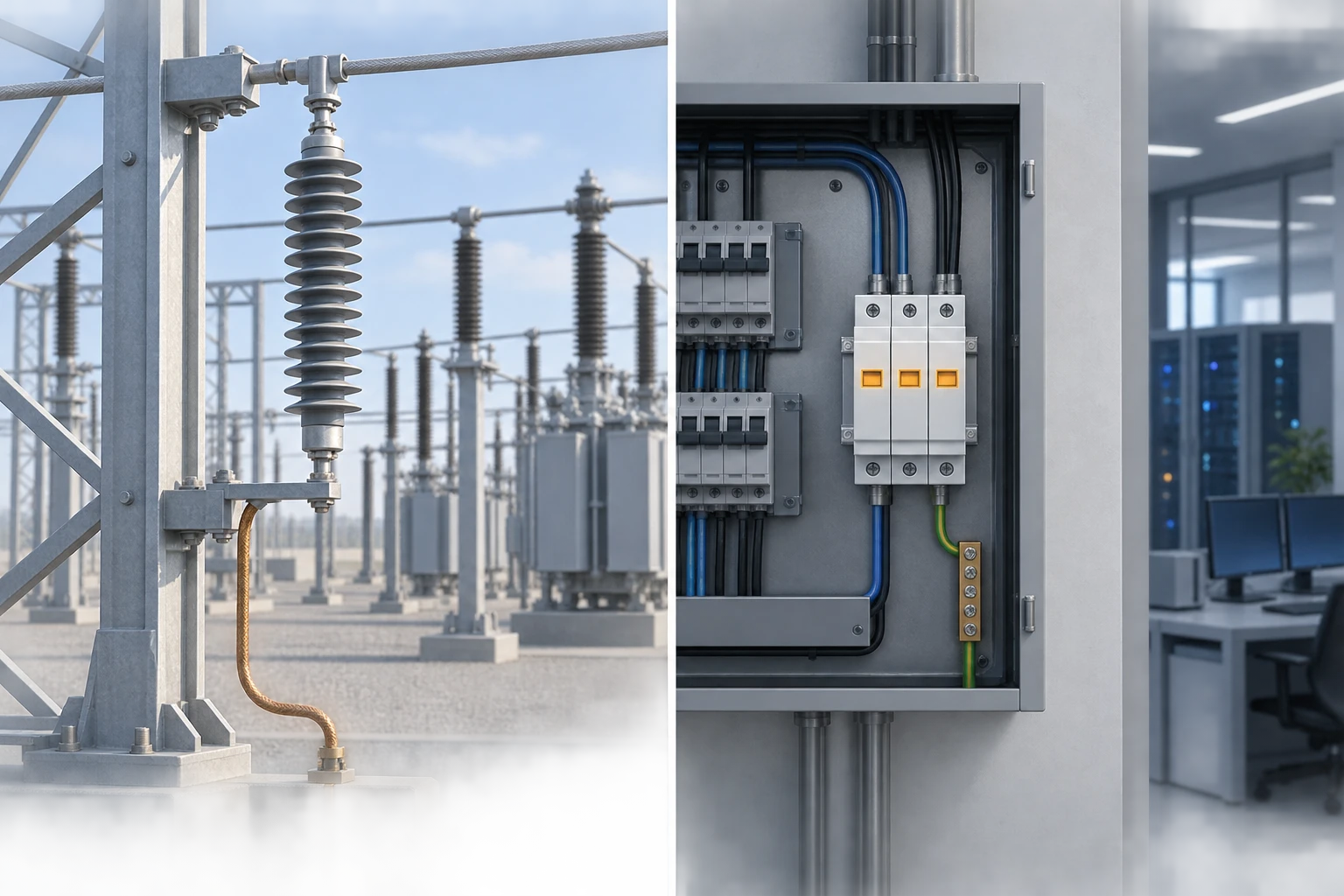
The boundary is useful because it prevents a visual match from becoming an engineering decision. A panel-mounted modular device and a power-system arrester may both contain voltage-dependent components, yet they belong to different product systems and application standards. A buyer should not substitute one for the other based on a photograph or a shared word such as “lightning.”
Solar PV requests need the same discipline. A PV DC SPD is not a utility-class arrester merely because the array operates at a comparatively high DC voltage. The current category, circuit location, maximum operating conditions, and applicable PV protection requirements must be stated.
A four-step workflow for an ambiguous specification
When a bill of materials says only “surge arrester” or “lightning arrester,” keep the line open until the technical context is documented. Four steps usually reveal which product domain the request belongs to.
- 1. Identify the circuit and voltage domain. Record whether the device is connected to an AC power circuit above 1 kV, a low-voltage AC panel, a PV DC string or combiner, or another circuit. Include nominal and maximum operating conditions rather than a single rounded voltage.
- 2. Identify the protected asset and installation point. Name the transformer, line, switchgear, distribution board, inverter, combiner box, machine panel, or point-of-use load. Record where the device sits relative to the service, overcurrent protection, and other surge-protection layers.
- 3. Read the governing document, not just the noun. Capture the cited standard, device type or class, ratings, connection configuration, environmental requirements, and required approvals. If the drawing uses legacy terminology, compare those requirements with the current standard language before changing the product description.
- 4. Request the correct evidence. For a power-system arrester, ask for the documents that address that arrester class and duty. For a low-voltage SPD, ask for the current datasheet covering system voltage, configuration, SPD classification, protective values, disconnection, indication, and accessories. Resolve conflicts before price comparison.
This workflow also improves supplier responses. A quotation based on a complete system brief can state assumptions and exclusions. A quotation based only on “surge arrester, 20 pieces” forces the supplier either to guess or to delay the offer with basic clarification.
Where Wanze’s catalog applies
Wanze’s catalog covers low-voltage AC and solar PV SPDs. If the documented request is a low-voltage AC panel application, browse the AC surge protection devices category and verify the exact model against the project data.
If the request is for a confirmed PV DC circuit, use the solar PV surge protection devices category. A category page is a discovery route, not evidence that a model satisfies a particular voltage, standard, certification, or connection requirement.
Do not route an above-1 kV, utility-class, or power-system arrester request into these low-voltage categories. Wanze’s current catalog does not list a high-voltage arrester product line.
Terminology mistakes to catch before an RFQ
- Declaring the terms identical: shared function does not erase the standards and application boundary.
- Deciding from appearance: similar enclosures or components do not establish voltage domain, duty, or compliance.
- Using “lightning” as the only requirement: state the circuit, protected asset, installation point, and governing document.
- Sending a low-voltage catalog for a power-system request: identify the domain before discussing models, pricing, or lead time.