

Quanta Services, Rosendin Electric, EMCOR, Everus Construction Group and MYR Group occupy the first five positions in EC&M’s 2026 Top 50 Electrical Contractors list. That makes them useful starting points when researching top electrical contractors in the US—not a ready-made shortlist for every project.
EC&M published the ranking in September 2026 using 2025 sales reported in its survey. The publication year and sales year are different. A contractor’s position describes the scale captured by that survey, not its suitability for a particular building, region or equipment package.
Top electrical contractors: a dated ranking, not a project recommendation
The table below reproduces only the first five entries and headquarters from EC&M’s original 2026 rankings table. It is a source-attributed subset, not a new Wanze ranking or a claim that these are the only qualified contractors.
| EC&M 2026 position | Company | Headquarters in the source table |
|---|---|---|
| 1 | Quanta Services | Houston, Texas |
| 2 | Rosendin Electric | San Jose, California |
| 3 | EMCOR | Norwalk, Connecticut |
| 4 | Everus Construction Group | Bismarck, North Dakota |
| 5 | MYR Group | Thornton, Colorado |
Readers comparing the biggest electrical contractors should retain the publisher, edition and reporting period beside any copied position. Do not combine positions from different lists or years into a single current ranking. Parent groups and operating companies also need clear labels to avoid counting the same business twice.
For procurement, the more useful next step is to distinguish published capabilities from the project-specific entity that would quote, deliver or review a package. The profiles below pair a short capability summary with a question a buyer can investigate.
Five company profiles and what to verify
Quanta Services
Quanta’s capability directory covers electric power, renewables, underground utilities, broadband and engineering, among other services. This is a broad infrastructure profile rather than a directory limited to commercial building electrical work.
For a shortlist, define whether the opportunity concerns utility infrastructure, renewable generation or a building-level electrical package. Ask which operating company handles that scope and geography. A corporate capability category is a starting point for that conversation, not evidence of an open purchase requirement.
Rosendin Electric
Rosendin describes electrical and communications construction and lists markets including commercial buildings, data centers, healthcare, semiconductors and energy. Its headquarters is in San Jose.
A buyer can use those named markets to frame a relevant inquiry, then ask about the actual project team, location and package boundaries. Sector experience and responsibility for a particular project are separate questions. The company website also displays other industry recognition; those positions should not be substituted for its position in the EC&M table above.
EMCOR
EMCOR’s corporate site presents construction, building services and industrial services divisions, along with subsidiary companies. The group profile spans more than one service line.
For a specific opportunity, identify the subsidiary and division before assigning a procurement contact or assuming a buying route. Keep a parent-company entry distinct from its operating businesses when building a comparison sheet. This avoids presenting a corporate directory as a list of unrelated contractors or treating every group service as one local team’s offering.
Everus Construction Group
EC&M lists Everus Construction Group fourth in its 2026 table and gives its headquarters as Bismarck. That identifies a corporate entry in the same ranking as the other companies here.
Use that entry as a lead for further qualification, not as evidence that a particular local business covers the intended package. Ask Everus to identify the relevant project entity, region and scope. This profile does not assign it a project capability based only on a ranking position.
MYR Group
MYR Group lists transmission, distribution, substation, commercial and industrial, transportation and clean-energy capabilities. It describes delivery through a network of subsidiary companies.
Its published capability categories can help organize an initial search. For an actual comparison, ask which subsidiary would handle the named project and what work it would perform. A utility construction capability does not, by itself, identify the purchasing route for a building’s low-voltage equipment. That route needs to be established for the particular package.
Turn the company list into a project-specific shortlist
A useful shortlist records a reason for including each company. “Large contractor” is not enough. Start with the work to be delivered and keep the following questions beside every candidate.
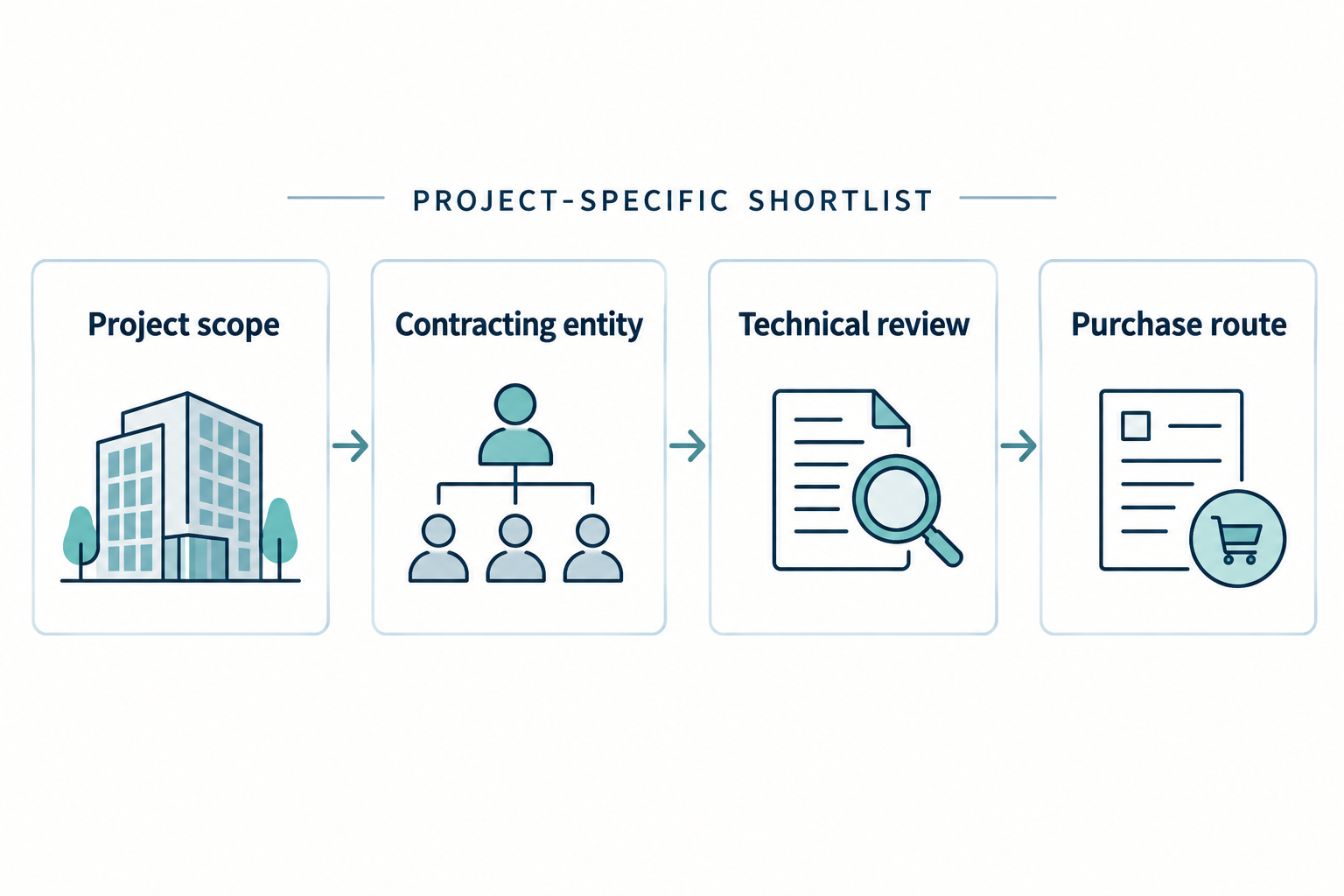
- Project scope: What facility, location and electrical work package are being compared? Name the deliverable rather than only the industry.
- Contracting entity: Which legal or operating business would quote and deliver that scope? Keep the parent group and project entity in separate fields.
- Technical review: Who evaluates the submitted equipment, and which project documents define acceptance? Ask for the actual review route rather than inferring it from a ranking.
- Purchase route: Which party would place the order, and what information is needed before a quotation is useful? Record confirmed answers separately from assumptions.
These are proposed qualification questions, not universal procedures attributed to the five companies. Add project references, geographic coverage and availability only when the relevant business supplies current evidence. An unanswered question should remain unresolved in the comparison sheet.
For example, researching a facility’s distribution-equipment package is different from researching a utility transmission contract. Both can involve a large electrical group, but the first inquiry still needs its own scope, responsible entity and acceptance documents. The ranking does not resolve those details.
Where surge-protection information belongs in that process
An SPD inquiry should begin with an identified circuit and equipment package, not a contractor’s position in a list. Wanze’s AC surge protection device category is a product-information starting point for AC distribution discussions. Its separate solar PV surge protection device category addresses PV DC product information.
For an initial document request, ask the project team to identify the intended circuit, electrical conditions and required product evidence. Keep the proposed model, technical documents and any project acceptance decision together. This separates what a supplier describes from what the project has actually accepted.
For a US opportunity, request the specific evidence the project requires for the exact model and configuration. The existence of a catalog page does not establish a US listing, approved-vendor status or suitability for a named project. A contractor’s corporate capability page cannot supply that missing product evidence either.
Wanze does not claim a partnership, endorsement or purchasing relationship with the companies profiled here. The purpose of the list is to help readers understand the contractor landscape and ask better project questions—not to imply that these firms use or recommend Wanze equipment.
A comparison is ready for a procurement conversation when it identifies the relevant business, the work package and the documents needed for review. Until then, even a list of the largest electrical contractors in the US is a research starting point, not a buying decision.