

The main difference between a Type 1 and Type 2 surge protector depends on the standard being used. In UL 1449, the designation includes permitted installation-location categories. In IEC-oriented SPD descriptions, Type 1 and Type 2 also distinguish test duties, commonly represented by 10/350 μs and 8/20 μs current waveforms. Keep the standard with the type label before comparing products.
For a buyer, this means “Type 1 is better” is an incomplete rule. A suitable device must match the actual system, protection role and documented installation conditions. An IEC Type 1+2 product description is not, by itself, evidence of a UL Type 1 listing.
Type 1 vs Type 2: compare the classification context
| Question | UL 1449 scope | IEC-oriented product description |
|---|---|---|
| What does Type 1 tell you? | The published scope includes line-side and load-side applications under the stated product conditions. | Type 1 is associated with an impulse-current test duty, commonly described using 10/350 μs. |
| What does Type 2 tell you? | The published scope describes load-side applications, including branch panels. | Type 2 is associated with discharge-current testing commonly described using 8/20 μs. |
| Does a Type 1+2 label prove a UL listing? | No. Obtain the listing record for the exact model/configuration. | A combined type claim must be supported by the applicable product documentation. |
| Can the terms be substituted directly? | No; verify the standard, rating basis and instructions. | Do not treat a catalogue type description as permission for an unverified installation location. |
UL Standards & Engagement’s published UL 1449 scope is the source for the US classification distinction above. ABB’s Type 1/Type 1+2 guidance provides impulse-test context; its application guide explains the Type 2 waveform comparison. They answer related questions, but they should not be compressed into a single universal definition.
Why 10/350 μs and 8/20 μs are not equivalent kA ratings
The waveform identifies a different test pulse shape and duration. A current value cannot be compared independently of that waveform. A device described by an impulse rating at 10/350 μs and another described by a maximum discharge rating at 8/20 μs have not been placed on the same scale merely because both values are expressed in kA.
Put the field name and waveform into separate comparison columns. Keep Iimp, In and Imax as distinct entries when the product documentation uses those terms. Do not calculate a conversion factor between them or use the largest number as the sole purchasing rule.
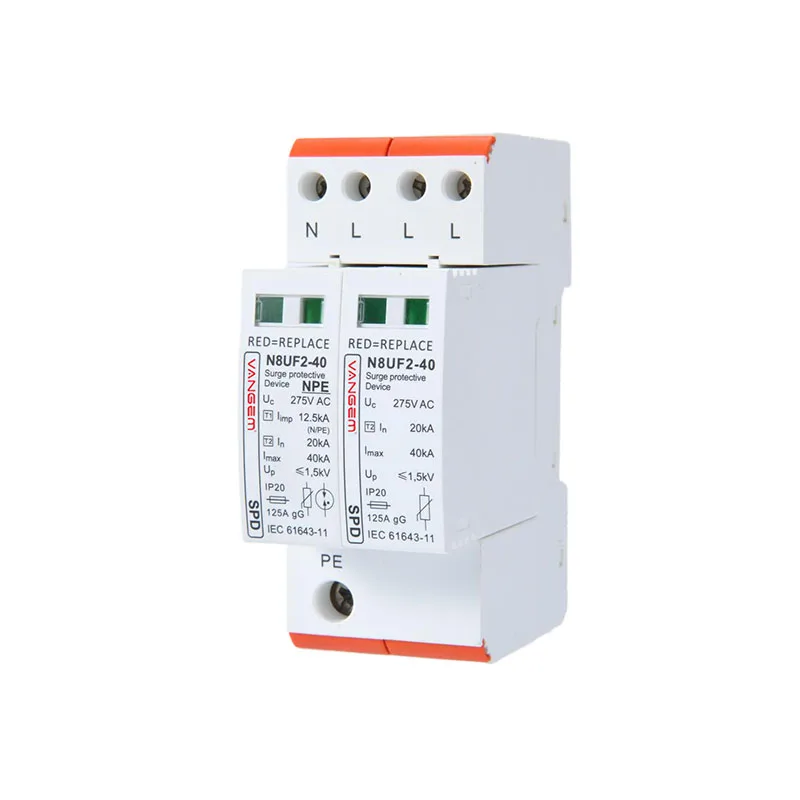
What a combined Type 1+2 SPD adds to the discussion
A combined designation describes a product presented for more than one test or application classification within its declared standard context. It does not remove the need to check operating voltage, protection modes, protection level, backup protection and installation limits. Nor does it prove that a single device replaces every downstream protection task.
Wanze’s current AC SPD range includes combined Type 1+2 catalogue models as well as Type 2 and Type 2+3 models. The N8UE1+2/6 page identifies one combined family; the N8UE2-40 page identifies a Type 2 family. These are model-discovery examples, not a statement that either is listed for an arbitrary US service position.
Choose a type from the project information
- Identify the governing context. State the destination market, required standard and any listing requirement before interpreting the type.
- Describe the installation location. Identify the incoming supply, main distribution, subpanel or equipment position on the one-line.
- Record the system. Provide voltage, phase, neutral and grounding information rather than a voltage label alone.
- Compare the complete ratings. Review continuous voltage, protection level, discharge/impulse values, fault-current conditions and required backup protection.
- Check the documentation. Obtain the exact model sheet, connection drawing and any configuration-specific report or listing record.
The panel SPD guide organizes those inputs by panel location. The wiring diagram guide explains how to check that the drawing belongs to the proposed configuration. Neither task should be completed by guessing from a type number.
Two example enquiries and the missing decision
“Type 1 surge protector for the main panel.” Ask which standard/type is required and where the proposed connection lies relative to the service overcurrent device. Then confirm the exact system and listing requirements. “Main panel” alone leaves the classification and installation permission unresolved.
“Type 2 SPD for a three-phase machine.” Ask for voltage references, neutral arrangement, grounding, existing upstream protection and the machine’s requirements. The words “three-phase” and “Type 2” do not identify a unique wiring arrangement or a suitable continuous voltage.
These examples show why a short but complete enquiry is more useful than a request for the highest kA device. It allows a supplier to identify a plausible family, state assumptions and supply the specific documents needed for review.
Questions about Type 1 and Type 2 surge protectors
Can a UL Type 1 SPD be used on the load side?
The published UL 1449 scope includes load-side applications for Type 1 devices. Verify the actual product listing, system and instructions. That scope must not be transferred to a product whose UL classification has not been established.
Does Type 2 mean inferior protection?
No. It is a classification within a defined context. Correct system matching, protection level and installation conditions matter more than treating the type number as a quality ranking.
Do Type 1 and Type 2 devices need coordination?
When a design uses multiple protection stages, review them as an arrangement. A combined product label or a shared brand name does not independently document coordination for the whole facility.
Can a Type 1 device replace a circuit breaker?
The type name does not make an SPD a substitute for required circuit protection. Review the device’s stated protective-device conditions and the system design separately.