

What causes power surges in a commercial electrical system? The usual source falls into one of three groups: equipment switching inside the facility, utility or lightning events outside it, and a condition that is not a short surge at all. Start by identifying the source, duration, affected circuit and operating state before selecting protection.
NEMA describes surges as short transient overvoltages. A sustained overvoltage or temporary overvoltage is a different condition and can require a different engineering review. That distinction matters because a generic “power surge causes” answer should not become an unverified diagnosis or product recommendation.
What causes power surges inside a facility?
Many commercial facilities create transient events during normal operation. Contactors, relays, breakers, capacitor banks, variable-speed drives, motors and transformers can change current or magnetic energy quickly. Starting and stopping large loads can also produce disturbances that appear at nearby equipment or on a shared distribution path.
These events may be less dramatic than lightning, yet they can occur repeatedly. A controller may reset, a drive may report a fault or a communication link may become unstable without a visible failure at the panel. Treat the symptom as evidence to investigate, not proof that one specific device caused the event.
Event timing is useful because it can separate a recurring internal pattern from an isolated external event. If alarms cluster around a scheduled process start, note the motor, contactor or drive state and the affected panel. If several unrelated panels report an event at the same moment, broaden the review to the service and utility history. Neither pattern proves a cause by itself, but both make the next measurement more targeted.
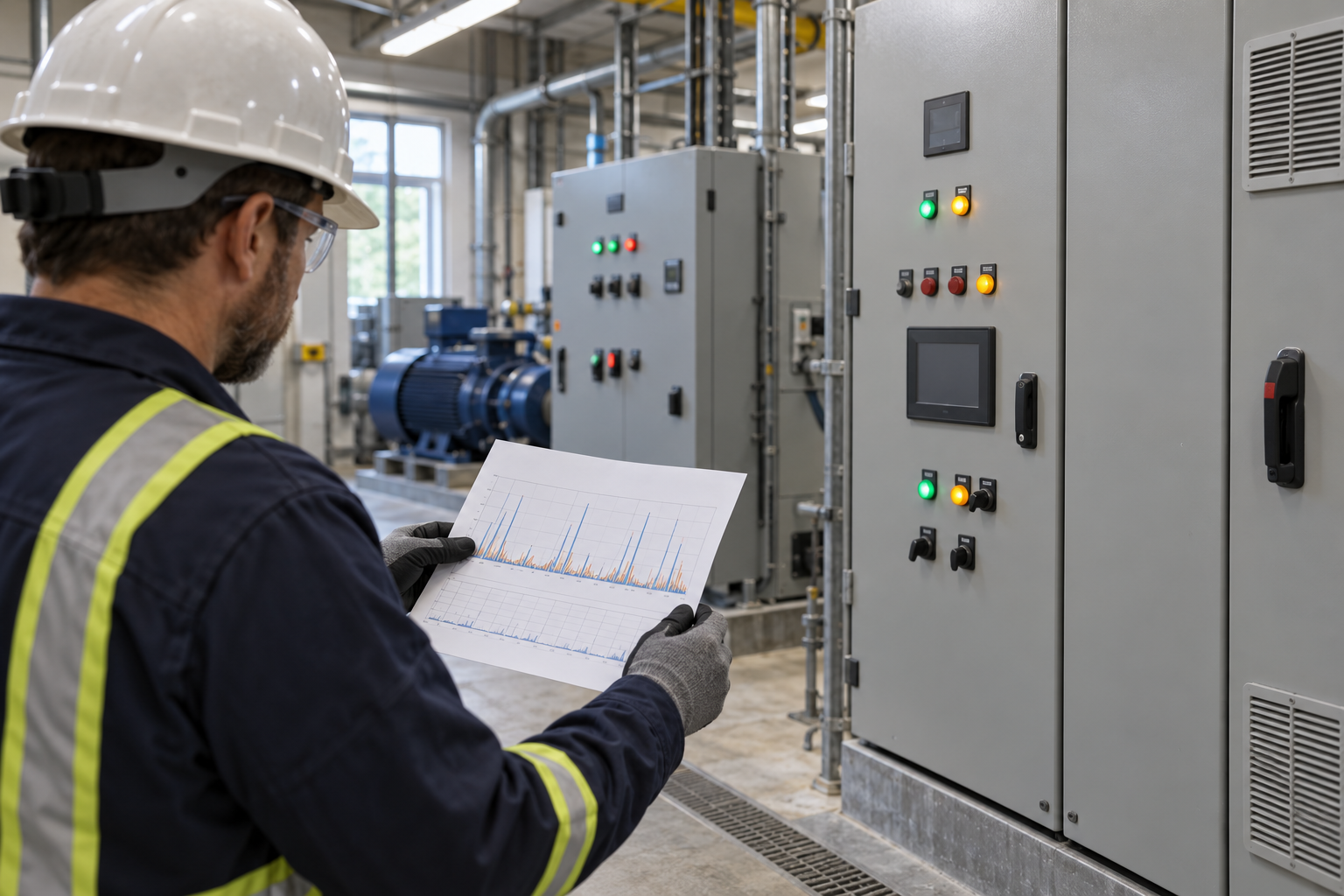
External causes: utility switching and lightning
External events can enter through the incoming electrical system or couple into power and communication conductors. Utility switching, capacitor-bank operations and fault clearing are common categories to review. Lightning can create a nearby or induced surge even when the building is not struck directly.
A direct strike and a lightning-induced surge are not the same design problem. The latter may be coupled into a facility power path and reviewed with SPDs and other protection layers. A direct strike requires a separate lightning-protection and grounding review; an SPD should never be described as a guarantee against the strike itself.
Cause-to-evidence matrix
| Possible source | What to look for | Evidence to collect |
|---|---|---|
| Internal switching | Events near motor starts, drives, contactors or capacitor switching. | Event time, equipment state, alarm history and affected feeder. |
| Utility switching | Disturbance follows a utility event, outage or reclose. | Utility notice, outage record, facility event log and incoming service data. |
| Lightning coupling | Event follows nearby storm activity or affects outdoor-linked circuits. | Weather timing, building entry points, power and communication paths. |
| Temporary overvoltage | Voltage remains elevated longer than a transient event. | Instrumented waveform, duration, phase relationship and qualified diagnosis. |
The matrix is a starting point, not a fault-finding procedure. Record uncertainty explicitly. A missing waveform, one-line diagram or equipment history should remain an open question instead of being filled with a generic surge-protector assumption.
Keep the record at the level the facility can actually verify. A maintenance log may show a reset and a motor start but not the transient waveform. A power-quality logger may show the waveform but not the operational consequence. Combining those records gives an engineer a more useful brief than either record alone, while preserving the distinction between observed facts and suspected sources.
Surge versus overvoltage
A surge or transient is a short-duration event with a rapid change. A temporary or sustained overvoltage lasts longer and may arise from fault conditions, switching states, grounding changes or other system behavior. The two conditions can produce different stresses and call for different protective approaches.
For that reason, do not choose an SPD solely because a display showed “high voltage.” Confirm what was measured, where it was measured, how long it lasted and whether the instrument captured line-to-line or line-to-ground behavior. A qualified engineer should interpret abnormal system measurements before equipment is specified.
Use a consistent event vocabulary in the handoff. Mark a short captured transient as a surge, a longer elevated condition as a temporary or sustained overvoltage, and an unexplained alarm as an unclassified event. This simple distinction prevents a purchasing request from quietly assuming that one device family solves several different power-quality problems.
What to document before requesting an SPD review
- Record the event time, affected equipment, operating state and any alarms or resets.
- Attach the current one-line diagram and identify the service, panel and equipment path.
- Describe voltage, phase, grounding and whether power or communication circuits were affected.
- List existing SPDs, recent equipment changes and any utility or storm event.
- Request the exact model documentation only after the system and event context is clear.
For a confirmed low-voltage AC application, the Wanze AC surge protection device category is a family-discovery path. It does not diagnose the event or establish a model match without the facility data.
FAQ
Can motors cause internal power surges?
Yes. Motor starting, stopping and inductive energy changes can create internal transient events. Confirm timing, feeder context and measured behavior before assigning a cause.
Can utility switching cause a surge?
Yes. Utility switching, capacitor-bank operations and fault clearing can create external transients that enter or couple into a facility. A utility record helps test that hypothesis.
What is the difference between a surge and an overvoltage?
A surge is a short transient; a temporary or sustained overvoltage lasts longer and may need a different review. Do not treat a voltage alarm as an SPD specification.