
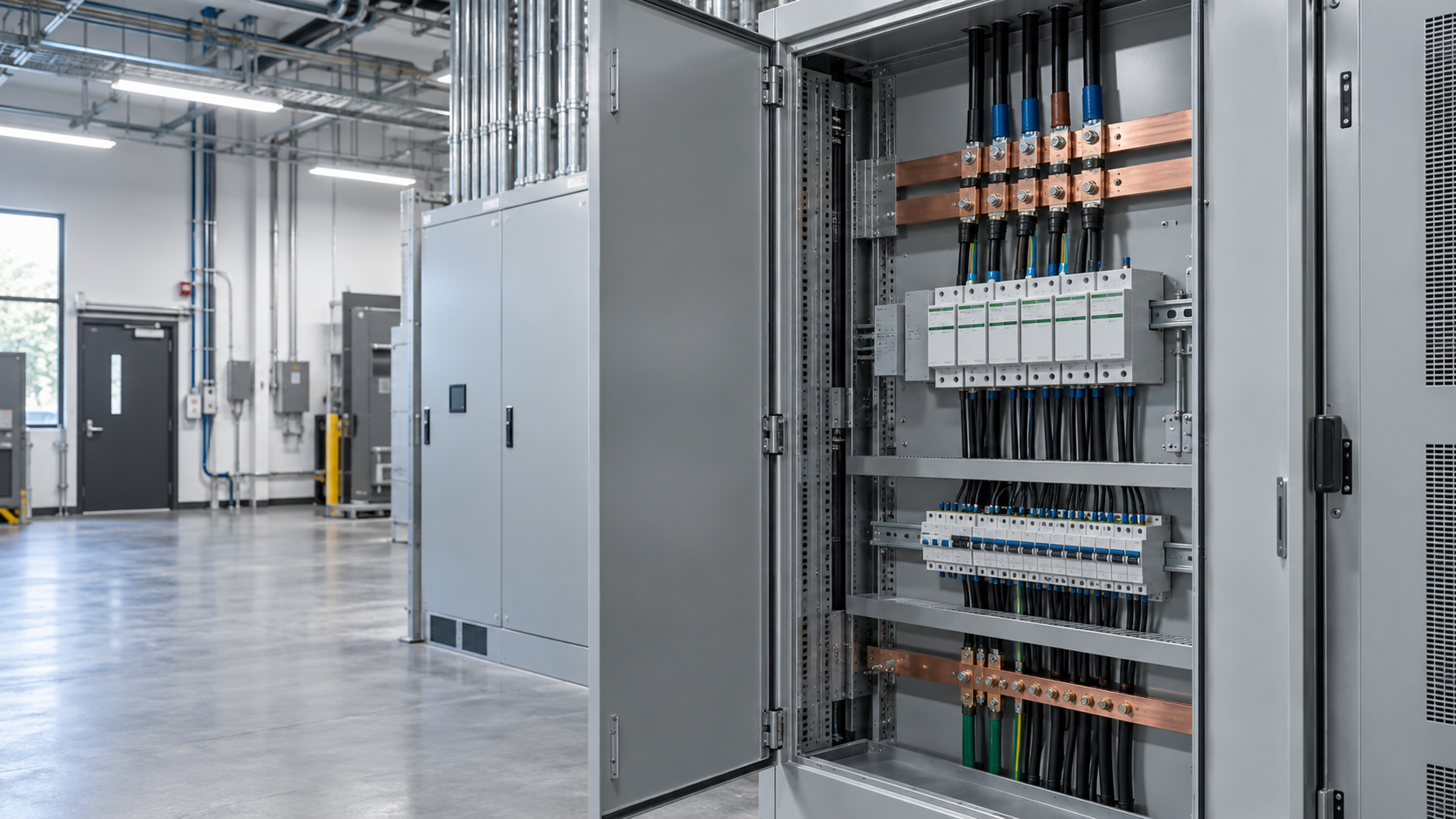
Commercial surge protection uses surge protective devices at selected supply, distribution and equipment locations to limit transient overvoltage. Start with the facility one-line, existing protection and critical loads, then choose documented devices for each protection role. One catalogue model does not by itself define the arrangement for an entire building.
This approach separates a useful commercial surge protection brief from a headline rating. Wanze’s verified scope supports AC surge-protection-device discovery, but ratings, coordination, enclosure, listing and installation conditions remain model- and project-specific.
What a commercial surge protection plan should cover
A facility plan normally considers the service entrance, main distribution, downstream panels and sensitive equipment. The objective is not to install the same device everywhere. It is to understand where transient exposure enters, which loads are critical and how each layer is coordinated with the others.
Record the facility’s one-line diagram, nominal voltage, phase and conductor arrangement, grounding terminology, panel locations, environment and existing SPDs. Add critical loads such as controls, automation, communications, medical or process equipment only when the project team has identified them. The record should show what is known and what still needs an engineer’s review.
Facility mapping matrix
| Facility point | Planning question | Evidence to request |
|---|---|---|
| Service entrance | What exposure and protection role are assigned at the incoming supply? | One-line diagram, service data, grounding information and current design basis. |
| Main or distribution panel | Which downstream paths and existing SPD layers must be coordinated? | Panel schedules, feeder details, existing device records and conductor routing. |
| Equipment or machine panel | Which critical loads need a closer protection layer? | Equipment list, control interfaces, environment and manufacturer instructions. |
| Communications or control path | Are signal or data circuits part of the protection brief? | Interface inventory and the exact protection family, kept separate from AC assumptions. |
The matrix is a coordination tool, not an installation diagram. A missing field should remain visible instead of being filled with a generic “commercial SPD” assumption.
How protection is coordinated across a facility
Coordination means reviewing the protection layers together with the system and the equipment. An upstream device may address a different part of the energy path than a point-of-use layer. The project team should therefore record the location, role, ratings and documentation for each proposed device before approval.
Do not infer coordination from the number of devices or from a single kA value. The exact voltage, MCOV, protection data, conductor path, enclosure and equipment withstand must be checked against current documentation. If the one-line diagram changes, the protection review changes with it.
Keep the review record current when panels, feeders or critical equipment are added to the facility.
Which loads may need dedicated review?
Loads that are costly to replace, difficult to restart or central to a process usually deserve a documented review. Examples can include automation controllers, building-management systems, variable-speed drives, network equipment and critical instrumentation. The category is a prioritization prompt, not a universal rule that every listed load needs a dedicated SPD.
Ask three questions: what is the load’s transient sensitivity, what upstream protection already exists and what does the equipment manufacturer require? If any answer is unknown, retain the item on the open-questions list instead of selecting a device by label alone.
Criticality should also be documented operationally. Note whether a transient can stop a production line, corrupt a controller, interrupt a building service or create a long restart sequence. Capture the responsible owner, the acceptable downtime and any recovery procedure alongside the electrical data. This does not decide the SPD model, but it gives the designer a defensible reason to prioritize the load and to review a closer protection layer. Keep business criticality separate from electrical compatibility: an important load still needs the correct voltage, grounding, enclosure and device documentation. A clear record helps the supplier ask for the missing drawing or datasheet instead of turning an urgent request into a generic “industrial surge protection” quote.
Commercial SPD approval checklist
- Attach the current one-line diagram and identify service, distribution and equipment locations.
- Record voltage, phase, grounding, enclosure and environmental conditions for each location.
- List existing SPDs, overcurrent protection, critical loads and any signal or communication interfaces.
- Request the exact model datasheet, current installation instructions and applicable listing or certification record.
- Ask the supplier to state assumptions, coordination inputs and unresolved project questions in writing.
For a confirmed low-voltage AC application, the Wanze AC surge protection device category can be used for product-family discovery. It does not replace the facility evidence review or establish a universal commercial installation.
Common planning mistakes
- Using one device as a facility plan: a single product does not document every power path or critical load.
- Choosing by a headline rating: a number without voltage, topology and role is not a product match.
- Ignoring existing layers: coordination must include what is already installed and what will change.
- Copying another project’s wiring: current instructions for the exact model and project should control.
Commercial scenarios: map the affected power path
| Illustrative facility task | Where the investigation starts | Information to retain |
|---|---|---|
| Building automation resets during switching | Controls supply and the upstream distribution path. | Event timing, affected panels, control power supplies and existing protection. |
| A production line is difficult to restart | Incoming supply, distribution panels and critical machine controls. | Downtime impact, equipment input requirements and the current one-line. |
| Equipment in a separate building is affected | Interbuilding power and signal routes. | Cable interfaces, bonding design, outdoor exposure and separate power/data requirements. |
| A rooftop PV system is being added | Array DC path, inverter and AC connection. | Separate DC and AC device requirements; do not reuse one device assumption for both. |
These are planning examples, not diagnoses of actual incidents. A reset, failure or alarm can have causes other than a voltage surge. Preserve event records and equipment information before attributing the problem to transients or selecting additional hardware.
Build a submittal that engineering and purchasing can both use
Assign a circuit or panel identifier to each proposed device. Beside it, record the system configuration, intended installation location, standard/type, exact model, declared ratings and relevant drawing. Keep the unresolved questions in a separate column. That structure makes it easier to compare offers without losing the relationship between the product and its place in the facility.
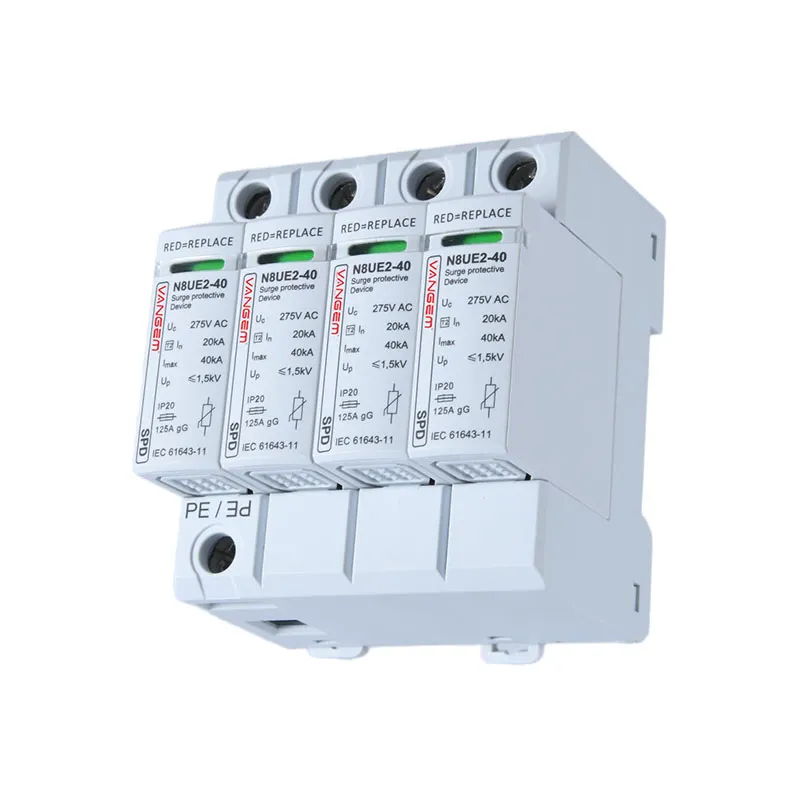
A typical catalogue starting point for a distribution review is the N8UE2-40 Type 2 AC SPD. A request involving a combined Type 1+2 category can instead begin with N8UE1+2/6. These links identify actual product families; the current configuration documents and project requirements determine whether either belongs in the submittal.
Use the panel SPD selection guide for panel-level details and the SPD rating guide for terminology. NEMA’s facility-location guidance supports reviewing protection at more than one distribution location, but a device count by itself does not prove coordination.
Include maintenance and change control in the purchasing decision
The quotation should explain the status indication, replacement arrangement and documents supplied for the exact model. If remote indication is needed, request the relevant option explicitly; do not assume it from a family photograph. Keep the installed reference and any replacement-module reference with the maintenance record.
Review that record when a new panel, feeder, inverter or production machine is added. A device selected for an earlier arrangement is not automatically reassessed when the equipment list changes. Include the SPD review in the same change process as the one-line and panel schedule.
Do not promise a return on investment without site data
A useful business case records actual interruption history, replacement cost, recovery time and the equipment affected. It also separates the cost of protective equipment from the cost of the engineering and installation work. Those figures allow the facility to explain its priorities without inventing a universal savings percentage or claiming that every failure would have been prevented.
FAQ
Where should commercial SPDs be installed?
Review the service entrance, distribution panels and sensitive equipment locations as separate protection roles. The exact placement depends on the facility one-line, system data and current device instructions.
How is surge protection coordinated across a facility?
Record each layer, its location and its role, then check ratings, conductor paths, equipment requirements and existing protection together. A device count alone does not prove coordination.
Which loads need dedicated surge protection?
Prioritize loads that are sensitive, costly to replace or critical to operations, then verify the equipment requirements and upstream layers. Treat the result as a project review list, not a universal installation rule.