

A surge protection device (SPD) limits transient voltage by diverting or limiting surge current before the transient reaches downstream equipment. An SPD is intended to protect electrical devices from short-duration voltage disturbances, but it does not replace grounding, overcurrent protection, or a complete lightning protection design.
The practical question is therefore not simply “Do we need an SPD?” A buyer must identify the electrical system, installation point, and protection objective before choosing a device family. Type 1, Type 2, and Type 3 describe different installation roles in the low-voltage system; they are not a simple good-better-best ranking.
What creates a transient, and what does an SPD do?
A transient is a brief change in voltage rather than a sustained operating condition. It may result from lightning-induced events, switching elsewhere in the power system, or the switching of loads inside a facility. The source may be outside the building, but a facility can also generate disturbances within its own distribution network.
During normal operation, an SPD should not behave like a continuous load. When a transient reaches its operating threshold, the device provides a controlled path that diverts or limits surge current and restricts the voltage presented to protected equipment. The exact behavior and protective level depend on the device design, system conditions, and installation.
This protective function has a clear boundary. An SPD does not correct a persistent overvoltage, repair poor grounding, replace an overcurrent protective device, or make an unsuitable installation safe. It also cannot prove that every connected item will survive every event. Coordination, conductor routing, system bonding, and the actual equipment withstand level remain part of the engineering decision.
Older documents may use TVSS or “secondary surge arrester” for the low-voltage function. In the cited US terminology context, those are legacy terms. For current low-voltage specifications, “surge protective device” is the clearer term, while the system voltage and application should still be stated explicitly.
How Type 1, Type 2, and Type 3 surge protection device roles differ
The type designation describes where an SPD is intended to operate in a coordinated protection arrangement. A type number alone does not determine the correct model, rating, or connection method. The project still needs the manufacturer’s current data and the applicable electrical design requirements.
| SPD type | Typical system role | Buyer should confirm |
|---|---|---|
| Type 1 | Service-side or service-entrance protection where the device is designed for that location. | Supply arrangement, installation point, upstream protection, connection method, and the exact standard classification on the datasheet. |
| Type 2 | Distribution-level protection on the load side of the service overcurrent device, often at a main or sub-distribution panel. | System voltage, grounding arrangement, panel location, available protection, and coordination with devices upstream and downstream. |
| Type 3 | Point-of-use protection close to sensitive loads, used as part of a coordinated system rather than as the only layer. | Protected equipment, connection method, upstream SPD arrangement, installation distance, and product instructions. |
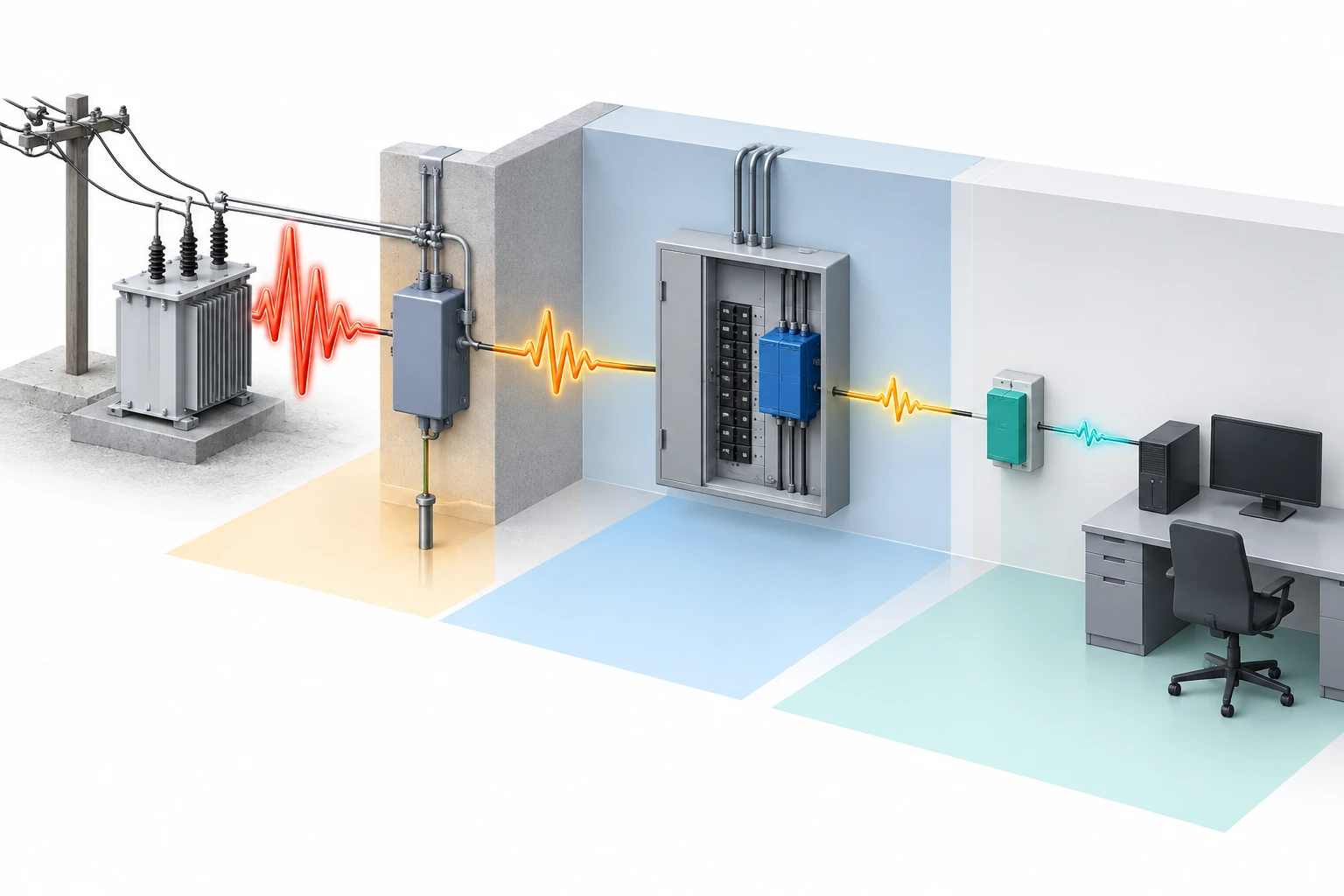
These roles can be combined. A service-level device may reduce a large incoming transient, a distribution SPD may further limit what reaches branch circuits, and point-of-use protection may address the needs of a sensitive load. The layers must be selected and coordinated as one system. Installing several unrelated devices does not automatically create effective coordination.
Placement also affects performance. Long or poorly routed conductors can add voltage during a fast transient. That is why the installation instructions, conductor path, bonding arrangement, and enclosure layout matter alongside the product label. A procurement list should preserve those design conditions instead of reducing the request to “Type 2, highest kA.”
Build a six-input SPD selection brief
A useful request for quotation starts with system facts. It should give a technical reviewer enough information to reject an unsuitable category before comparing individual models. Record these six inputs as a minimum:
- 1. Electrical application. State whether the protected circuit is low-voltage AC, solar PV DC, or another system. Do not treat an AC device and a PV DC device as interchangeable because their housings look similar.
- 2. System voltage and configuration. Record nominal voltage, maximum continuous operating conditions, phase arrangement, conductor configuration, and grounding system. A single voltage number may not describe how the device connects.
- 3. Installation point. Identify the service entrance, main distribution board, subpanel, machine panel, combiner box, inverter side, or point of use. Include whether the location is indoors or exposed to environmental conditions.
- 4. Protection role and coordination. State the required type or class only when the governing design has established it. List existing upstream and downstream SPDs so the supplier can review the intended layer.
- 5. Project requirements. Provide the applicable standard, approval, enclosure, disconnection, indication, remote-contact, and documentation requirements. These must be verified against the current model datasheet rather than inferred from a category page.
- 6. Operating and procurement context. Record the protected equipment, installation environment, quantity, target delivery, drawing format, and who will approve the technical submittal. Flag any missing input instead of filling it with an assumption.
This brief separates device selection from marketing shorthand. Surge-current ratings, voltage-protection values, and response characteristics matter, but they only become meaningful after the system and installation role are known. A larger published number does not by itself prove better protection for a specific panel.
Choose the correct AC or solar PV path
For a confirmed low-voltage AC requirement, use the AC surge protection devices category as a discovery path. Compare the actual system configuration and required installation role with the current product documentation. The category establishes scope; it does not establish project suitability.
For a solar array or other verified PV DC location, start with the solar PV surge protection devices category. The request should identify the DC system voltage, array configuration, installation side, grounding arrangement, and the project’s protection requirements. Do not select a PV device only because its nominal voltage appears to exceed the operating voltage.
If the application is not clearly AC or PV DC, pause the product search. A transformer, telecom circuit, data line, or power system above the verified category scope may require a different device family and a different governing standard.
Selection mistakes that create avoidable rework
- Buying from one headline rating: a surge-current value without system voltage, connection arrangement, protection level, and installation role is not a complete selection.
- Treating the type number as a quality grade: Type 1, Type 2, and Type 3 identify roles and locations. A higher number is not automatically better.
- Ignoring coordination: an SPD should be reviewed with upstream protection, downstream loads, conductor routing, and any other surge-protection layers.
- Using legacy terminology as the specification: “TVSS” or “surge arrester” may hide whether the request concerns low-voltage AC, PV DC, or a higher-voltage power system.
- Assuming the category page proves compliance: confirm ratings, standards, approvals, and accessories on the current model documents for the exact configuration.